Death Valley – Arcalvada Consolidated Mines Company
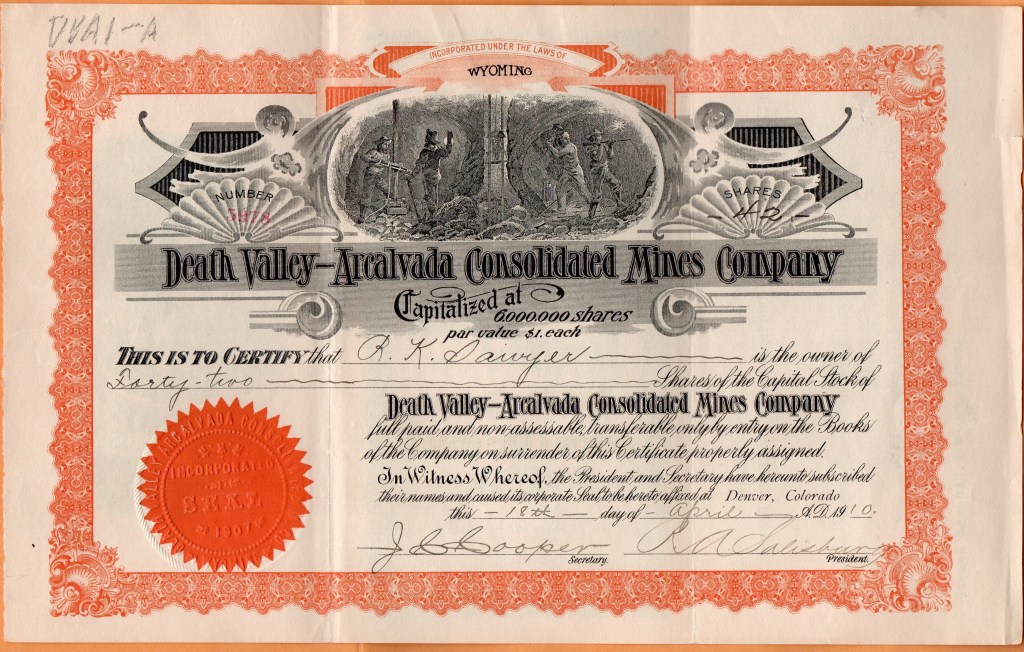
Certificate No. 5978, Forty-Two Shares Issued to R. K. Sawyer, April 18, 1910. J. B. Cooper, Secretary; R. A. Salisbury, President.
The Death Valley – Arcalvada Mines Company operated not in Death Valley, but near Cima, California, about 130 miles southeast from the Furnace Creek Visitor Center.
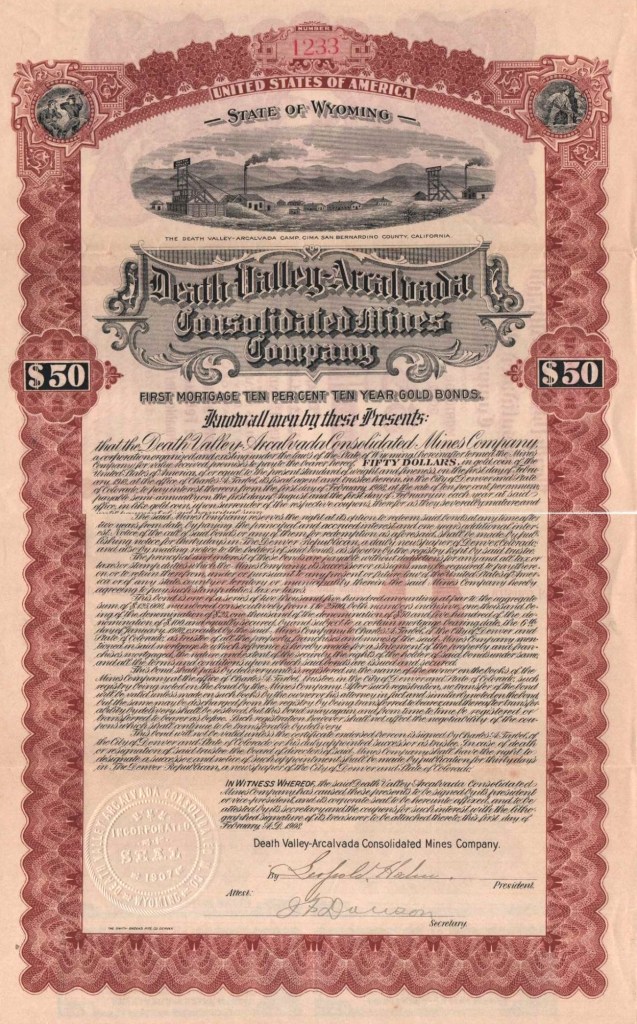
First Mortgage Ten percent Ten Year $50 Bond, Certificate No. 1233, January 6, 1908. Leopold Hahn, President; I. F. Dawson, Secretary.
In 1906, prospector J. L. Bright struck a promising lead-silver vein and named it the Death Valley Mine, likely for dramatic flair. He soon sold the claim to the Denver-based Death Valley Gold Milling and Mining Company, run by the Dawson brothers. They established a mining camp called Dawson, which quickly grew into a bustling desert outpost.
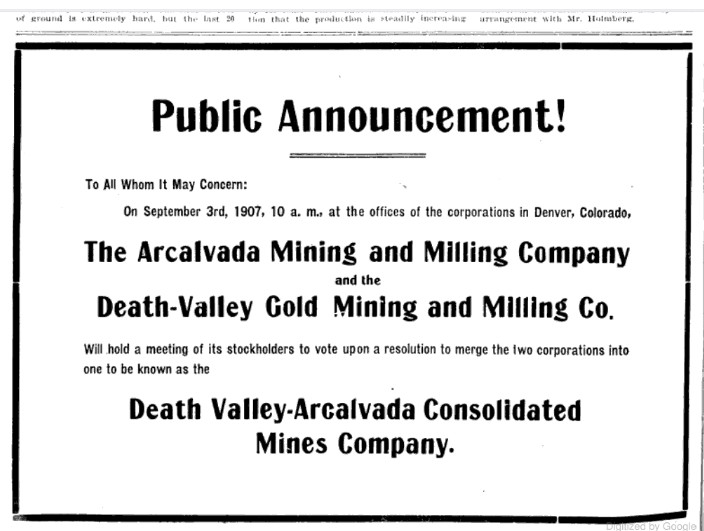
Just northwest of the Death Valley Mine was the Arcalvada Mine, working the same ore body. By late 1907, the two operations merged into the Death Valley–Arcalvada Consolidated Mining Company, employing around 75 men. Ore rich in silver, lead, and some gold—was hauled by horse-drawn wagons to the railroad at Cima, then shipped via the Salt Lake Railroad to smelters in Needles.
In mid-1908, legal troubles hit and ownership disputes or other litigation put a halt to the operations. The courtroom battles dragged on for years (from 1908 until 1915) and the mine was mostly idle during that time. Real action didn’t resume until 1915 when a new owner finally cleared the title and took over.
1915–1921 is often cited as the peak of production, especially the years around World War I. High demand for lead (for bullets and batteries) and silver helped spur renewed mining. The company pumped water out from the deep shafts and reopened tunnels. By the late 1910s the site was again humming with activity, yielding steady if not spectacular profits.
In 1927, fire destroyed the mine’s surface plant and mill facilities. Flames consumed even parts of the underground workings. This effectively marked the end of large-scale operations. By 1931, the Great Depression led to collapse of metals prices, and Death Valley Mine faded into dormancy.
By the 1950s there was a revival at Death Valley Mine. New technology and a post-war hunger for minerals led a small operation to rework the site. The Death Valley – Arcalvada Mines site is now included in, and under the protection of the Mojave National Preserve.
Death Valley Exploration Company
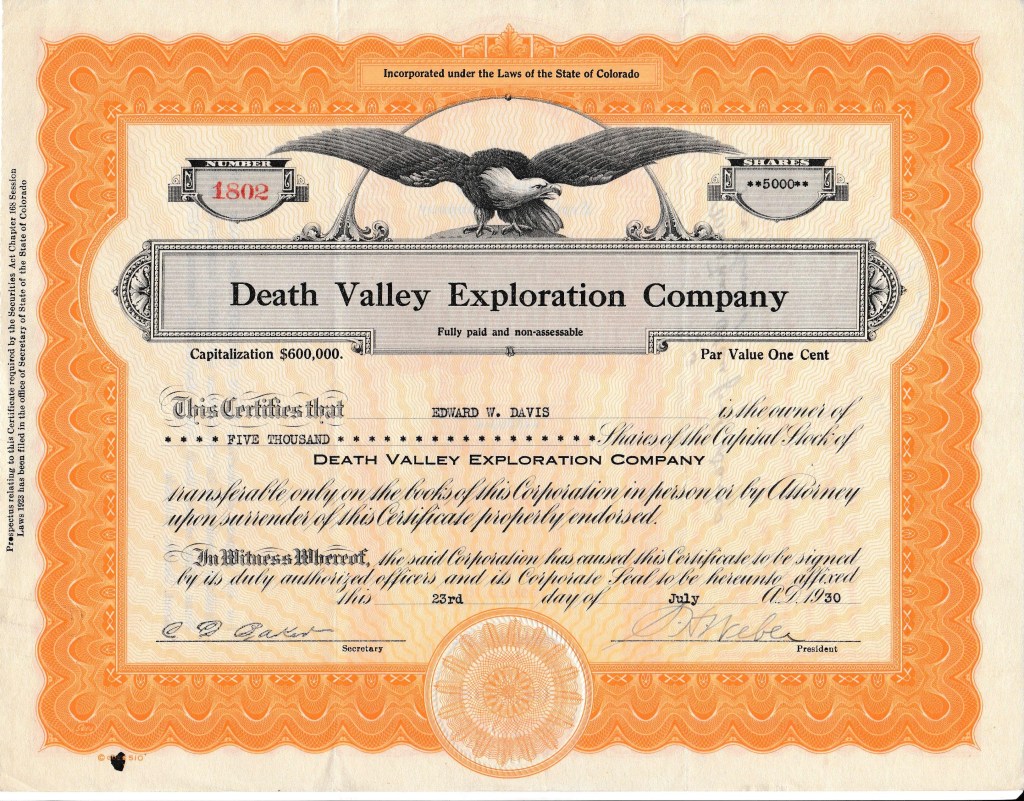
Certificate No. 1802, Five Thousand Shares to Edward W. Davis, July 23, 1930. C. D. Baker, Secretary; D. H. Weber, President.
 Death Valley Mining History - Thru Scripophily