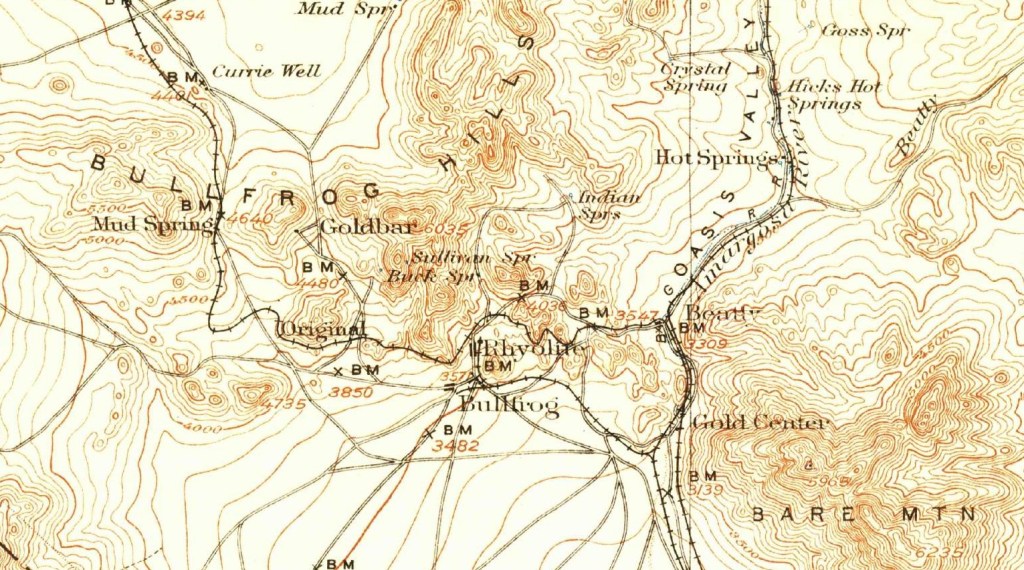
Map of the Beatty – Rhyolite – Bullfrog – Gold Center Area, USGS Furnace Creek Quadrangle, 1910.
The Bullfrog district and the Pioneer district to the north, are located in the Bullfrog Hills just west of Beatty in southern Nye County. The Bullfrog Hills extend in an east-west direction between the Amargosa range on the west and Bare Mountain – Pahute Mesa on the east forming a divide between Sarcobatus Flat to the north and the Amargosa Desert to the south. The western portion of the district in included within the boundary of Death Valley National Park – the area known as the park’s “Nevada Triangle.”
Gold was discovered at the original Bullfrog mine at the south end of Bullfrog Mountain, seven miles west of Beatty, on August 9, 1904, by Frank “Shorty” Harris and Ernest “Ed” Cross. Harris said during a 1930 interview for Westways magazine, “The rock was green, almost like turquoise, spotted with big chunks of yellow metal, and looked a lot like the back of a frog.”
Mining Companies in the Nevada Triangle of Death Valley National Park
Original Bullfrog Mines Syndicate
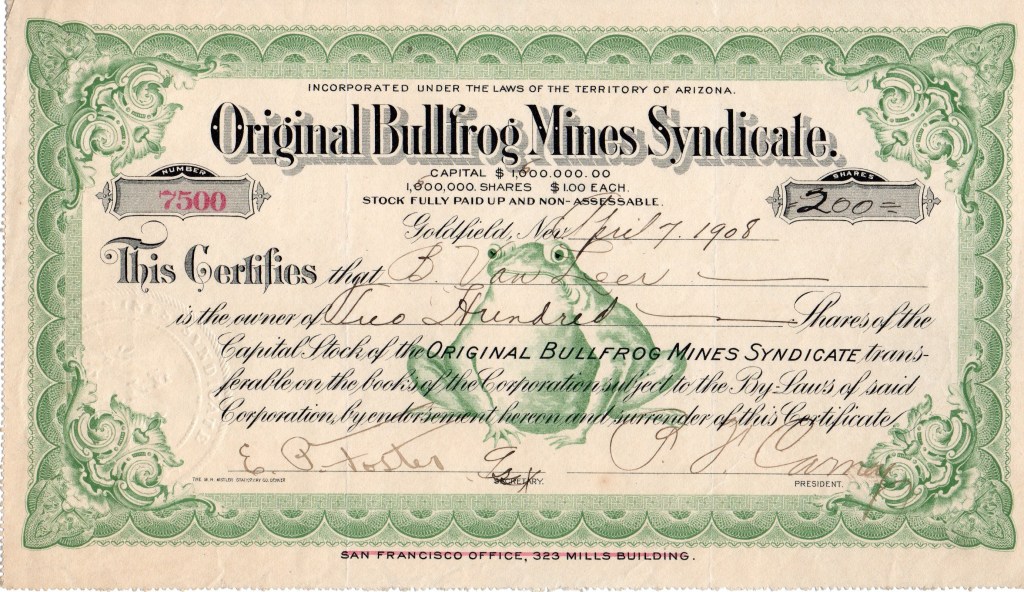
Certificate No. 7500, Two Hundred Shares to B. Van Leer, April 7, 1908. E. P. Foster, Asst. Secretary; P. F. Carney, President.
Frank “Shorty Harris and Ernest “Ed” Cross discovered an outcrop “lousy with gold,” on August 4, 1904, in the Bullfrog Hills. Shorty got drunk and sold his portion of the discovery for $500 and a mule. Cross made a better deal with Goldfield promoters. Ed claimed to have received $125,000 for his share of the mine, but that figure is probably inflated. By early 1905, the mine was shipping high-grade ore to Goldfield smelters, with ore values reaching $818 per ton.
As 1907 began, the Original Bullfrog Mine had already seen its best days. On August 26th, the mine was closed and the employees laid off. The national financial panic of late 1907 hit hard, drying up investment and the syndicate ceased major activity around that time. December, the company let its property go on the delinquent roll, rather than pay $46.20 in taxes. Shares of Original Bullfrog stock were now selling for 3¢ each.
In the spring of 1908, the mine was reactivated, but on a small scale. The mine limped along, attempting to extract enough ore to cover operating costs. Total April production, when Van Leer bought his/her 200 shares, reached only $350. For the next several decades, the mine’s limited production continued through a series of lessors.
And what of the two lonely prospectors who made the discovery? Shorty Harris went on, as most old-time prospectors did, to hunt again for gold in the desert. Amazingly, Shorty found gold a second time, at Harrisburg, on the western rim of Death Valley. Again, however, Shorty was unable to capitalize upon his discovery, and he died in 1934, alone on the desert, still looking for gold, and with little but his burro and his blanket to his name. Ed Cross, returned to his home and farm in California and died at his daughter’s house in 1958.
Bullfrog Extension Mining Company
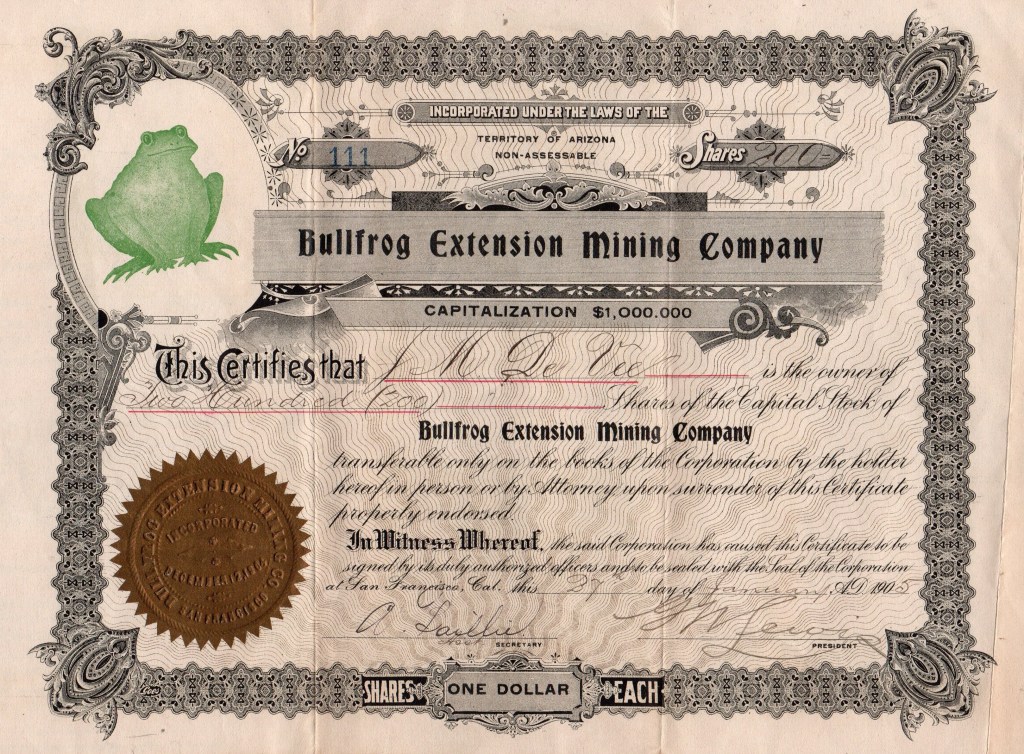
Certificate No. 111, Two Hundred Shares to J. M. DeVee, January 27, 1905. A. Fairfield, Secretary; G. W. Lewis, President.
The Gold Bar Consolidated Mining Company
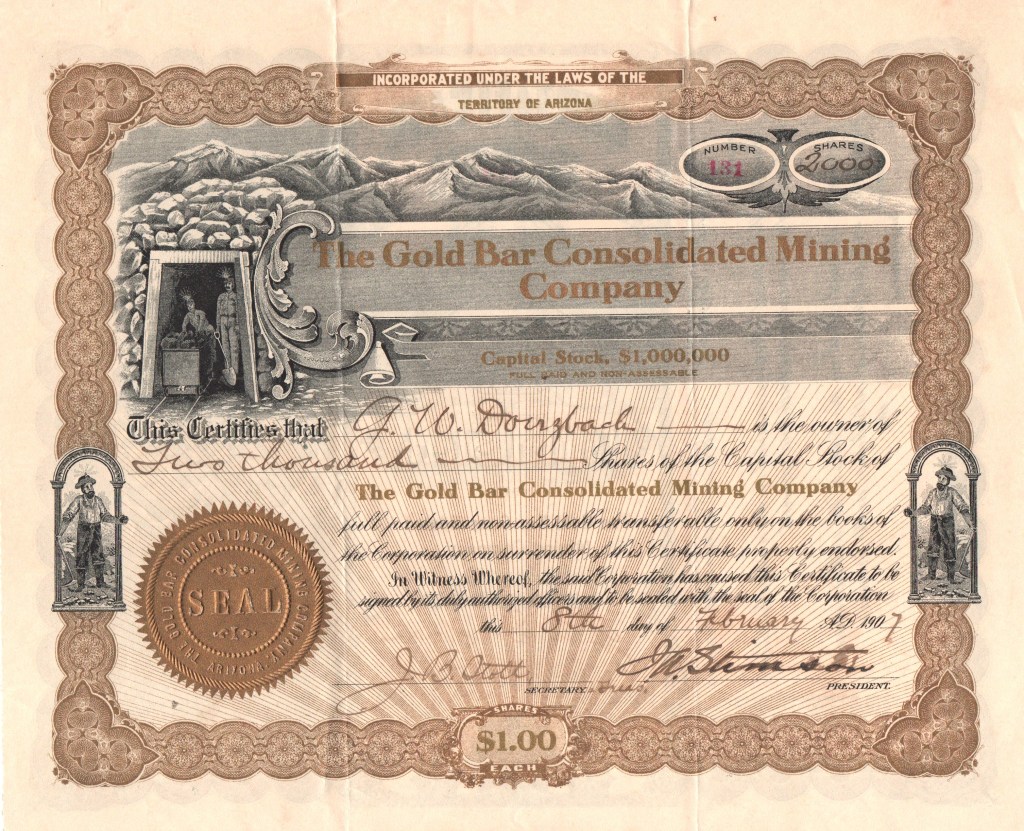
Certificate No. 131, Two Thousand Shares to G. W. Dougback, February 8, 1907. J. B. Stott, Secretary-Treasurer. J. W. Stimson, President.
Bullfrog Gold Bar Mining Company
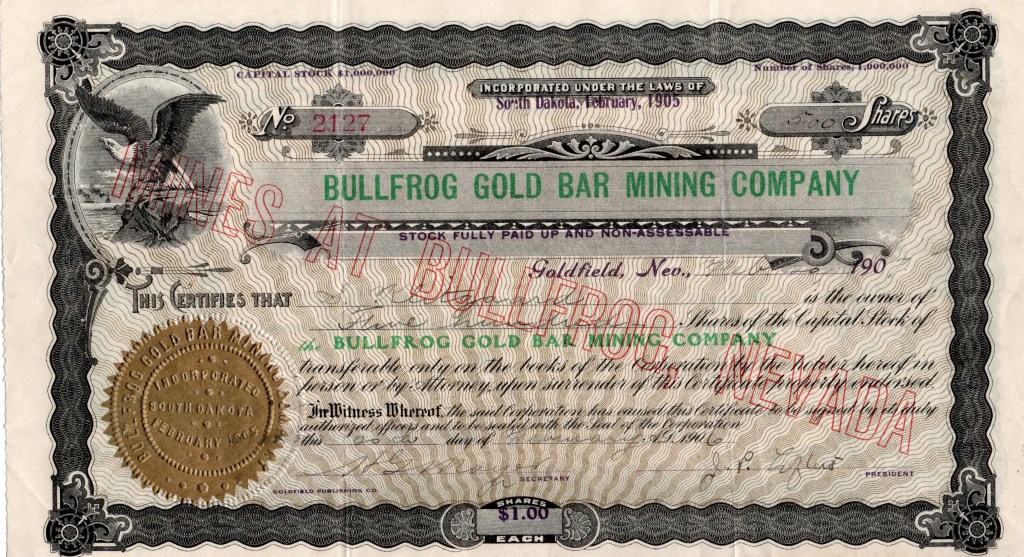
Certificate No. 2127, Five Hundred Shares to S. Klitgaard, February 20, 1906. H. G. Mayer, Secretary; J. P. Loftus, President.
Gold Bar Annex Mining Company
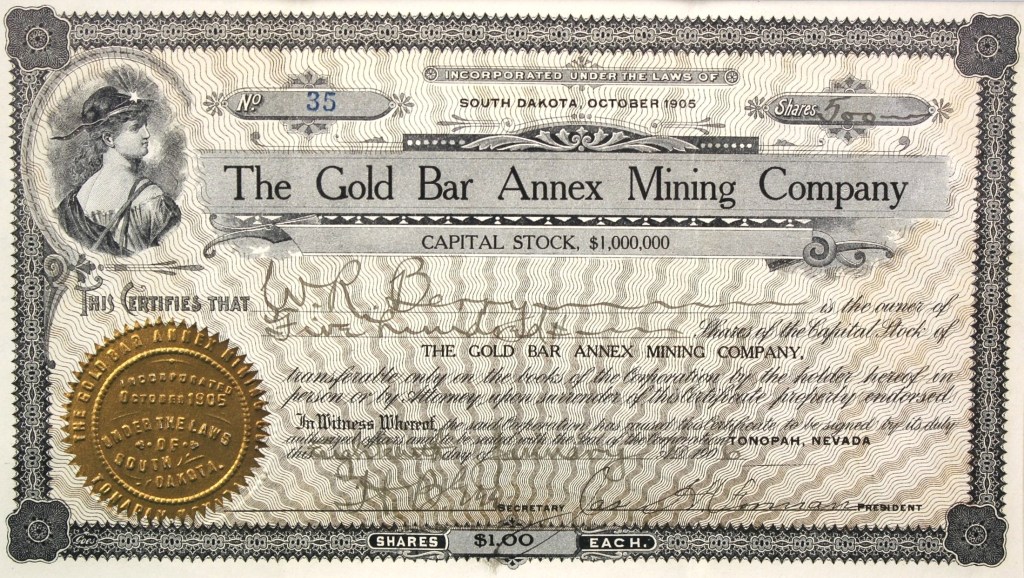
Certificate No. 35. Five Hundred Shares to W. R. Berry, February 8, 1908. H. (Herbert) B. Gee, Secretary; Jas. (James) H. Forman, President.
On November 11, 1905, the Tonopah Bonanza reported the incorporation of the Gold Bar Annex Mining Company, with five claims adjoining the Gold Bar property. By September 1906, the paper reported, “…small bunches of ore running from a trace to $10.80, but as yet have not encountered a permanent body.” Throughout its life, the Gold Bar Annex was never reported to have reached that “permanent body,” and faded away with the rest of the district.
Gold Bar Extension Mining Company
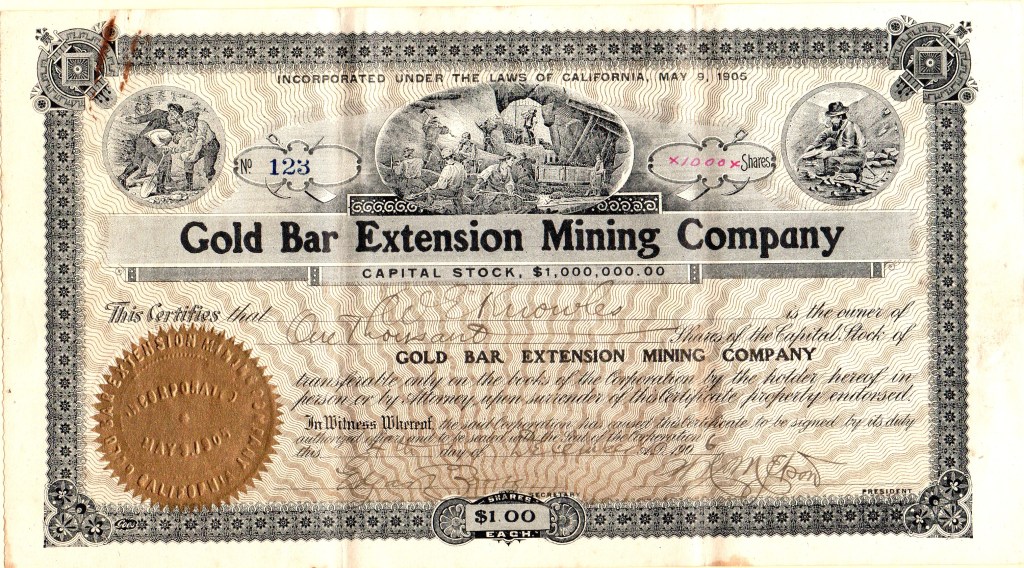
Certificate No. 123, One Thousand Shares to W. E. Knowles, December 4, 1906. Edgar Booth, Secretary; [Illegible], President.
The Gold Center Mining and Development Company
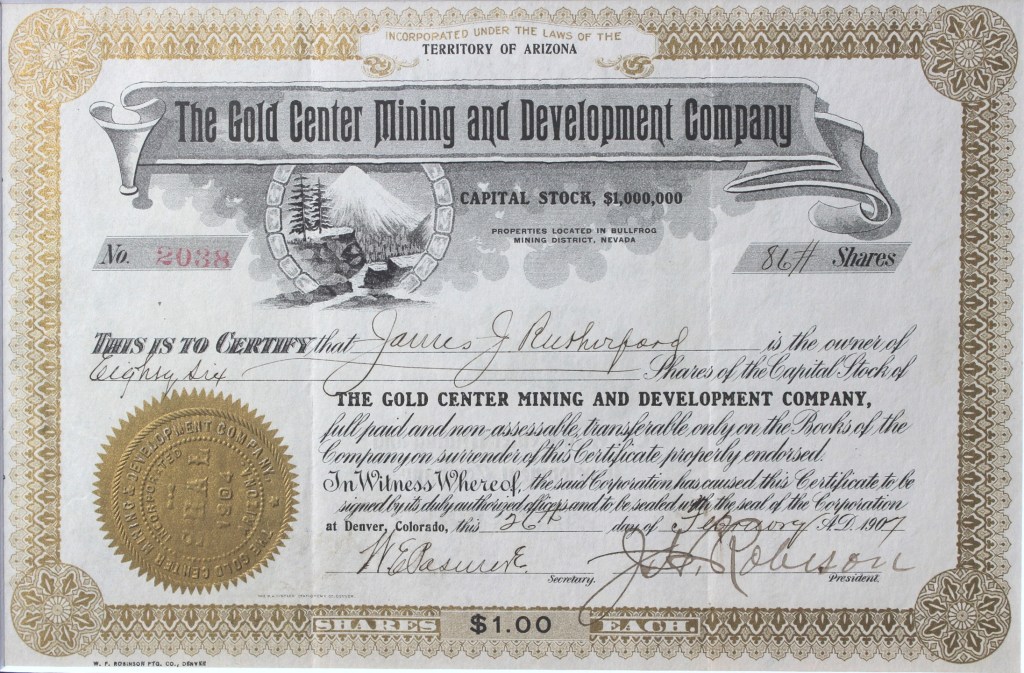
Certificate No. 2038, Eighty-Six Shares to James J. Rutherford, February 26, 1907. W. E. Passmore, Secretary; J. H. Robison, President.
The settlement of Gold Center was established in late 1904, due south of the town of Beatty, Nevada, on the Amargosa River. By 1905, the Gold Center Mining and Development Company was organized and owned the Daisy Claim, on Montgomery Mountain, east of the Montgomery Shoshone mine, the Northern Light Claim, just north of Rhyolite, and the Surprise Claim on Bonanza Mountain.
By 1909, as Bullfrog mines were in decline, activity was moving north to Pioneer. The Gold Center company held a large holding of stock in the Bullfrog Syndicate Mining Company at Pioneer.
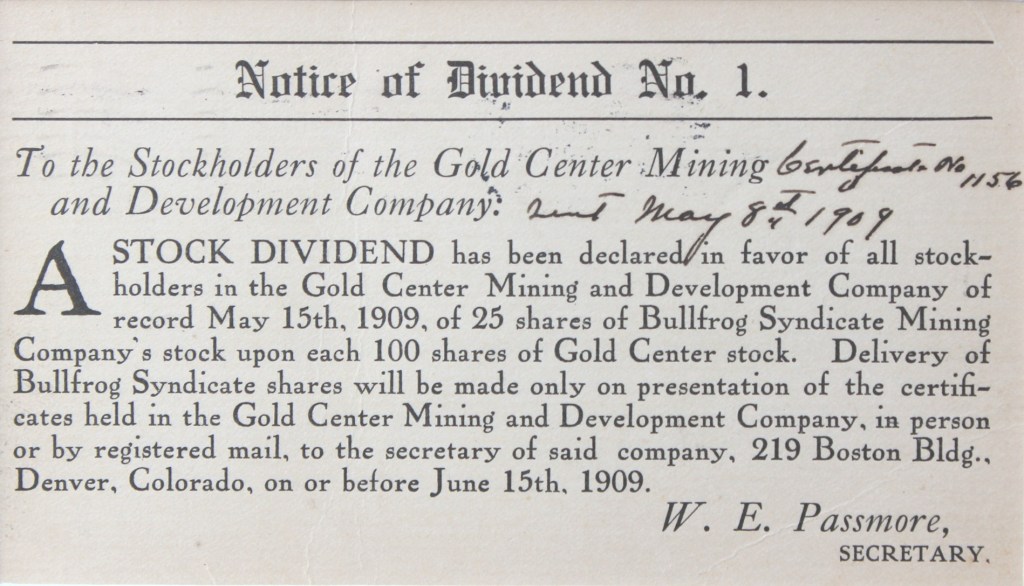
Notice of Dividend No. 1, Gold Center Mining and Development Company, 1909.
The Homestake King Consolidated Bullfrog Mining & Milling Co.
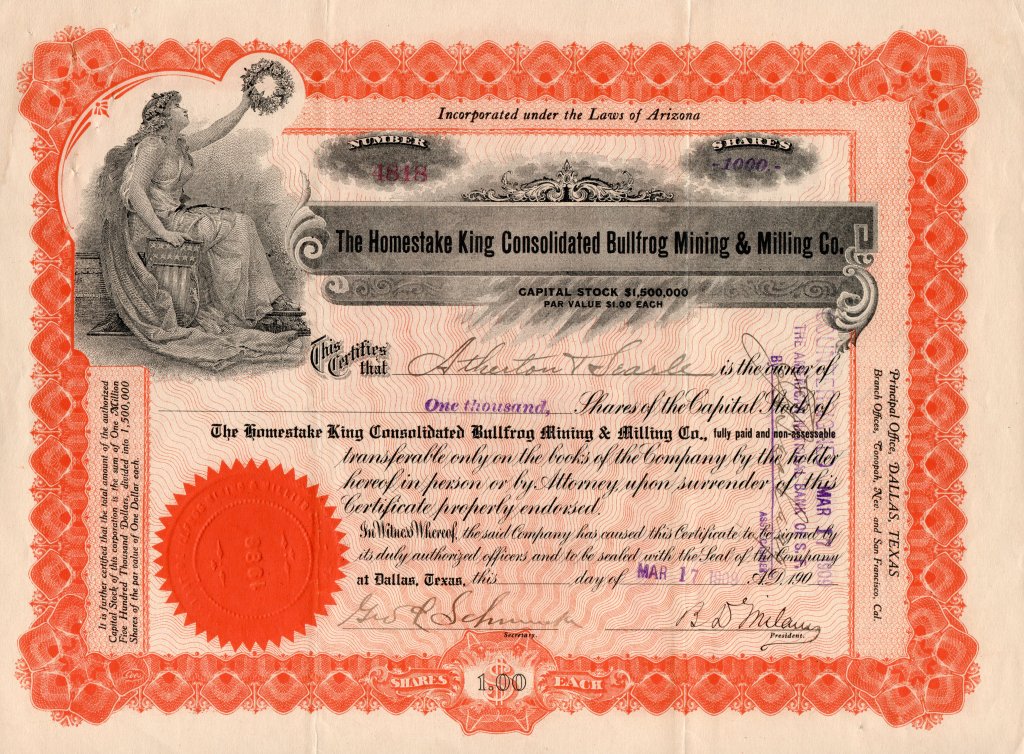
Certificate No. 1818, One Thousand Shares to Atherton & Searle, March 17, 1909. Geo. C. Schmucker, Secretary; B. D. Milam, President.
In early 1905, prospector John McMullin studied the Gold Bar claims, the surrounding territory and decided that the Gold Bar vein ran southwest – northeast, perpendicular to prior guesses of other gold seekers. McMullin staked out three claims and named them the Homestake after the famous South Dakota gold mine. McMullin guessed right.
As McMullin dug, he found indications of good ore deposits. Within two months of his discovery, eastern financiers had obtained an option on his claims. The good findings continued as he dug, and in September 1905, McMullin sold out to the Homestake King Consolidated Bullfrog Mining and Milling Company.
The Homestake company was dominated by Dallas businessmen, including B. D. Milam, a former real estate magnate. Con O’Donnell, a director, was named General Manager. John McMullin took a seat on the board – a prospector who made good.
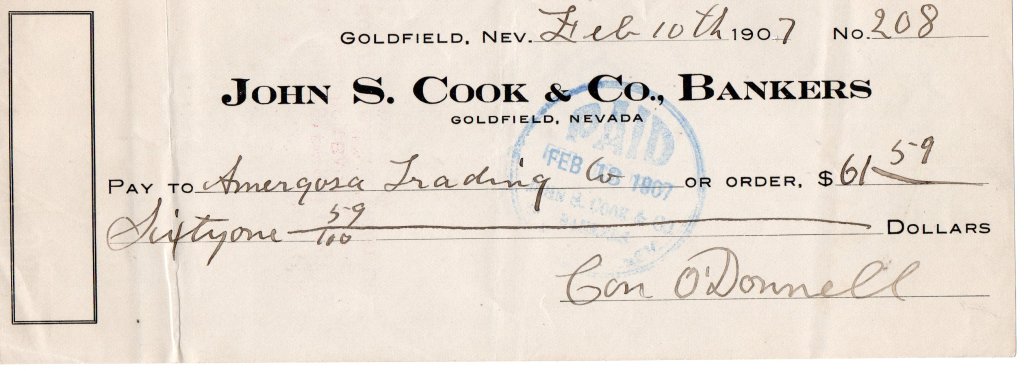
Check No. 208 for $61.59, to Amergosa (sic) Trading Co., drawn on John S. Cook & Co., Bankers, Account of Con O’Donnell, General Manager of the Homestake King Consolidated Bullfrog Mining and Milling Co. Amargosa Trading operated a lumber yard in Rhyolite, Nevada.
Montgomery Shoshone Consolidated Mining Company
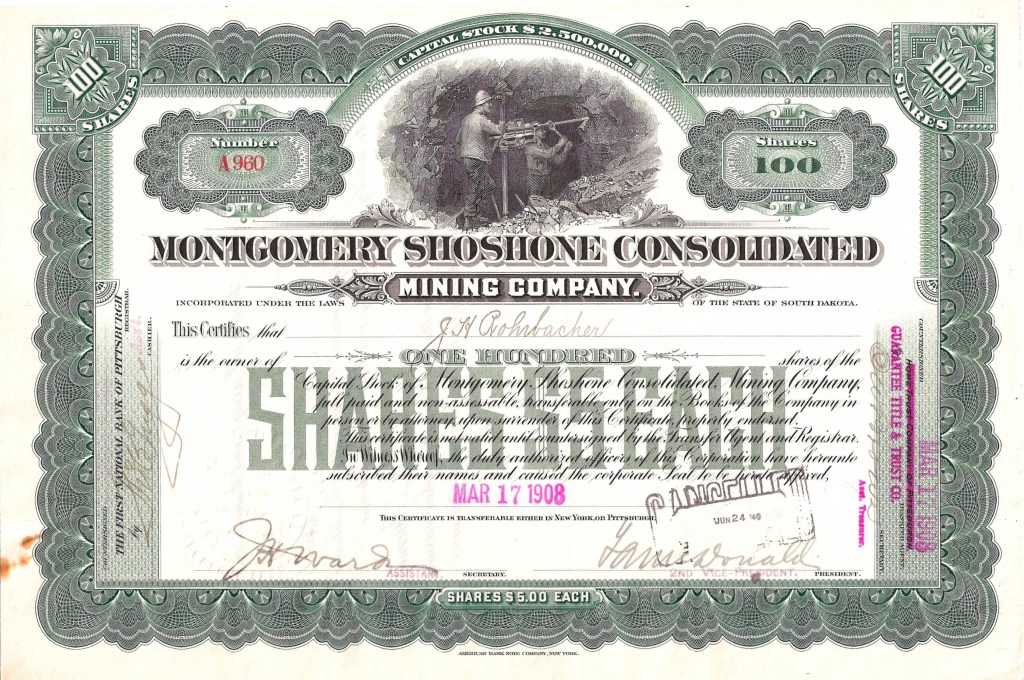
Certificate No. A960, One Hundred Shares to J. H. Rohrbacker, March 17, 1908. J. H. Ward, Asst. Secretary; L. MacDonald, Second Vice President.
The Montgomery Shoshone Consolidated was located by E. A. (Ernest Alexander) “Bob” Montgomery in September 1904 as the Shoshone Mine. The mine was about one-half mile east of the town of Rhyolite. The Shoshone was so successful, that Montgomery sold it to steel magnate Charles M. Schwab, who combined the mine with Montgomery’s contiguous Polaris Mining Company and the Crystal Bullfrog Mining Company under the newly incorporated Montgomery Shoshone Consolidated Mining Company. (Bob Montgomery went on to acquire control of the Skidoo mines in the Panamint Mountains.)
The mines operated between 1905 and 1911, producing gold and silver ore.
Montgomery – Shoshone Extension Mining Company
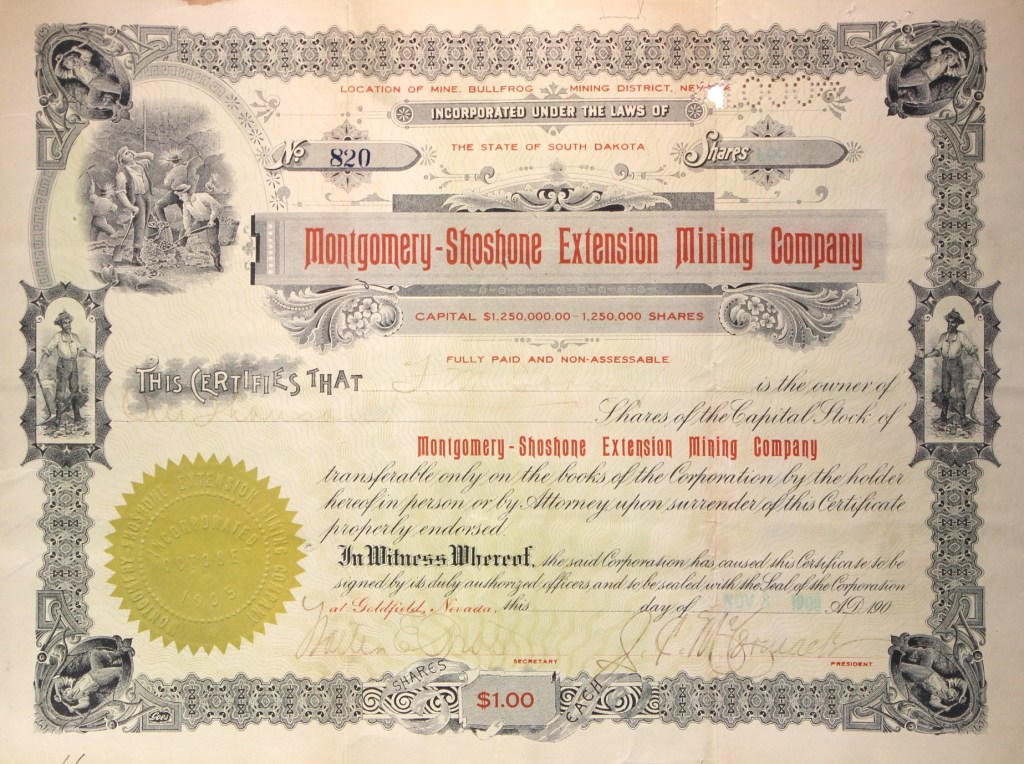
Certificate No. 820, One Thousand Shares to F. M. Dorsey, November 8, 1908. Walter E. Pratt, Secretary; J. C. McCormack, President.
The Montgomery – Shoshone Extension owned two claims, the Emerald and the Ruby, adjoining the Montgomery – Shoshone mine, immediately on the south. The Extension company was the first ground in the Bullfrog district to receive a land ownership patent.
Montgomery Mountain Mining Company of Bullfrog
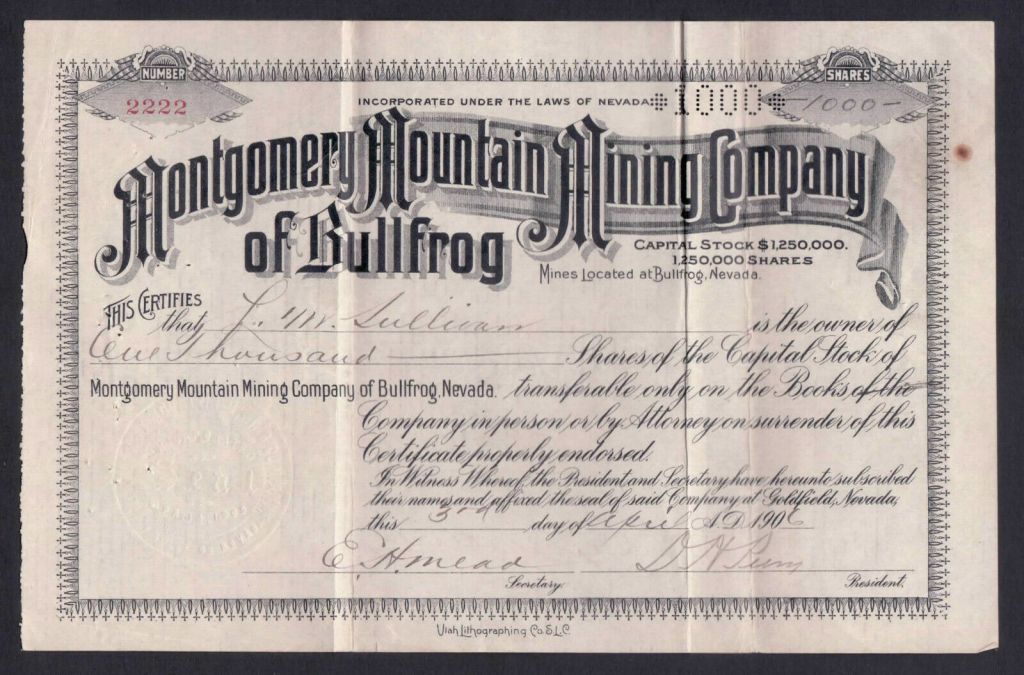
Certificate No. 2222, One Thousand Shares to L. M. (Larry Mikola) Sullivan, April 3, 1906. E. (Edmund) H. Mead, Secretary; D. H. Peery, President.
Montgomery Mountain Mining properties consisted of sixty acres adjoining the Montgomery Shoshone mine.
We note the share owner was Larry Sullivan, who at the time, was the owner of the L. M. Sullivan Trust Company in Goldfield. Known as “Shanghai” Larry, Sullivan was the former underworld boss of the Portland, Oregon waterfront docks. In a successful attempt to clean up Portland in advance of the 1905 Lewis and Clark Centennial Exposition, city fathers ran Sullivan out of Portland. He landed in Goldfield, Nevada.
Despite its name, Sullivan Trust was not a bank or financial institution but a stock jobbing front. Sullivan would create mining companies with little or no prospect of ever profitably mining ore, and sell stock in those companies to “rubes” and “plungers.” George Graham Rice, author of My Adventures with Your Money, was a close associate of Sullivan in running stock-jobbing scams in Goldfield.
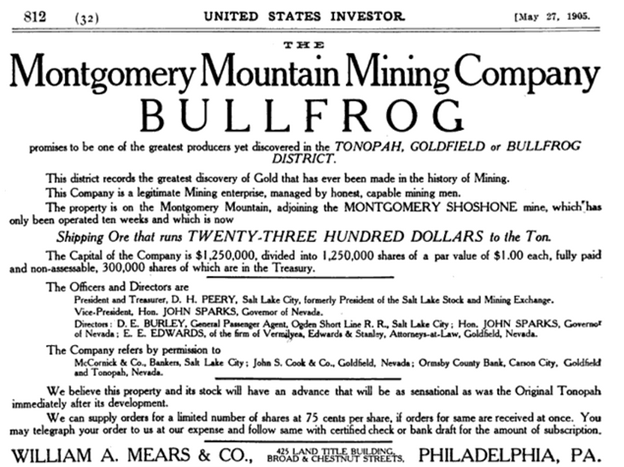
Advertisement, United States Investor, May 27, 1905.
The Nevada Prospecting and Mining Company
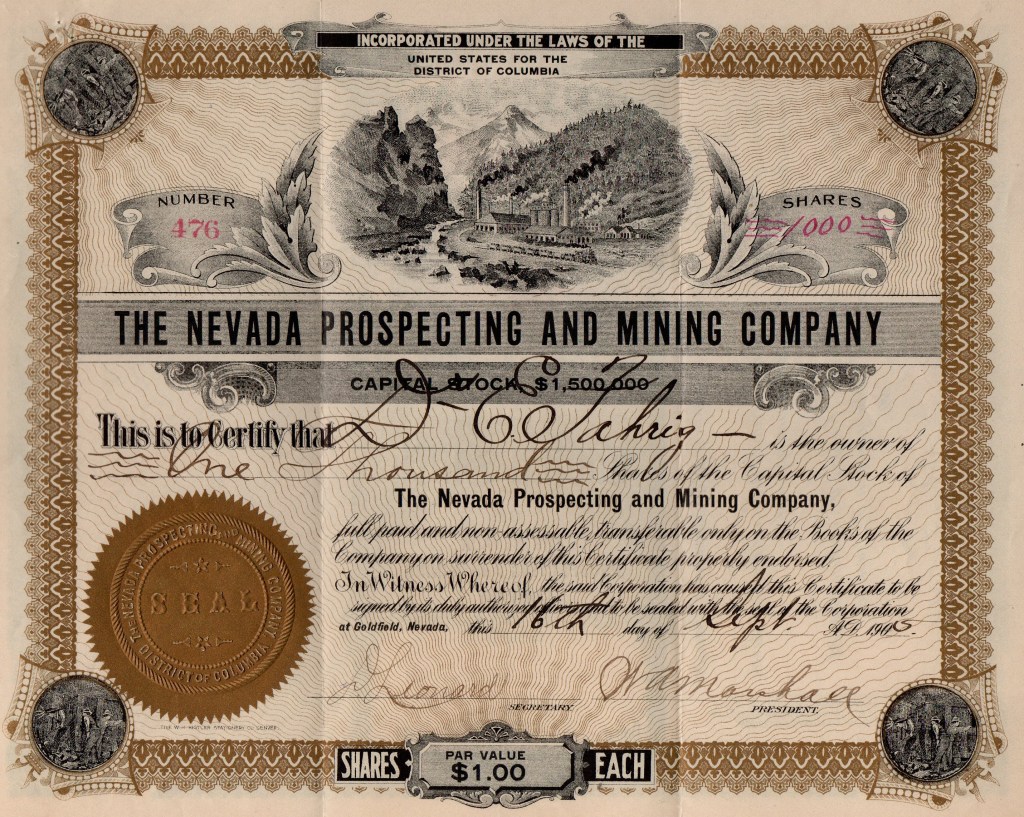
Certificate No. 476, One Thousand Shares to D. E. Fahrig, September 16, 1905. D. Leonard, Secretary; W. (William) A. Marshall, President.
The company was organized in December 1904, with a portfolio of claims at the Goldfield, Gold Mountain, and Bullfrog Districts. At Bullfrog, the Cardinal and Wart claims, about two miles northeast of the Montgomery – Shoshone, were touted as the company’s best prospects.
Nevada Prospecting and Mining spent much of 1905 advertising in newspapers from California to Kansas, with shares initially offered at 1-cent. By the time D. E. Fahrig purchased his shares, the price had increased 10-fold to 10-cents. Aside from a newspaper notice in December 1905 announcing the annual corporate meeting in Goldfield, no more is reported – suggesting that the company was a mere exercise in stock-jobbing.

Advertisement, The Goldfield News, April 14, 1905.
Bullfrog Golden Scepter Mining Company
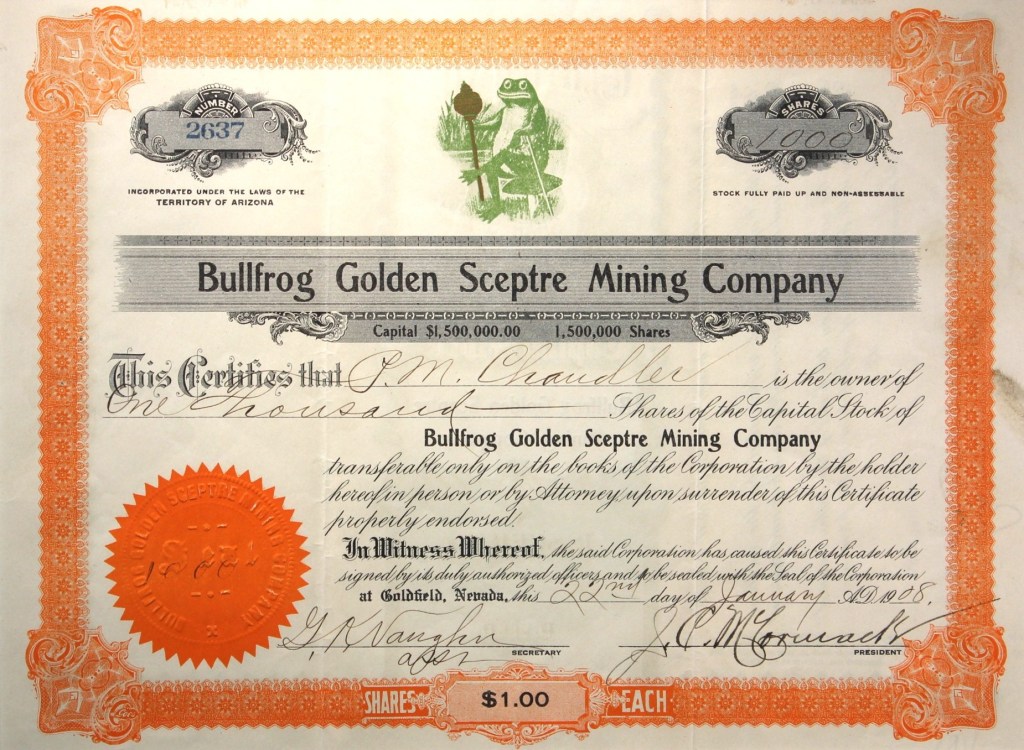
Certificate No. 2637, One Thousand Shares to P. M. Chandler, January 22, 1908. G. K. Vaughn, Assistant Secretary; J. C. McCormack, President.
The Bullfrog Golden Scepter Mining Company had 15 claims on the crest and east slope of Bonanza Mountain. About 40 acres of the company’s ground was within the limits of the unincorporated town of Rhyolite. The Golden Scepter was surrounded by the Gibraltar mines on the south, the Tramp and Eclipse on the west, and the Great Eastern on the north.
While the Bullfrog Golden Scepter boomed and busted with the rest of the District’s mines, its stock certificate, with the throned bullfrog with the gold scepter, became one of the most collectable stock certificates.
The Bull Frog Chief Mining Company
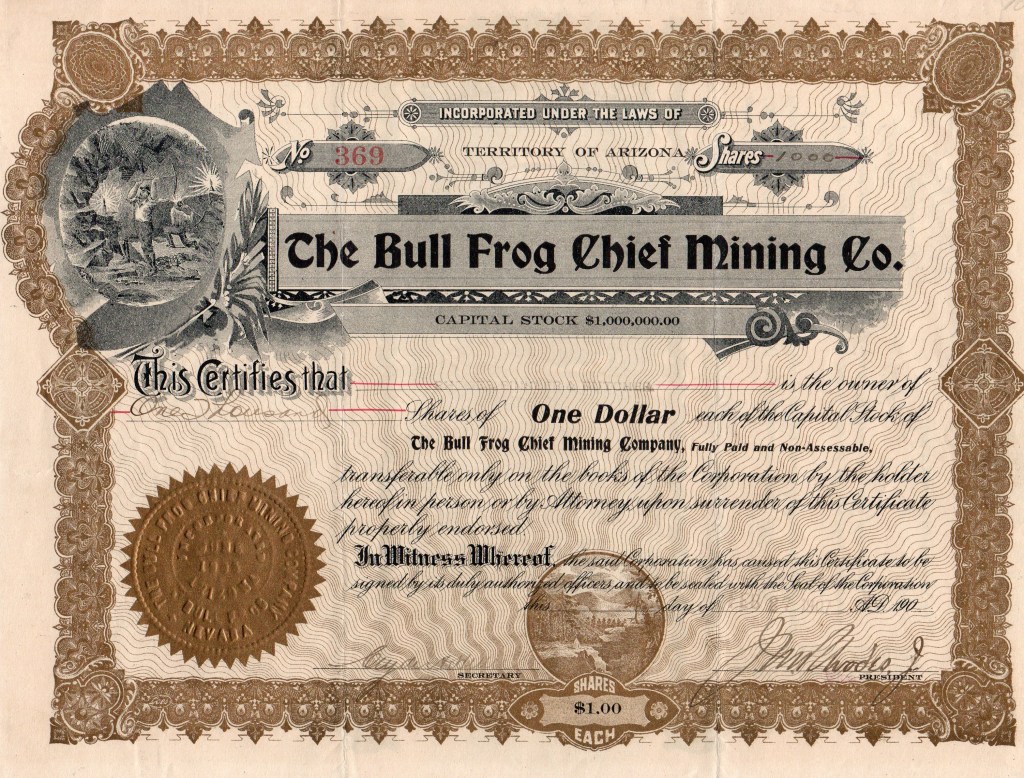
Certificate No. 369, One Thousand Shares to Rhodes Sinkler & Butcher, February 27, 1907. Clyde A. Heller, Secretary; J. M. Rhodes, Jr., President.
The Bull Frog Chief Mining Co. owned five claims, with shafts on two claims, the Chief and the Good Will.
The Rhyolite Rose Gold Mining Company
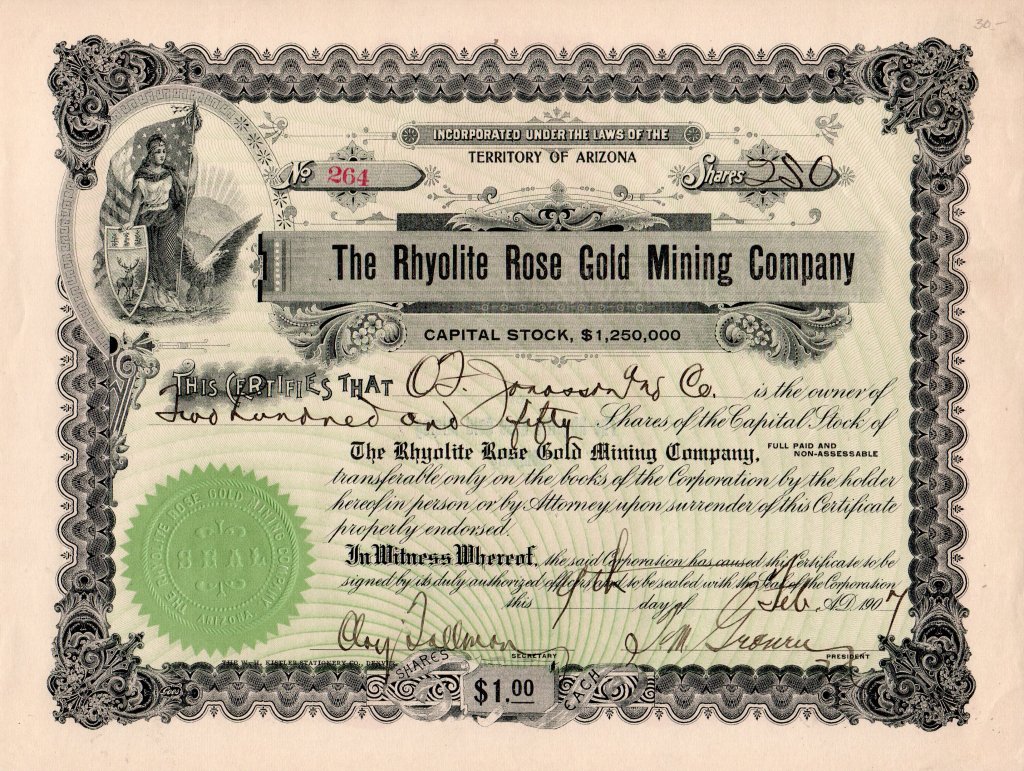
Certificate No. 264, Two Hundred Fifty Shares to O. F. Jonasson and Co., February 9, 1907. Clay Tallman, Secretary; T. M. Gromen, President.
The Rhyolite Rose company owned seven claims in the Bullfrog District. One group of five claims was three quarters of a mile north of Rhyolite on the northern slope of Bonanza Mountain. The other two claims were located on Red Mountain, two miles north of Rhyolite. Company Secretary Clay Tallman was a well-respected attorney in the district. He was in charge of the successful liquidation of the Bullfrog Bank and Trust Company after the financial panic of 1907. He was later appointed as the head of the U.S. General Land Office, precursor of the Bureau of Land Management.
Bullfrog Crescent Mining Company
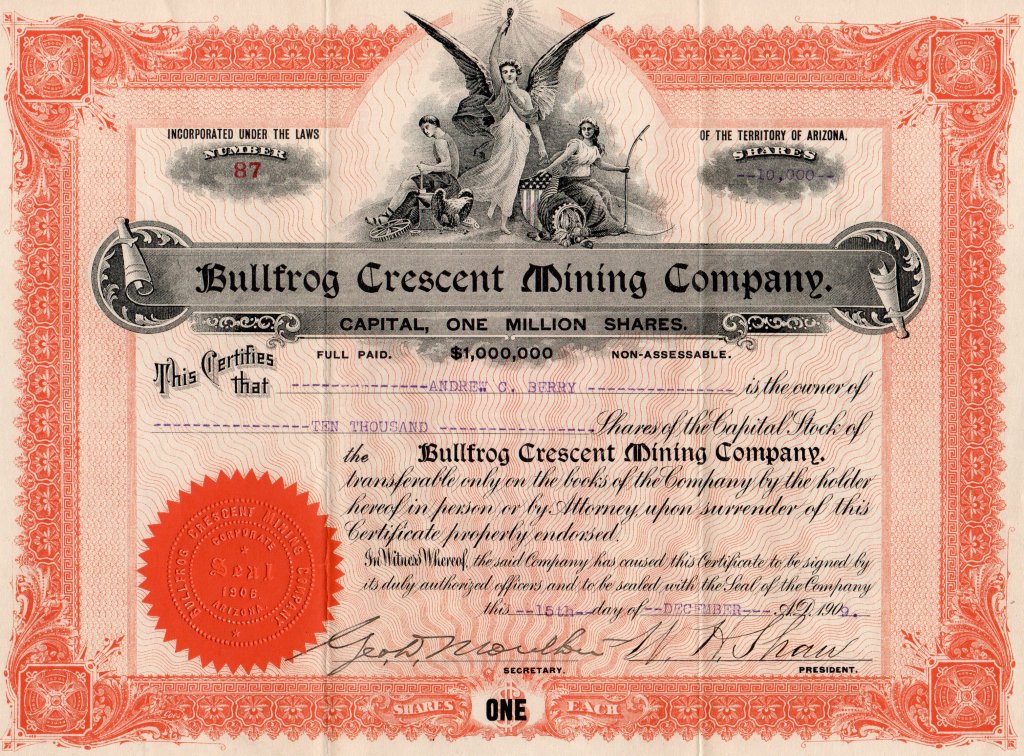
Certificate No. 51, Five Hundred Shares to Andrew C. Berry, June 11, 1907. Geo. D. Moulton, Secretary; Walter H. Shaw, President.
The Salt Lake Herald reported in April 1908 that the company had 80 feet of work completed.
China Nevada Gold Mining Company

Certificate No. 327. Three Hundred Thirty-Five Shares to the Beatty Bullfrog Miner (Newspaper), April 13, 1907. F. H. Stickney, Secretary; H. (Henry) M. Gracey, President.
True to its name, the China-Nevada comprised the group of claims known as the Tientsin, Peking, Canton, Hankow, Foochow, Hong Kong, and the Nora Mine. The claims were about 1-1/2 miles north of the Mayflower mine, in the Crystal Springs Section.
Sunset Mining and Development Company
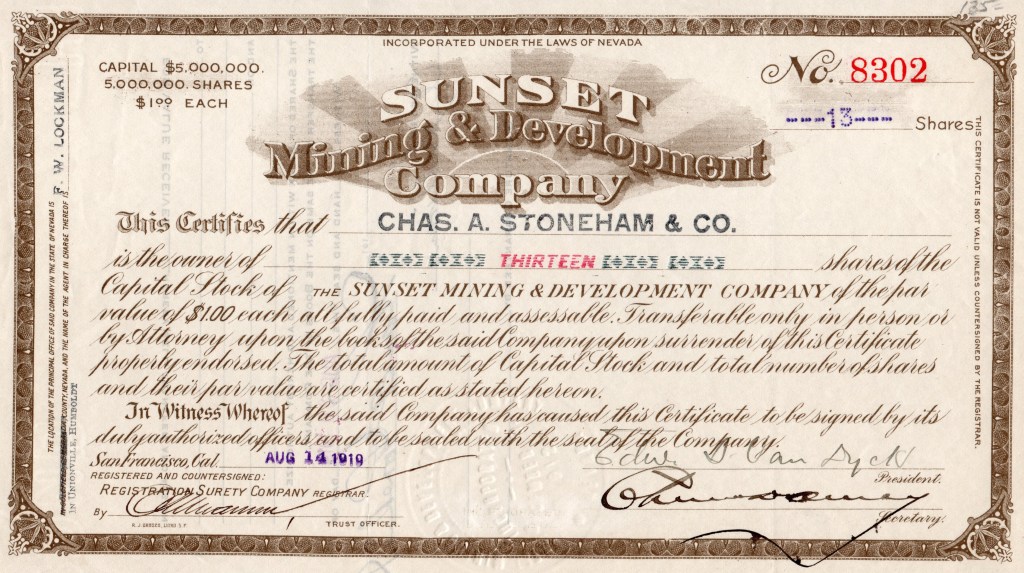
Certificate No. 8302, Thirteen Shares to Chas. A. Stoneham & Co., August 14, 1919. Edward S. Van Dyke, President; Chas. D. Olney, Secretary.
Gibraltar Mines Syndicate
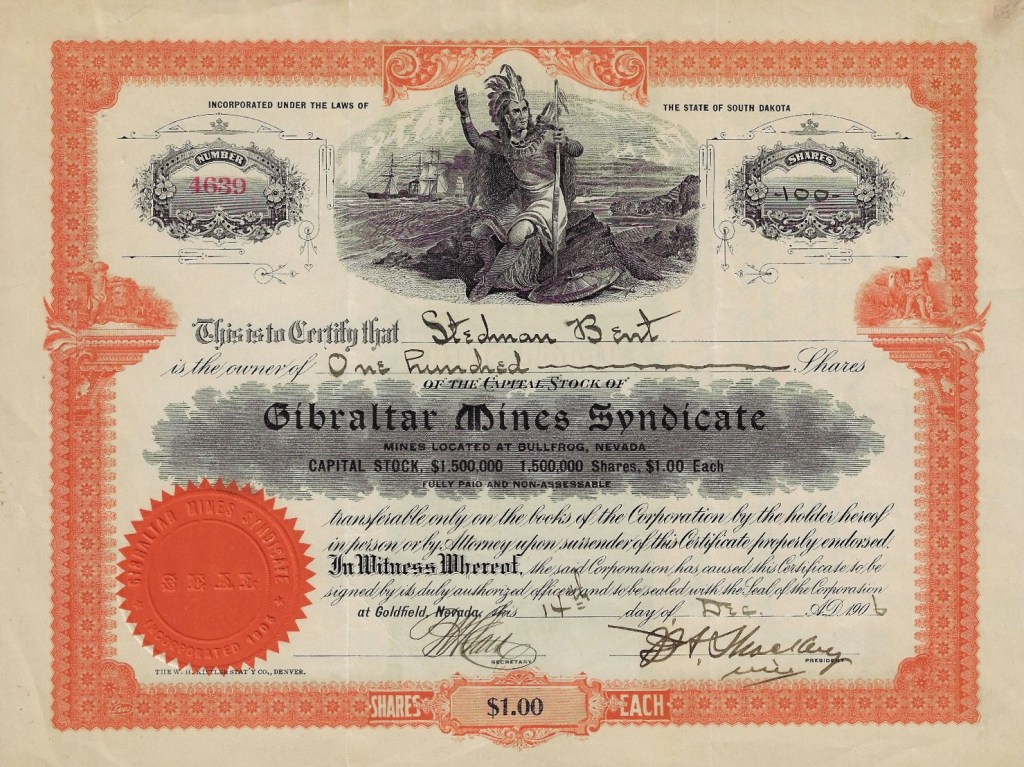
Certificate No. 4639, One Hundred Shares to Stedman Bent, December 14, 1906. W. H. Clark, Secretary; *
The Gibraltar Mines Syndicate was organized in November 1906 by Salt Lake City men during the later, post-1906 late-phase of the Bullfrog boom. No major mine is known to have operated under the name “Gibraltar,” and the syndicate likely owned, operated, and/or leased claims in the Bullfrog District.
The Salt Lake Tribune of January 8, 1907, reported the likely first shipments of two car-loads of syndicate ore at $241/ton and $100/ton to Salt Lake City mills. A subsequent shipment of $351 ore was reported in May 1907, by the Spanish Fork Press (Utah). That may have been the high point of production and shipments, as the Financial Panic of 1907, general playing-out of the Bullfrog District, and lack of money forced the syndicate to turn to lessors to operate the claims.
Fifteen tons of ore were reported as sent for milling in the November 5, 1910 edition of the Goldfield News. The recovered value from milling was not disclosed. This was the last known ore shipment from the mine.
The February 1, 1912, Salt Lake Tribune carried the financial report for the Gibraltar Syndicate for the year 1911, with the company treasury having $268 on-hand. The New York Sun newspaper of February 1, 1917, reported the auction lot sale of 15,000 shares of Gibraltar Mines Syndicate for $5.00, that’s $0.000333/share.
Pioneer Mines
In 1907, new claims north of the Mayflower Mine gave rise to the Pioneer Mine and its adjacent townsite. On May 9, 1909, a fire destroyed most of the business district. The fire was believed to have been started by Mercedes Brong, wife of well-known regional autoist, “Alkali” Bill Brong. The Pioneer townsite never really recovered from the devastating fire.
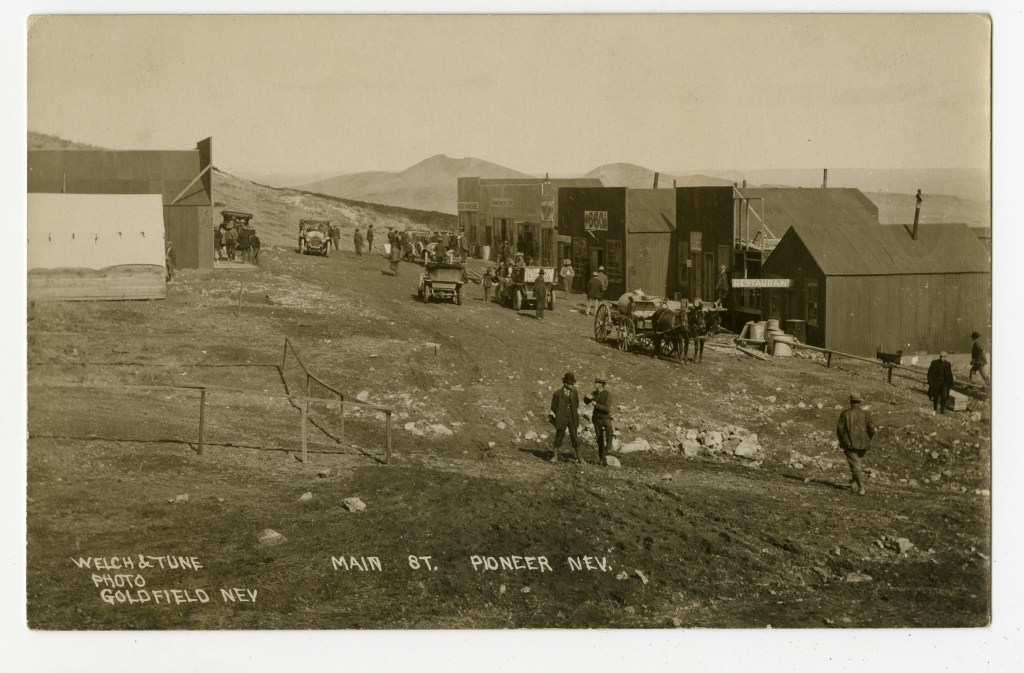
Postcard view of Pioneer, Nevada’s Main Street – before the fire. “Alkali” Bill Brong’s office was located in the 66 Club building, center right. Brong’s Pope-Toledo automobile is parked in front.
Pioneer Consolidated Mines Company
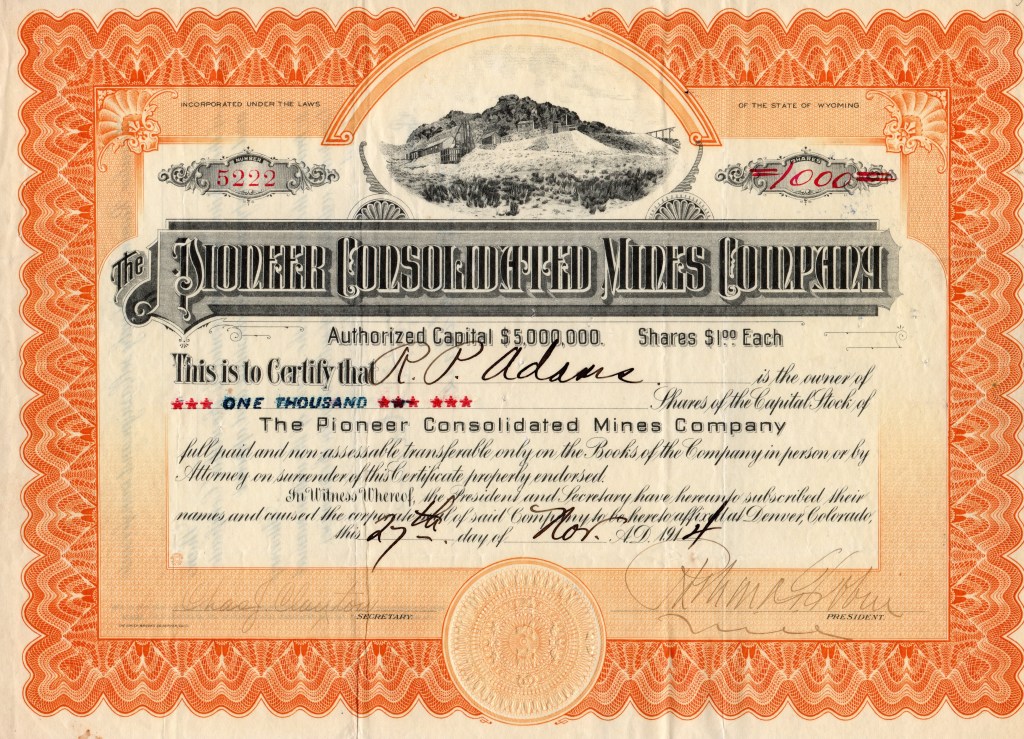
Certificate No. 5222. One Thousand Shares to R. P. Adams, November 27, 1914. Chas. J. Clayton, Secretary; Richard F. Tobin, Vice President.
The Pioneer Consolidated Mines Company, backed by industrialist George Wingfield, erected a 10-stamp mill and a 30-ton cyanide and amalgamation plant by 1913, later adding a relocated 10-stamp mill in 1915. Over its operational span, the Pioneer Mine produced an estimated $1.6 million in gold and silver before a partial mill collapse halted activities in late 1914.
Bullfrog Pioneer Extension Mines Company
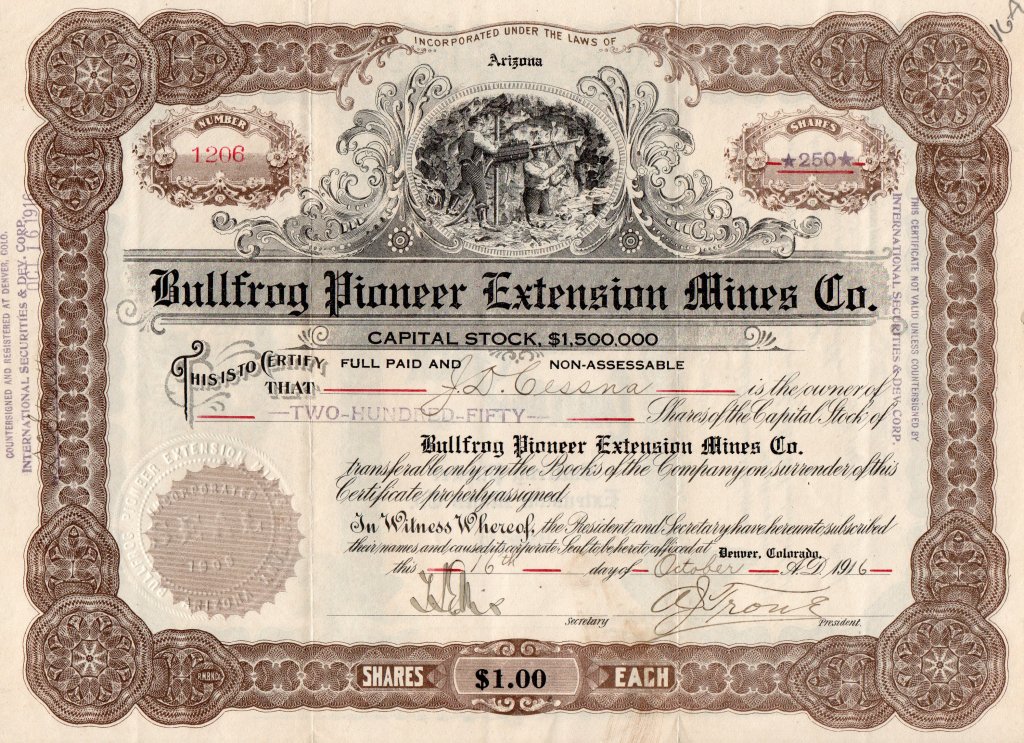
Certificate No. 1206, Two Hundred Fifty Shares to J. D. Cessna, October 16, 1916. [Illegible], Secretary; A. J. Frone [?], President.
Bullfrog Pioneer Extension Mines Company was formed by Denver, Colorado mining operators in early 1909. The company owned the Jolly Jane and Gold Center claims immediately adjacent to the original Bullfrog Pioneer mine property.
The Consolidated Mayflower Mines Company
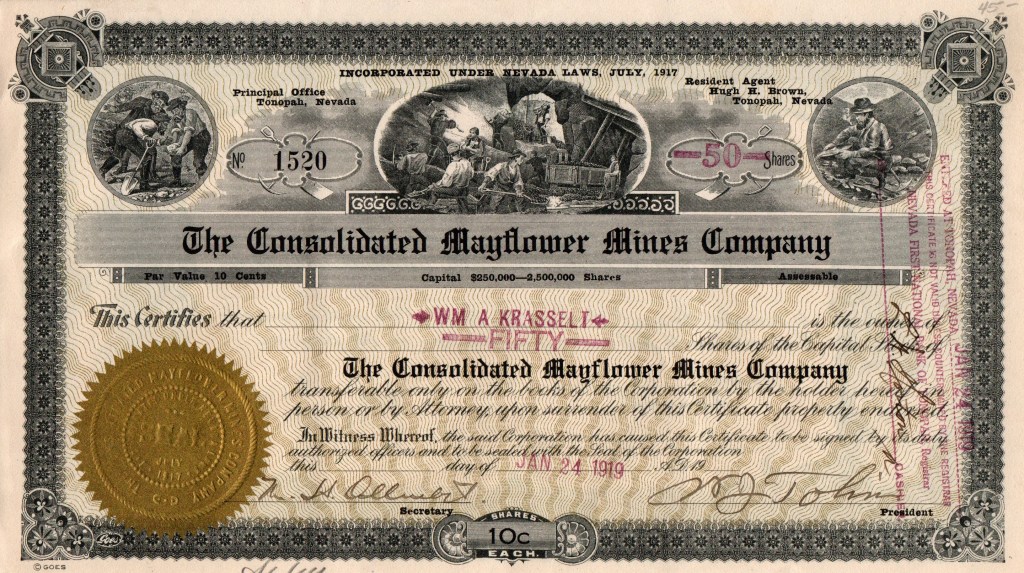
The Consolidated Mayflower Mines Company arose in 1917 from a reorganization of the Mayflower Bullfrog Consolidated Mining Company. The mine and mill had been idle for five years and required substantial repairs and new equipment. By mid-1918, the company was shipping ore. Contrary to positive newspaper reports, the company issued as many as eight assessments to shareholders through 1922. By 1924, no further news of the mine was available.
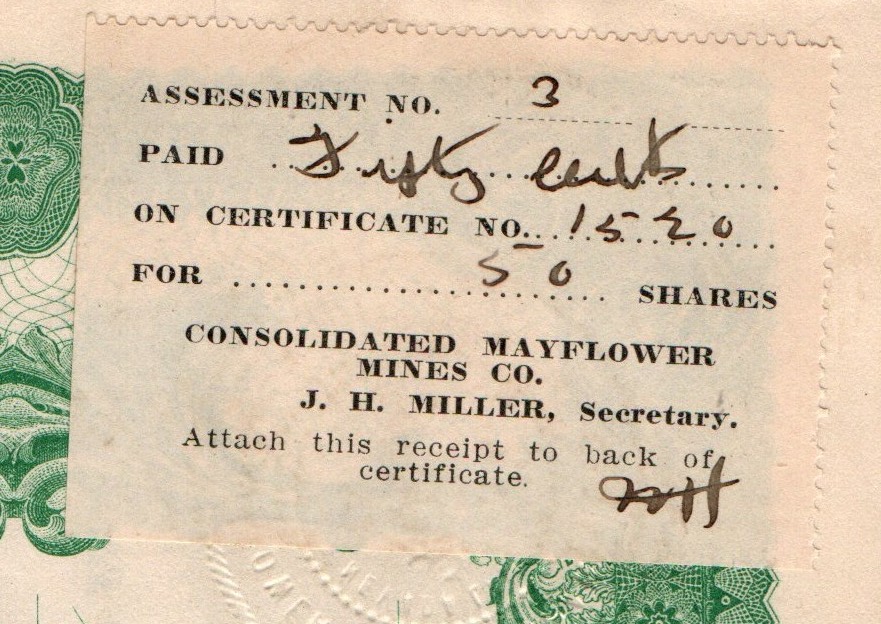
Certificate No 1520 with Assessment No. 3 Stamp on Reverse, Fifty Shares to Wm. A. Krasselt, January 24, 1919. M. (Marie) H. Ollmert, Secretary; W. J. Tobin, President.
Banks
Bullfrog Bank and Trust Company of Nevada
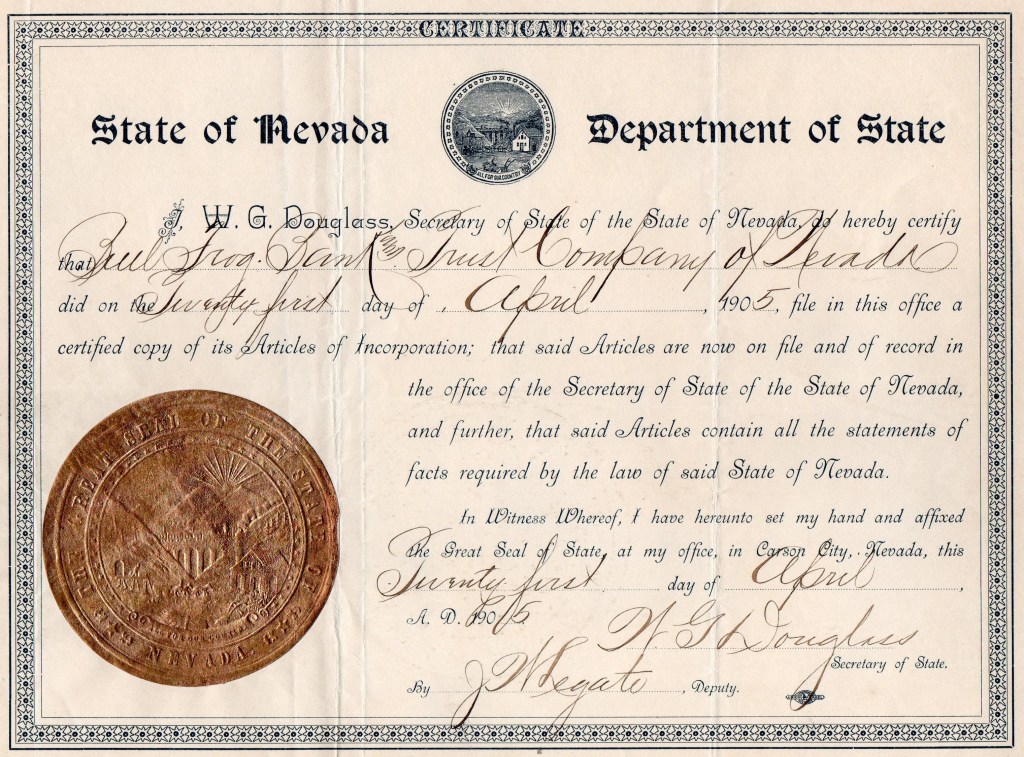
Bullfrog Bank and Trust Company of Nevada, Certificate of Incorporation. W. G. Douglas, Secretary of State; J. W. Legato, Deputy, April 21, 1905.
With one of every ten mines in the Bullfrog District shipping valuable ore, five banks opened during a short interval in 1905. The first to open was the Bullfrog Bank and Trust Company, incorporated on April 21, 1905, and opened for business on May 10. It was followed by the John S. Cook Bank, Southern Nevada Bank, the State Bank and Trust Company, and the First National Bank of Rhyolite. The Bullfrog Bank and Trust also operated a branch in Beatty, Nevada. However, within five years, all the Bullfrog District banks were closed.
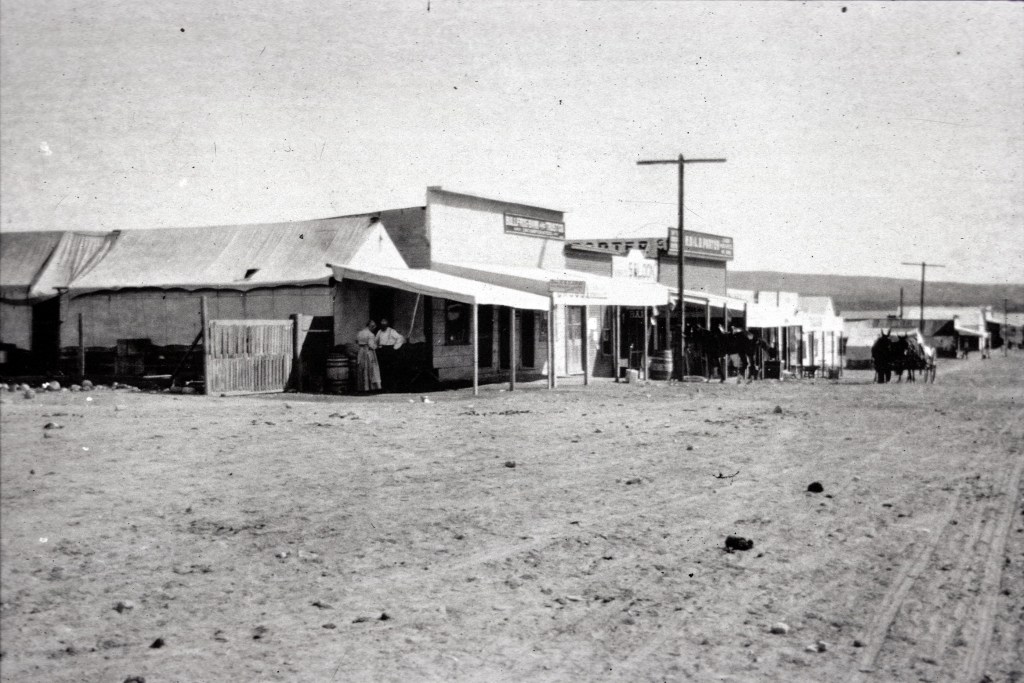
Photo, the Bullfrog Bank & Trust occupied the second building from left.
It didn’t take long for circumstances to impact banks in the district. On April 18, 1906, the 7.6 magnitude earthquake struck San Francisco, followed by the fire that destroyed 25,000 buildings. Losses by U.S. and British insurers strained liquid reserves in regional, New York, and London money-center banks. However, the gold production at Bullfrog district mines somewhat cushioned the blow for Rhyolite banks.
The San Francisco calamity was followed by the national financial Panic of 1907. That event cut off more investment in the district. By 1909, the gold ore production of Bullfrog mines was declining, and the population of the district was in steep decline.
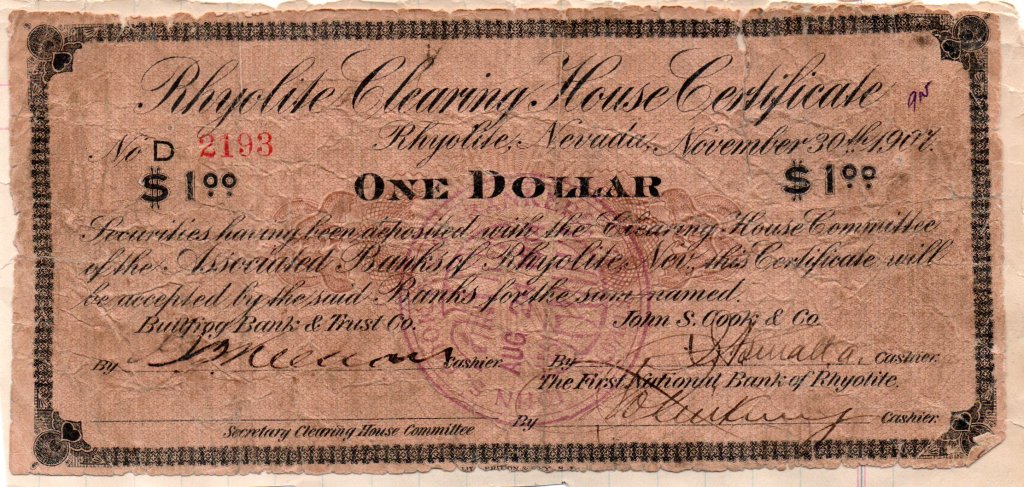
Rhyolite Clearing House Certificate No. D2193, One Dollar Note, November 30, 1907. Issued during the Financial Panic of 1907, on behalf of the Clearing House members, T. B. Beeman for the Bullfrog Bank & Trust Co., J. O. Walthall for John S. Cook & Co., and F. H. Stickney for the First National Bank of Rhyolite.
The Bullfrog Bank and Trust failed on June 30,1909, and was taken over by the Nevada State Bank Examiner. The bank had liabilities of nearly $100,000, with only $2,100 cash on hand and in deposits at other banks.
Local attorney Clay Tallman was placed in charge as trustee for the bank examiner. Tallman was well respected in the region. In 1910, depositors were paid-off and made whole through Tallman’s efforts. Tallman went on to become head of the U.S. General Land Office, precursor of the Bureau of Land Management.
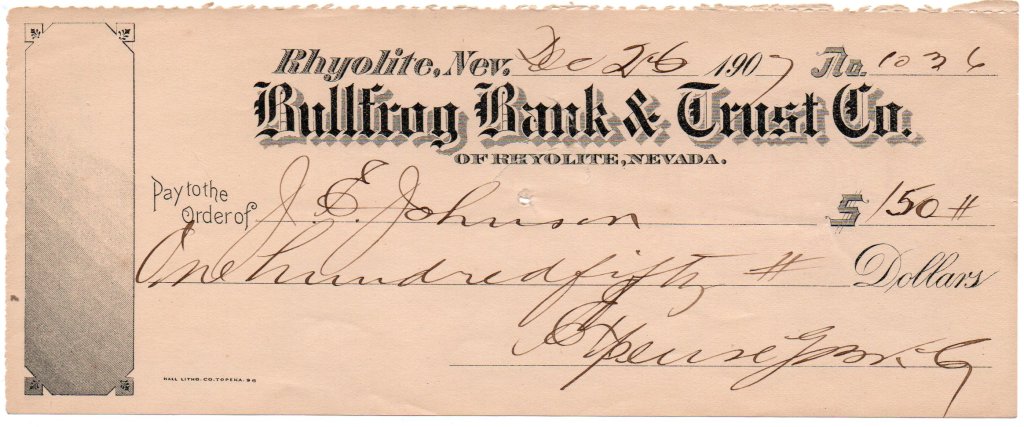
Bullfrog Bank & Trust Co. Check No. 1036, One Hundred Fifty Dollars, Payable to J. E. Johnson, December 26, 1907, on the Expense Account of the Goldfield Bank & Trust Co.
John S. Cook Bank
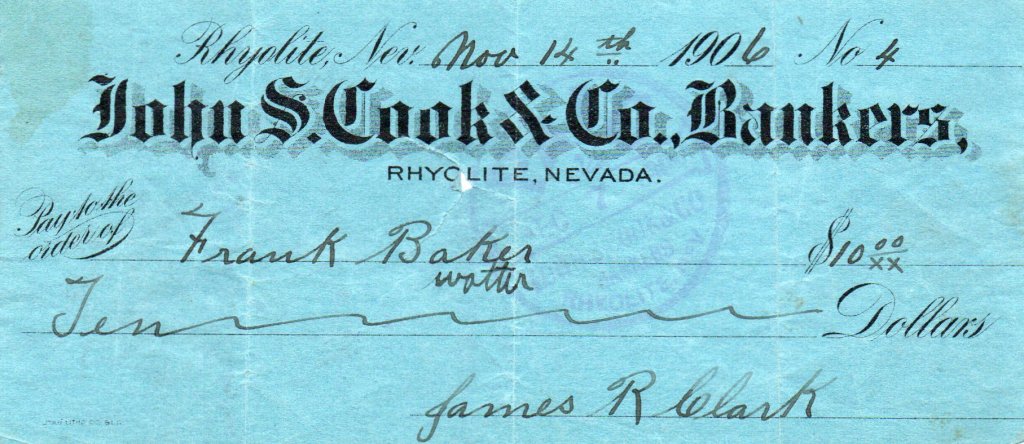
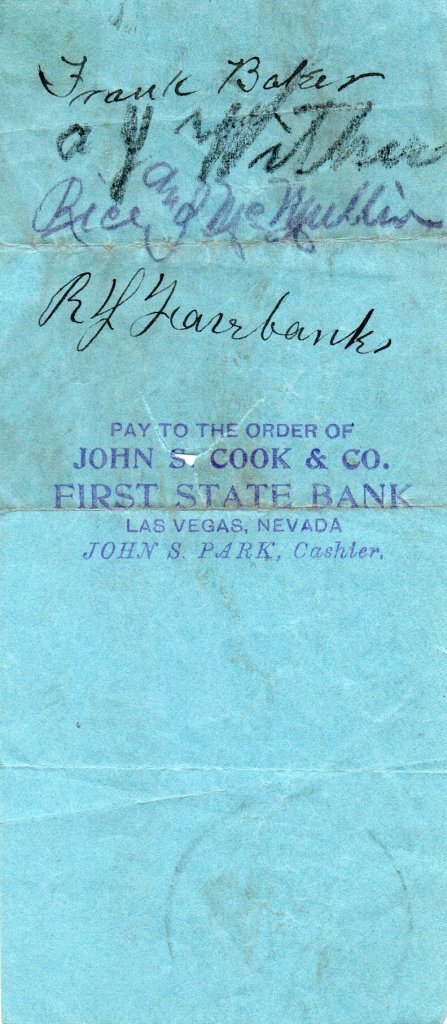
Bank Check No. 4, Account of James R. Clark, November 14, 1906. Final Endorsement by R. J. “Dad” Fairbanks, Death Valley Pioneer and Founder of Shoshone, California.
The First National Bank of Rhyolite, Nevada
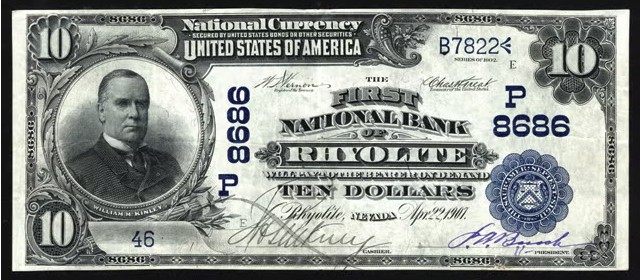
Ten Dollar National Currency Banknote issued by the First National Bank of Rhyolite. F. (Frank) H. Stickney, Cashier; P. A. Busch, Vice President.*
The First National Bank of Rhyolite was chartered by the U.S. Treasury’s Comptroller of the Currency on May 14, 1907, with a capital of $50,000. From 1863 to 1935, National Bank Notes were issued by banks throughout the United States and its territories. Banks with federal charters would deposit U.S. government bonds with the U.S. Treasury. The banks then could issue banknotes worth up to 90 percent of the value of the bonds. With bonds on deposit, the federal government would back the full value of the banknotes.
The First National Bank circulated only $5 and $10 denominated banknotes, with a total value of $30,640. The bank ceased operations in 1910 with the decline of the Bullfrog District.
For decades, no First National Bank of Rhyolite banknotes were thought to have survived the bank’s closure. However, the banknote shown above surfaced in 2015, when it was offered at a collectable currency auction.
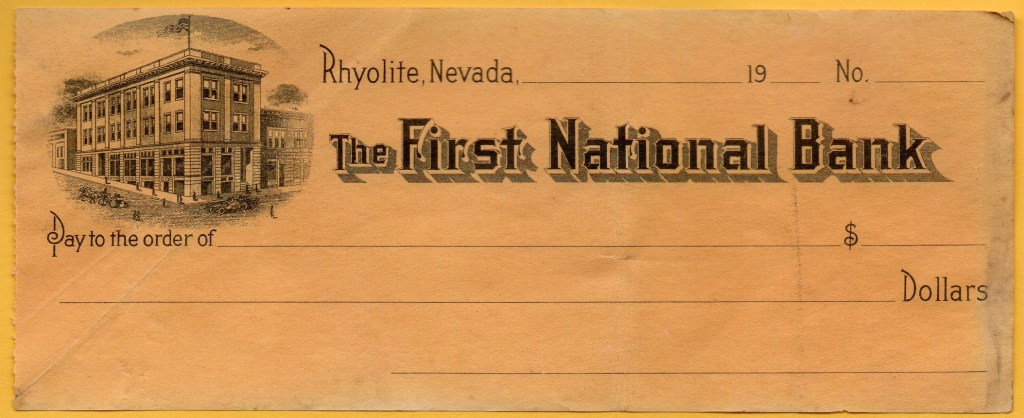
Blank Check, First National Bank of Rhyolite – After the bank relocated to the John. S. Cook Bank in early 1908.
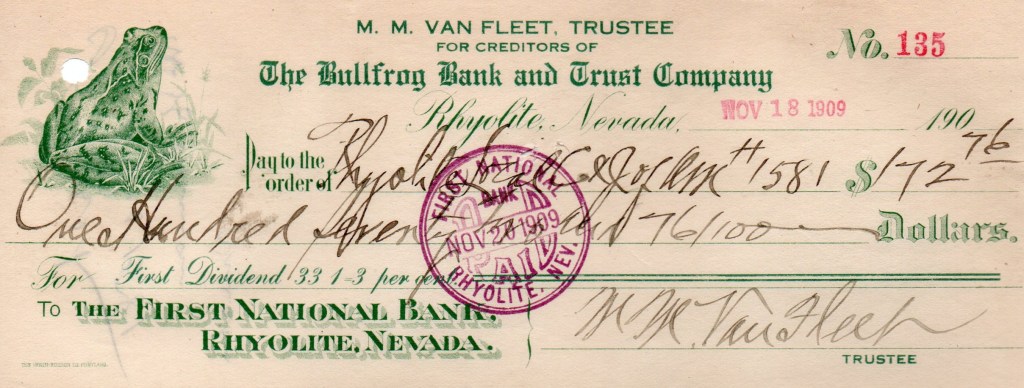
First National Bank of Rhyolite, Account of the Liquidation of the Bullfrog Bank and Trust Co., Check No. 135, One Hundred Seventy-Two Dollars and 76 Cents to the Rhyolite Local C. & J. of Am. #1581, [United Brotherhood of Carpenters & Joiners of America Local #1581,] November 18, 1909. Signed by M. (Morgan) M. Van Fleet, Trustee. Mr. Van Fleet was the Bank Examiner for the State of Nevada, and guided the successful dissolution of the Bullfrog Bank and Trust, with the assistance of his deputy and local Attorney, Clay Tallman.
Bullion and Exchange Bank
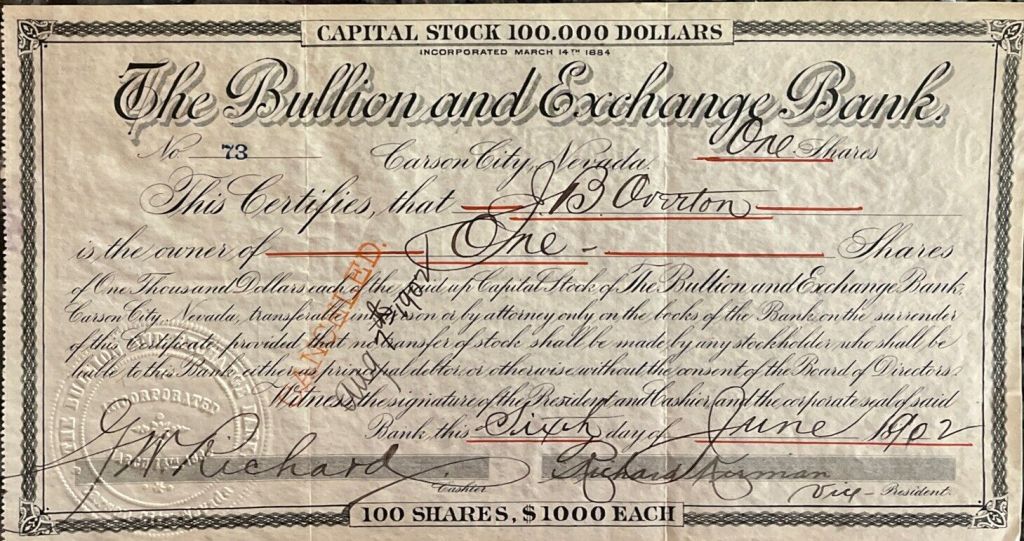
Certificate No. 73, One Share to J. B. Overton, June 6, 1902. G. W. Richard, Cashier; Richard Kirman, Vice President.
The Bullion and Exchange Bank began its life as the Carson City Savings Bank, chartered in 1876. In 1884 it was reorganized and took on the Bullion and Exchange Bank name, operating under that title until 1903, when it became the State Bank and Trust Company. The reorganization was driven by state banking statutes and an effort to broaden trust services.
State Bank and Trust Company
State Bank and Trust opened a branch in Rhyolite on April 5, 1906. The branch ceased operations on March 31, 1908, a victim of the national financial panic of 1907. Two days later, the Nevada Appeal reported that the bank’s vault in Rhyolite had been locked and its remaining assets transferred to Carson City.
Townsite and Utility Companies
Bullfrog Gold Center Water and Mills, Ltd.
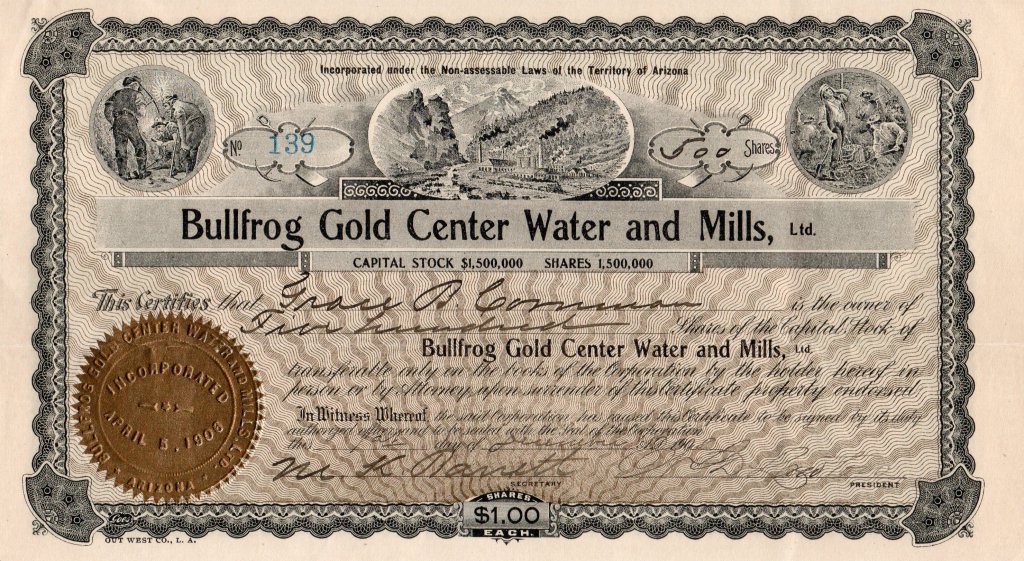
Certificate No. 139, Five Hundred Shares to Grace B. Corman (?). M. K. Barrett, Secretary; W. D. Lawton, President.
Bullfrog Townsite Water and Ice Company
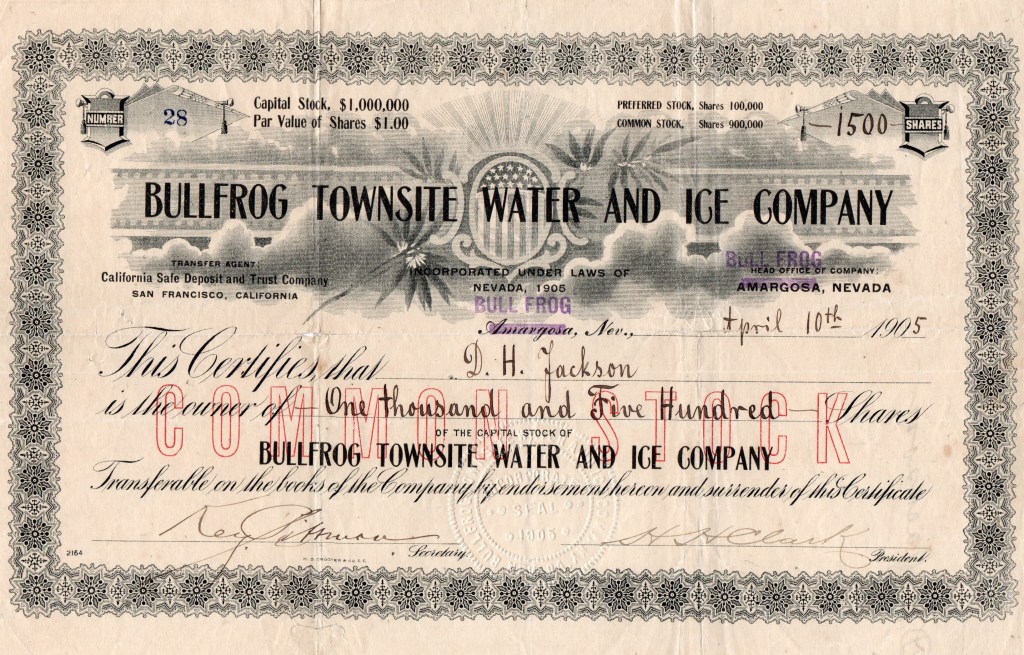
Certificate No. 28, One Thousand Five Hundred Shares to D. H. Jackson, April 10, 1905. Key Pittman, Secretary; H. H. Clark, President.
On August 9, 1904, Frank “Shorty” Harris and Ed Cross staked the Original Bullfrog mining claim, a few miles southwest of what would become the boomtown, and later ghost town, of Rhyolite, Nevada. The Original Bullfrog mine is just inside the boundary of Death Valley National Park, in the area often referred to as the park’s “Nevada Triangle.”
As prospectors and miners rushed to the discovery, the first townsite, Aurum, later named Amargosa, was established in September 1904 near the Original Bullfrog mine. Amargosa quickly grew to have the essentials: grocery, clothing, boots, and mining supply stores, and the Bullfrog Mining District’s recorder’s office – all operating out of tents. The one missing essential was a local water source. Water was carried in by wagon and could be had at $5.00 a barrel.
A second townsite, a bit closer to the mine, popped up by October 1904 and was named Bullfrog – the first of two Bullfrog townsites. Bullfrog had one thing in common with Amargosa – a tent town without a water source.
A third townsite, Bonanza, was established in December 1904, east of Amargosa and south of what would become the city of Rhyolite. Prospecting and mining activities were moving eastward from the Original Bullfrog mine area. The organizers of Bonanza were hoping a central location would prove to be profitable despite also having no local water source.
In March 1905, the Amargosa townsite owners incorporated the Bullfrog Townsite, Water and Ice Company and purchased the Bonanza townsite and integrated Bonanza into their new (and second) Bullfrog townsite. Residents and businesses of Amargosa were given identical lots in the new Bullfrog, and the Bullfrog townsite company paid their moving expenses. The post office that had been established in Amargosa moved to Bullfrog, and with the help of ex-U.S. Senator and Bullfrog resident-lawyer William Stewart, the post office was renamed Bullfrog, Nevada.
The men who were the moving force behind the establishment of Bullfrog, and the founders of the that townsite company were H. H. Clark and future-U.S. Senator Key Pittman. Clark and Pittman heavily promoted Bullfrog by contracting for daily auto stage service from Goldfield, selling water at $1.00 a barrel until a spring-sourced water pipeline was completed, and having telephone and telegraph services to the outside world. Businesses included a newspaper, the two-story Merchants Hotel, several saloons (of course!) and the district’s first bank.
Alas, in 1906 the Bullfrog district was in decline, with residents and most businesses relocating their tents uphill to the booming town of Rhyolite. Bullfrog became just a suburb of the boss town. Just a couple of restaurants, boarding tents, and saloons remained in Bullfrog. One of the last businesses to move was the Southern Nevada Banking Company. In 1907, the bank relocated to the Overbury building in Rhyolite. Finally, the Bullfrog post office was shuttered on May 15, 1909.
All that’s left today of Bullfrog are the resilient foundations of Stewart’s adobe law office, the never-used ice house and the town jail.
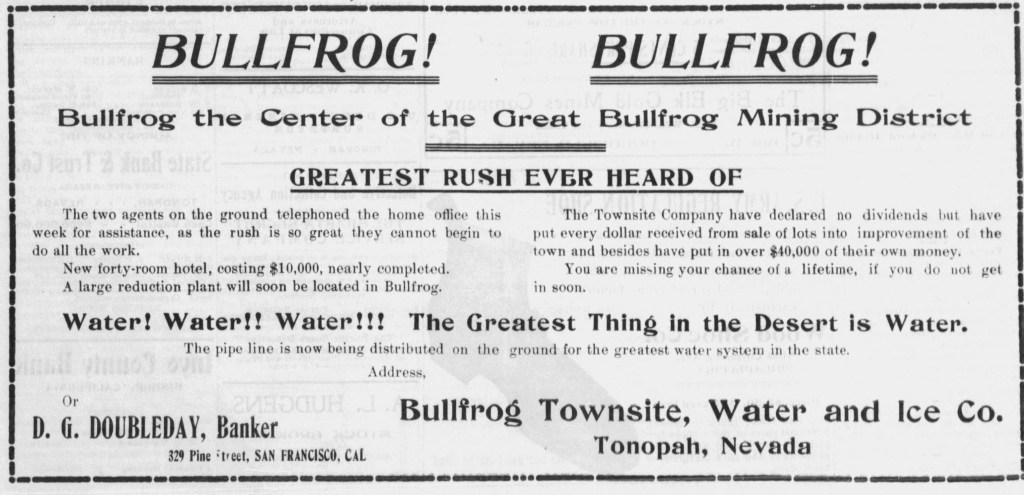
Advertisement, Tonopah Bonanza, April 29, 1905.
Rhyolite Townsite and Mining Company

Certificate No. 672. 500 Shares to Andrew L. Teamer, February 5, 1904. Milton M. Detch, Secretary; Sol Camp, Vice President.
The Bullfrog Water, Light and Power Company
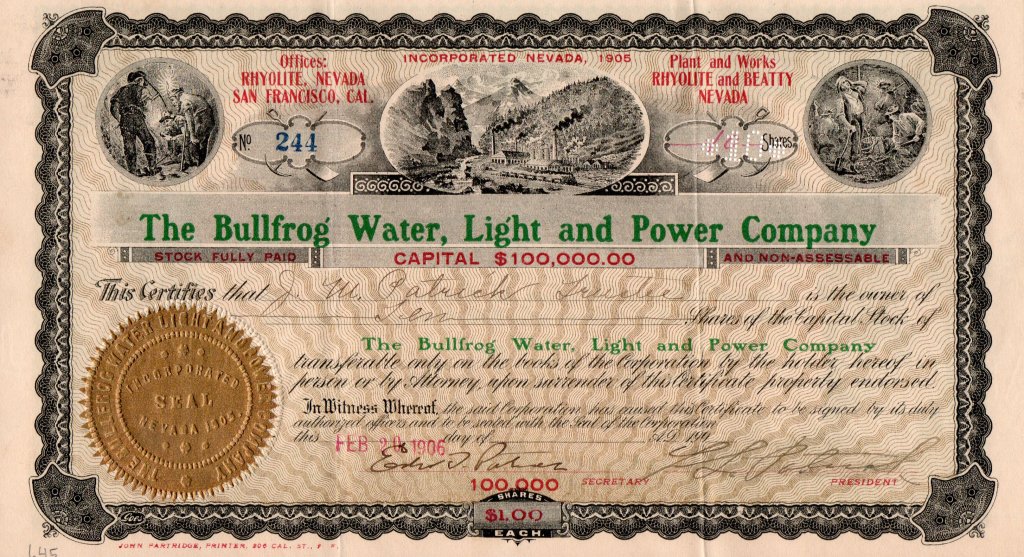
Certificate No. 244, Ten Shares to J. M. Patrick, Trustee, February 20, 1906. Edw. T. Patrick, Secretary; L. L. Patrick, President.
Southern Nevada Consolidated Telephones & Telegraph Company
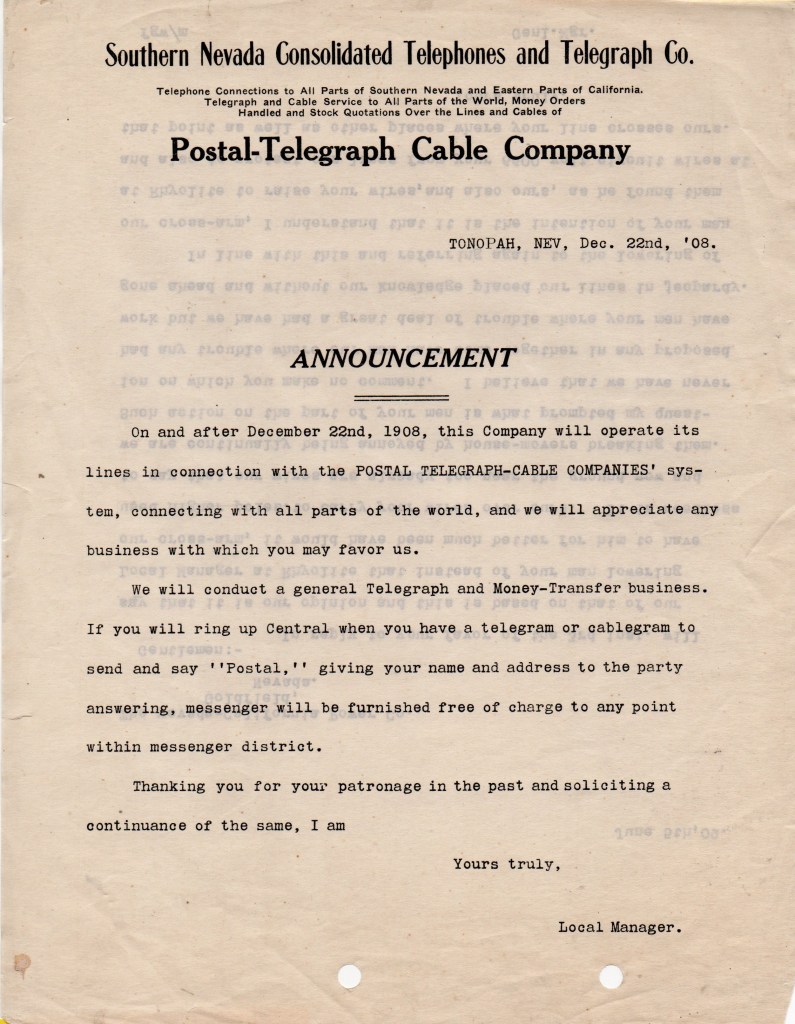
Southern Nevada Telephones & Telegraph Company announcement of world-wide connections via the Postal-Telegraph Cable Company, December 22,1908.
The Southern Nevada Consolidated Telephone-Telegraph Company roots trace back to the early 1900s, when telephone and telegraph lines were first extended from Tonopah to Goldfield in 1904. By 1907, telephone and telegraph service reached Rhyolite, and global communications were available in December 1908.
Nevada – California Power Company
In 1904 a consortium of Nevada and Colorado capitalists formed the Nevada Power, Mining and Milling Company to bring electricity into Tonopah and its booming mines. That same year the company acquired Watson’s Tonopah Light & Power, immediately extending transmission lines into Rhyolite, Goldfield, Silver Peak, and isolated camps in Inyo County, California.
In January 1907 the Nevada Power was reorganized as the Nevada–California Power Company. This new entity absorbed all local power providers in southwestern Nevada by 1912. In 1916, electricity to Rhyolite was turned off. Nevada–California was acquired by Southern California Edison in the 1920s.
General Businesses
H. D. and L. D. Porter, General Merchandise of Rhyolite

Bank Check No. 3285, Two Dollars and Fifty-Two Cents, Payable to [Illegible], July 21 (?), 1917, Drawn on Account at the First National Bank, Los Angeles.
The H.D. & L.D. Porter General Merchandise Company was a key commercial fixture in Rhyolite. Founded by brothers Hiram D. Porter and Louis D. Porter, the business operated as a wholesale and retail general store, supplying goods to miners and residents in Rhyolite and other desert towns like Ballarat, Beatty, and Pioneer.
The Porters were seasoned entrepreneurs who followed the mining rushes across the Mojave and Death Valley regions. One account describes Hiram Porter loading thirty tons of merchandise onto an 18-mule team freight wagon in Ballarat and hauling it across Death Valley to the Bullfrog District.
As Rhyolite was depopulating after the demise of the Montgomery-Shoshone, the Rhyolite Herald reported on May 7, 1910, “The entire $25,000 stock of the H. D. & L. D. Porter is to be sold in seven business days at prices never before witnessed in this section of the country. Biggest sale ever in Rhyolite.” It’s not known when exactly the Porter’s Rhyolite store closed. H. D. Porter was among the last residents of the town, as he served as postmaster when the Rhyolite post office closed on September 15, 1919.
United States Post Office – Rhyolite, Nevada
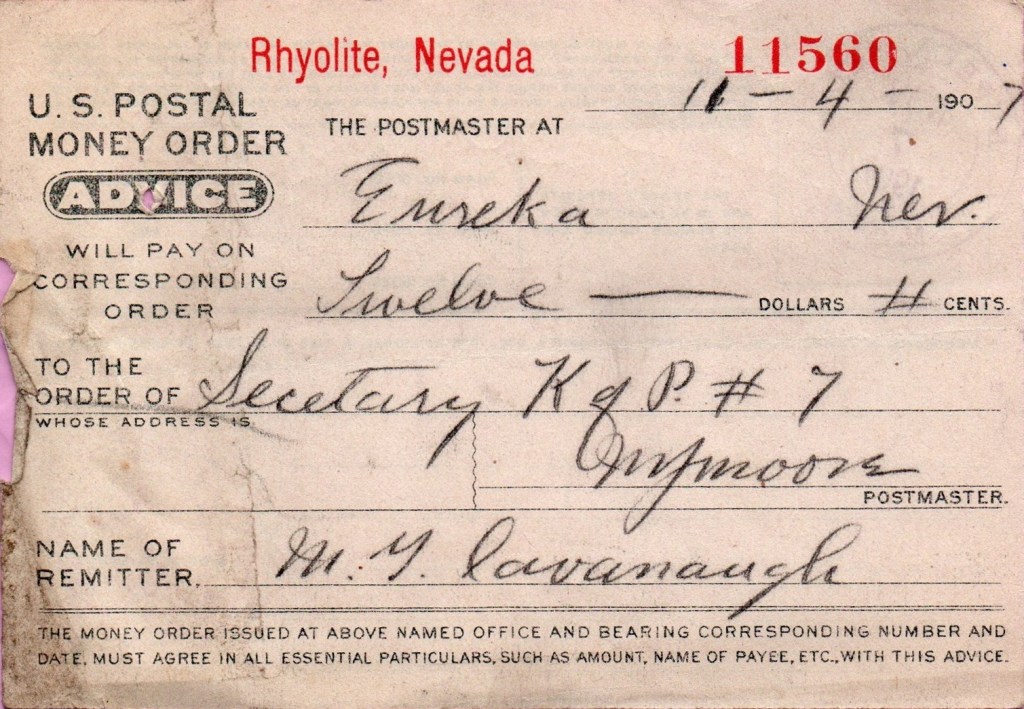
U. S. Postal Money Order Advice No. 11560, Rhyolite, Nevada, Twelve Dollars, November 4, 1907. M. J. Cavanaugh, Remitter; Payable to Secretary, K. of P. (Knights of Pythius) #7, Eureka, Nevada; M. (Michael) J. Moore, Postmaster.
The U. S. Post Office in Rhyolite, Nevada opened on May 19, 1905, operating out of a ten-by-twelve foot tent on Golden Street. The post office soon outgrew the tent and was re-established in a frame building on Broadway. In July 1908, the post office moved to the 30 ft. x 70 ft. basement of the John S. Cook Bank building. According a report in the San Pedro News Pilot, the post office closed on December 15, 1913, with mail addressed to the few remaining Rhyolite resents sent to the post office in Beatty, Nevada.
Famous Players-Lasky Corporation of California
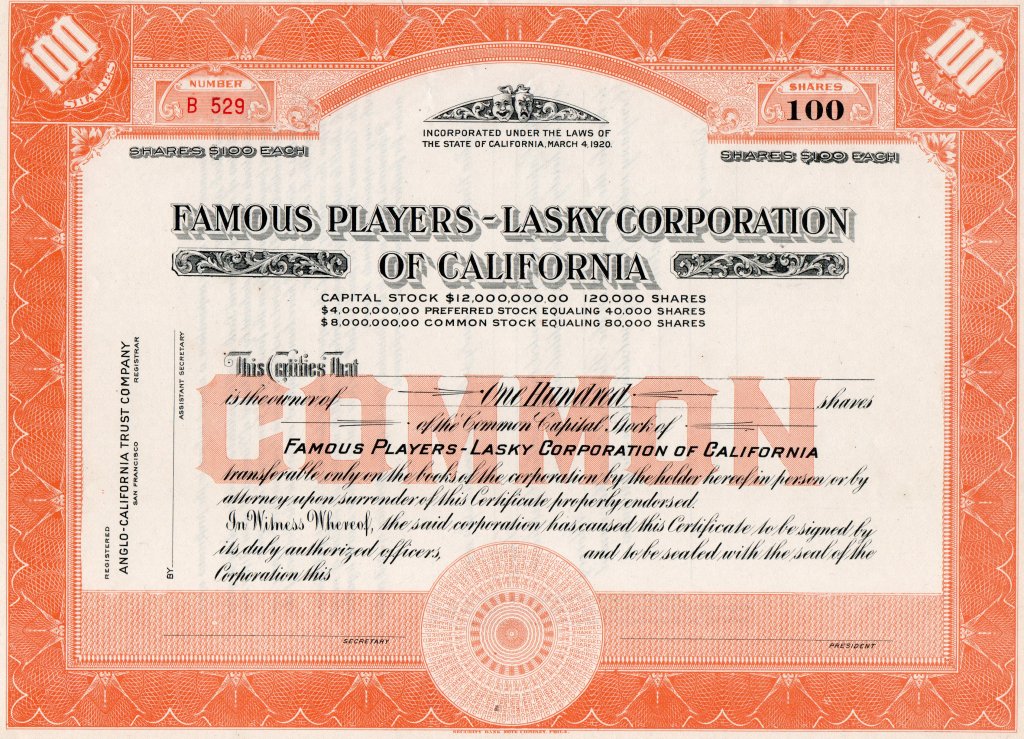
Certificate No. B529, One Hundred Shares, Unissued.
In 1925, the Famous Players–Lasky Corporation produced the silent film, “The Air Mail,” starring Warner Baxter, Billie Dove, and Douglas Fairbanks, Jr. The connection to the Death Valley region? The production was filmed at, and in the clouds above, the ghost town of Rhyolite.
The Famous Players – Lasky Corporation was formed on June 28, 1916, from the merger of Adolph Zukor’s Famous Players Film Company and the Jesse L. Lasky Feature Play Company. Famous Players–Lasky was one of the biggest movie producers in the silent film era. In 1927, the company name was changed to Paramount Famous Lasky Corporation.
To make “The Air Mail,” the Famous Players–Lasky cast and crew traveled by train to Beatty. A temporary headquarters was established on January 10, 1925. The aircraft used in the film arrived from Reno via Tonopah. Stunt pilot Frank Tomlck was hired to do the actual flying in the film, eschewing the use of sound stages or studio effects. Famous Players–Lasky used the Rhyolite Bottle House as a filming set. The film crew tore down the rear wall of the Bottle House so filming could take place inside the building. After wrapping up, the company rebuilt the wall and did basic stabilization and restoration work on the exterior. Filming was completed by the end of January.
Only four of eight reels of a single print of “The Air Mail” exist today at the Library of Congress in Washington, D.C.
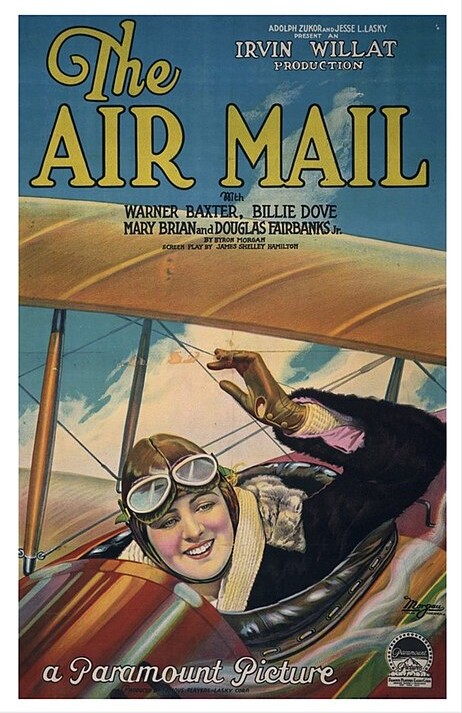
Theater Poster, “The Air Mail“

Aerial Publicity Photo for “The Air Mail.” The caption pasted on the back of the photo reads: “Rhyolite, Nevada, former boom town with a permanent population of 10,000 is now a deserted city with but one inhabitant. Rhyolite was the scene of many sequences in ‘The Air Mail’ which Irvin Willat produced for Paramount. Sixty players headed by Warner Baxter, Billie Dove, Douglas Fairbanks Jr., and Mary Brian were in camp at this spot for more than a month. This photograph was made from an air mail plane with Burr H. Winslow as pilot. Winslow, ace of the air mail service, was loaned by the Government to Paramount for the making of the picture.”
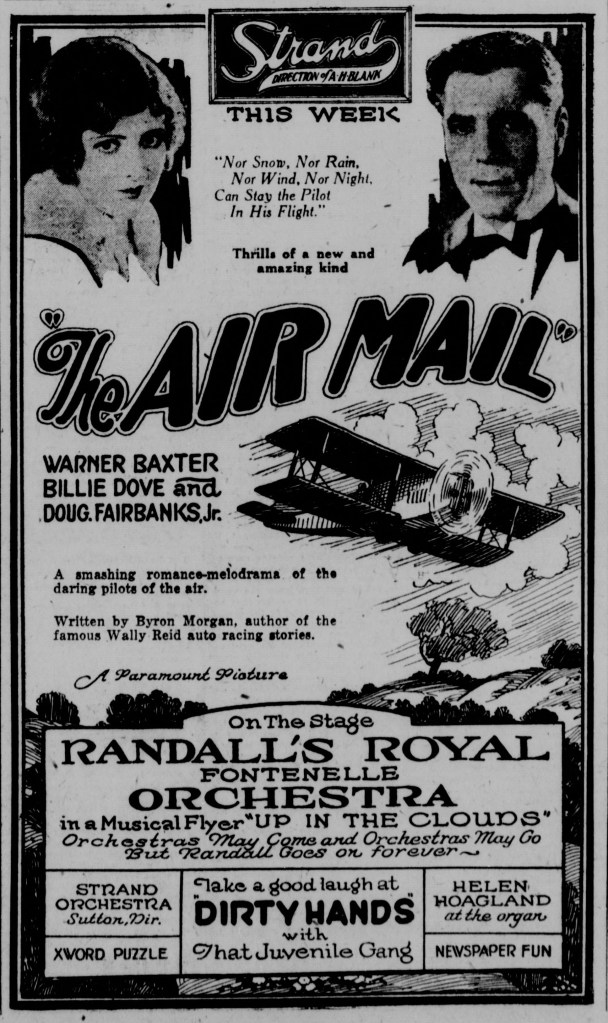
Advertisement for The Air Mail, The Sunday Bee, Omaha, Neb., March 29, 1925.
 Death Valley Mining History - Thru Scripophily