The ghost town of Leadfield has become identified in western mining lore as an example of fraud, deception and deceit at its worst. Located in Titus Canyon about twenty-two miles west of Beatty, Leadfield boomed briefly in 1925 and 1926. The extensive promotion which surrounded the camp, the unsavory character of its chief promoter, and the swift and sudden demise of the boom has led to unkind treatment at the hands of popular writers of western history. There was one positive remnant from the district we can enjoy today: a well-constructed road up and over Red Pass, through Titus Canyon, exiting into Death Valley.
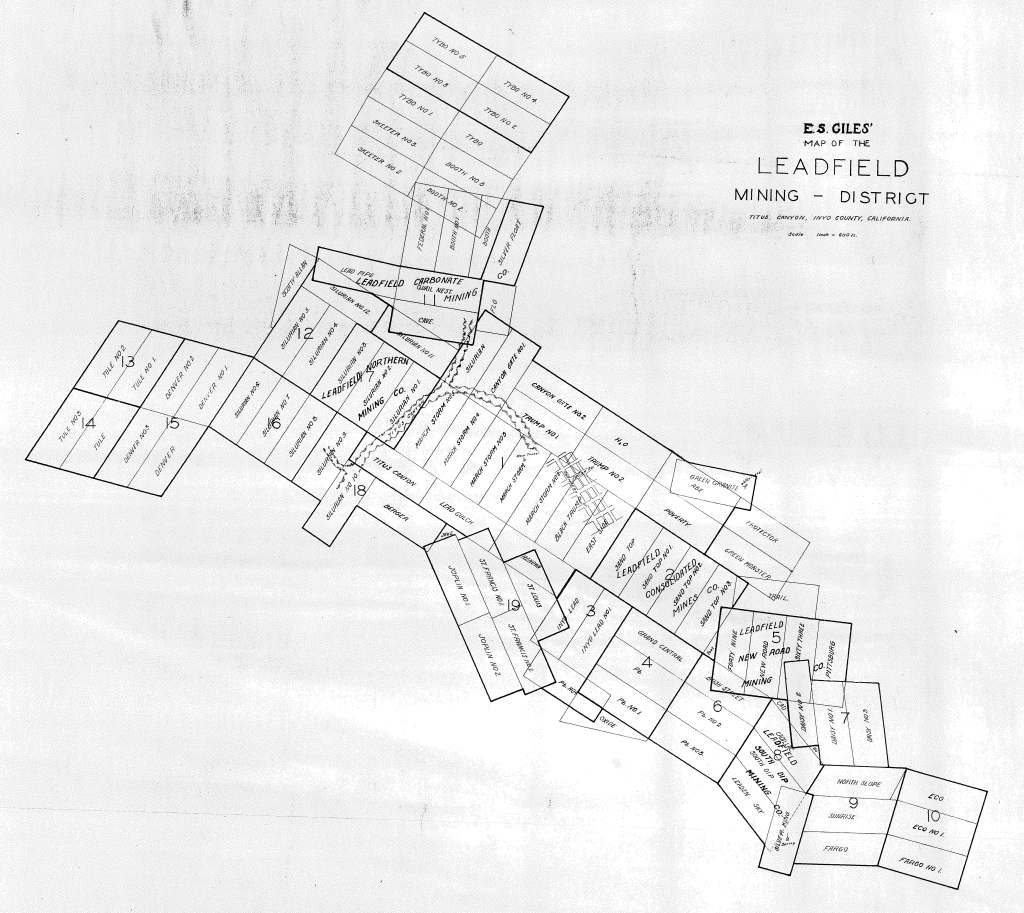
Map of Mining Claims and Mining Companies in the Leadfield District, E. (Edwin) S. (Schofield) Giles, Goldfield-Based Mining Operator.
Death Valley Consolidated Mining Company

Certificate No. 28. Five Hundred Shares to J. Lukov, March 19, 1906. Clay Tallman, Secretary; W. H. Seaman, President.
The mining history of Leadfield, at the upper reaches of Titus Canyon, began in 1905. During the early days of the Bullfrog boom, most of the surrounding territory was examined by hopeful prospectors. In the fall of 1905, W. H. Seaman and Curtis Durnford staked out nine lead and copper claims in the canyon. They brought samples of ore into Rhyolite that assayed as high as $40 to the ton. The prospectors were soon bought out by a consortium headed by Clay Tallman, a local attorney and promoter, and the Death Valley Consolidated Mining Company was incorporated. The company immediately began a development and promotional campaign, and shares of its stock were sold for 2-1/2 cents each. As the company went to work, and the initial prospects looked encouraging, the price of the stock rose to 4-1/2 cents on the local exchange.
By May of 1906, Death Valley Consolidated had progressed far enough to start taking out its better ore for shipment to the smelters. The company soon realized, however, that the long and arduous trip between the mine and Rhyolite, and the high freight rates prevalent between Rhyolite and the far-off smelters, made the shipment of its ore unprofitable. As a result, the company ceased operations, and after a brief six-month-long life span, the Death Valley Consolidated Mining Company disappeared.
Company Secretary Clay Tallman went on to successfully recover depositor funds after the failure of the Bullfrog Bank and Trust Company in 1908. He was later appointed Commissioner of the General Land Office by President Woodrow Wilson. Tallman served in that position from 1913 to 1921. In 1946, the General Land Office and the Grazing Service were combined to form the Bureau of Land Management, within the Department of the Interior.
Almost twenty years after the demise of the Death Valley Consolidated Mining Company, the Titus Canyon lead claims were resurrected and formed the basis of C. C. Julian’s Western Lead Mines swindle.
Western Lead Mines Company
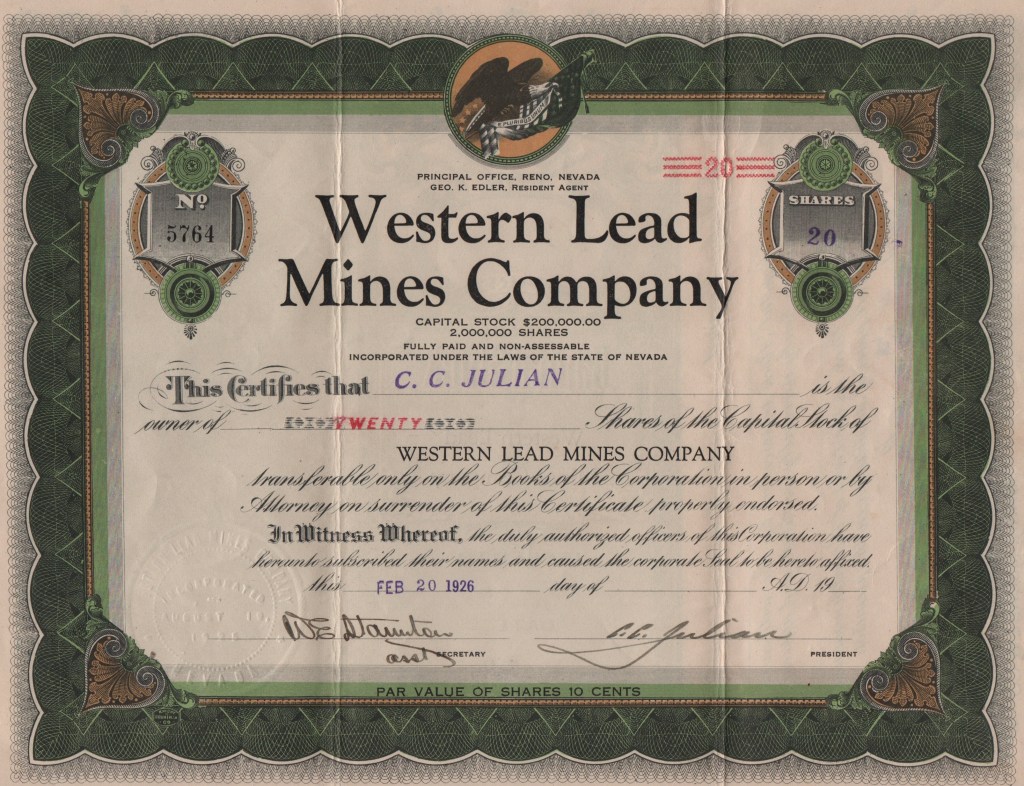
Certificate No. 5764. Twenty Shares to C. C. Julian, February 20, 1926. C. C. (Courtney Chauncey) Julian, President; W. E. Staunton, Asst. Secretary.
The ground at Leadfield, at the head of Titus Canyon, had been claimed for lead and copper deposits as early as 1905, during the Bullfrog boom. By 1906, some high-grade ore had been shipped, but the remaining deposits were too remote to justify further development.
In March 1924, prospectors Ben Chambers, L. Christensen and Frank Metts returned to the area, staking and working numerous claims for a year, before selling out to promoter John “Jack” Salsberry. Salsberry was known in the Death Valley region since the Bullfrog days. He was a promoter of Ubehebe District mines and the Carbonate Mine on the east side of the Panamint Mountains. Salsberry purchased twelve claims for the Titus Canyon prospectors formed the Western Lead Mines Company. The number of company’s claims eventually grew to over fifty.
As 1925 ended, he had increased the number of claims owned from the original twelve to more than fifty. Eighteen men started building an automobile road out of the canyon. Workers added a boardinghouse and pipeline from Keane Spring by January 1926, the same month that Leadfield received its name. Six mining companies operated in the town, and shares in the Western Lead Mines Company sold for $1.57 each.
As Leadfield prospered, C. C. Julian, who became president of the Western Lead Mines Company, arrived. A flamboyant oil promoter from the Los Angeles area, Julian was already deeply immersed in the town’s biggest financial scandal in the 1920s, an oil-stock swindle, and he sought refuge in the desert. In his Colorful style, he advertised the sale of stock in a venture he called Jazz Baby, manipulating the value of the stock on the Los Angeles Stock Exchange. To increase investor interest, Julian often brought visitors to Leadfield. They typically came by train from Los Angeles to Beatty and then traveled the final fifty miles over his newly completed road from Rhyolite to Titus Canyon. Julian gave potential investors an outdoor feast, with an orchestra playing in the background, and then offered a mine tour. As March 1926 ended, he had sold more than three hundred thousand shares of company stock, at an average of $3.30 a share.
Then the California State Corporation Commission began investigating Julian for selling stock without a permit. At the same time, Leadfield investors learned that one of the richest lead veins had bottomed out, heralding the town’s end. In January 1927, the post office closed, and the community became a ghost town. Julian moved to Oklahoma but faced an indictment there for mail fraud in 1933. He fled to Shanghai, China, where he committed suicide a year later at the age of forty. His legacy, the Titus Canyon Road, built at an estimated cost of $50,000, heralded a future that promised better access to the outside world for everyone in Death Valley.

Leadfield New Road Mining Company
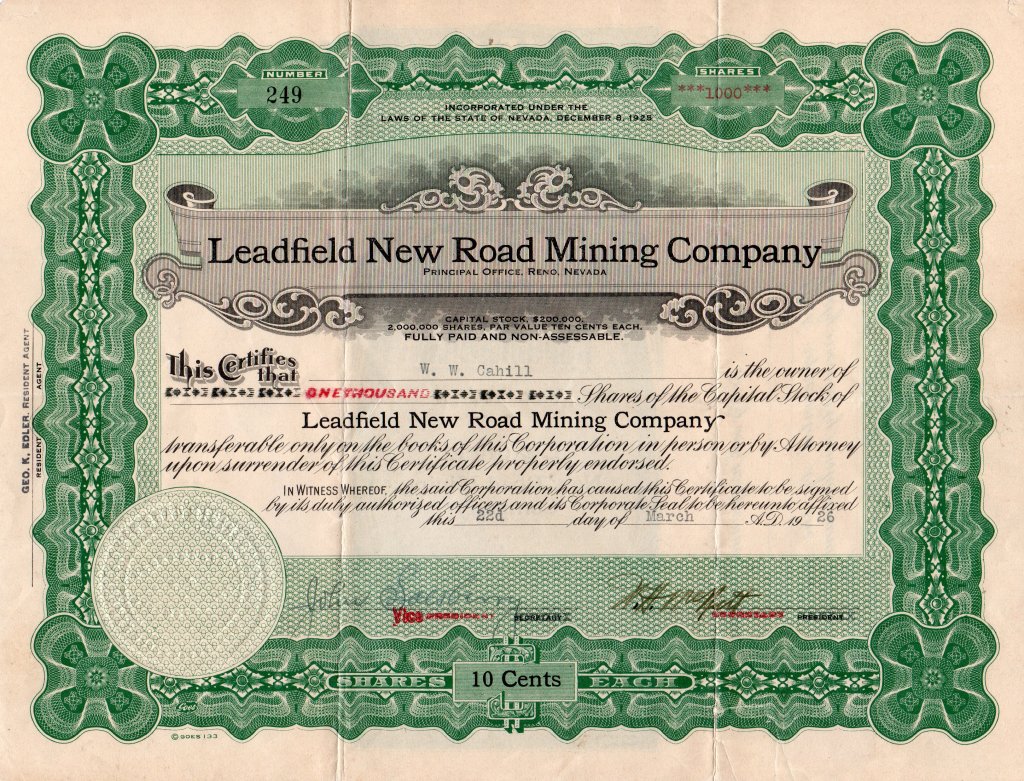
Certificate No. 249. One Thousand Shares to W. W. (William Washington) Cahill, March 22, 1926. John Salsberry, Vice President; W. H. McNutt, Secretary.
Western Leadfield Mining Company
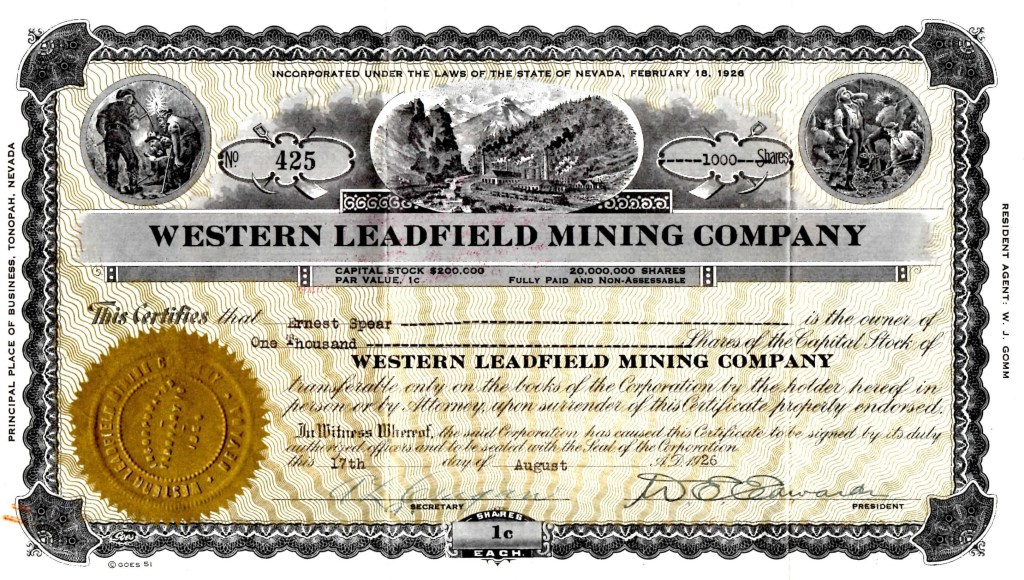
Certificate No. 425. 1,000 Shares to Ernest Spear, August 17, 1926. D. S. Edwards, President; A. L. Cougan, Secretary.
In February 1926, the Western Leadfield Mining Company was created. The capitalization was a paltry $200,000 (20,000,000 shares at 1 cent par), with shares offered to the public in Denver at 1-1/4 cents. The Mines Handbook of 1926 stated that the company had four claims in the Leadfield District and one leased claim in the Royston District, about 30 miles northwest of Tonopah. There is no information that the company attempted to operate at Leadfield. The Royston lease was relinquished early in 1927.
The Standard Stock Offering Service reported that 5,000 shares of Western Leadfield Mining were offered for sale by the Denver Brokerage Co. at 1/4-cent each in July 1927 but found no takers. Since the Marvyn Scudder Manual of Extinct or Obsolete Companies – 1930 noted that the company’s Nevada corporate charter was forfeited on July 1, 1927, for non-payment of taxes, it would have been a definite hard-sell for those 5,000 shares.
 Death Valley Mining History - Thru Scripophily