The American Carrara Marble Company
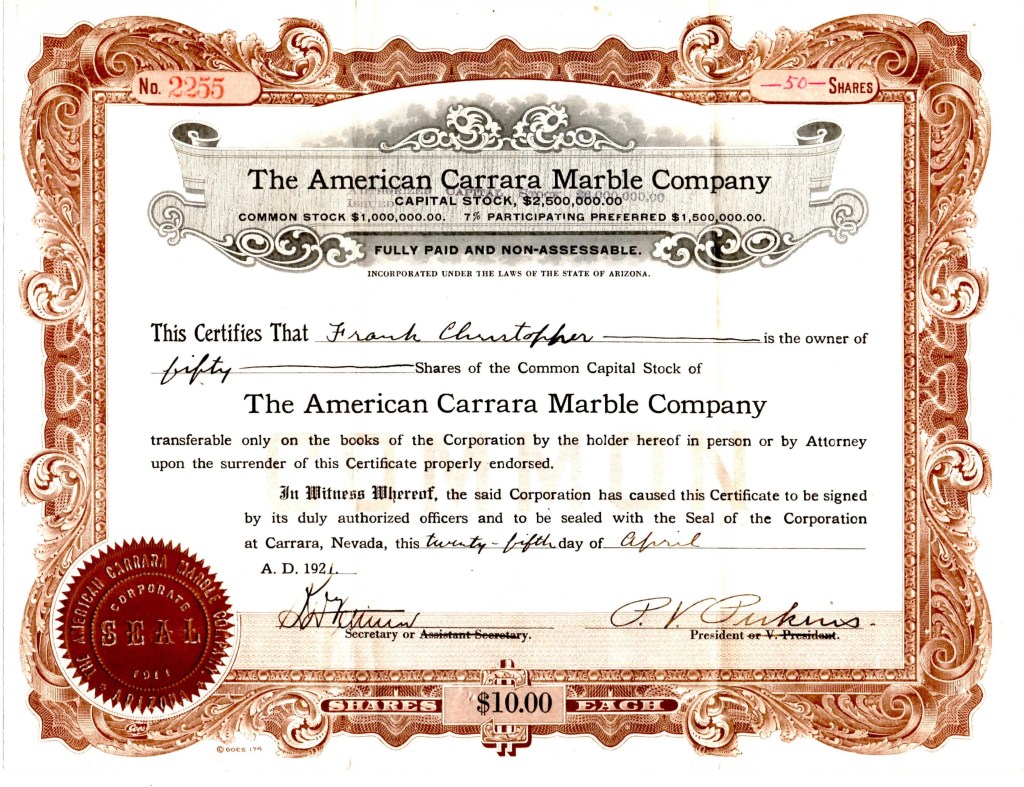
Certificate No. 2255, Fifty Shares to Frank Christopher, April 25, 1921. [Illegible], Secretary, P. (Park) V. Perkins, President.
Bare Mountain lies east of Death Valley, on the eastern margin of the Amargosa Valley. In December 1905, Nels Linn, a former stone-cutter, discovered a massive formation of white marble on Bare Mountain, about a dozen miles south of Beatty. Linn declared that the marble was as fine as the world-famous marble sourced from Carrara, Italy.
By 1908, Vermont-raised and M.I.T.-educated stockbroker Park V. Perkins visited the deposit and bought up the areas’ marble claims. He founded The American Carrara Marble Company and set to work raising funds from Ohio financiers to extract the estimated 10 billion cubic feet of commercial marble. The best thing going on for Perkins was the relatively short three-mile distance to the Tonopah & Las Vegas Railroad line. Otherwise, things didn’t go so well.
Perkins opened two quarries on Bare Mountain and graded a haul road down to the L V& T in Amargosa Valley. He organized the townsite of Carrara, Nevada, published the Carrara Obelisk newspaper, and on May 8, 1913, hosted a railroad excursion for Los Angelinos to show off his townsite and quarries.
Up at those quarries, Perkins had his miners drilling and sawing out so much fractured marble, that by April 1914, only one carload of 200 cubic feet was shipped to Los Angeles. Later that summer, fire destroyed the electrical system’s transformers, stopping work until January 1915.
At 100 feet down in the main quarry, the marble condition had improved such that Perkins built a gravity cable railway down to a finishing plant near the L V & T. Just as things were starting to improve, the California-Nevada Power Company turned off the electricity south of Rhyolite, putting Carrara in the dark. Just after finishing a diesel electric generating plant to resume operations, that plant burned down. Power was ultimately restored in time to find out that the marble was too highly fractured for commercial use.
Over $1.1 million was invested in the failed venture. Without a watchman to keep an eye on things, the town’s buildings, sheds, and shacks found their way to Beatty. Today, you can find the remains of the townsite’s foundations and marble water fountain off U.S. Highway 95, and the silent quarries up on Bare Mountain.
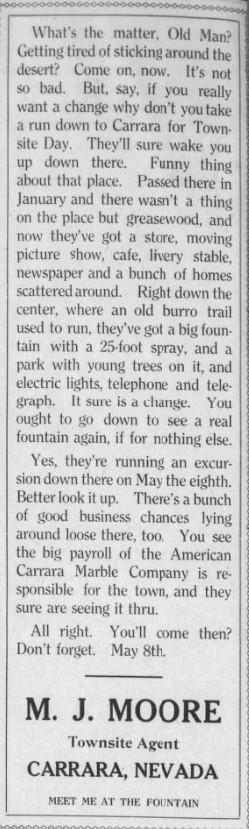

Advertisements, Tonopah Daily Bonanza, May 5, 1913.
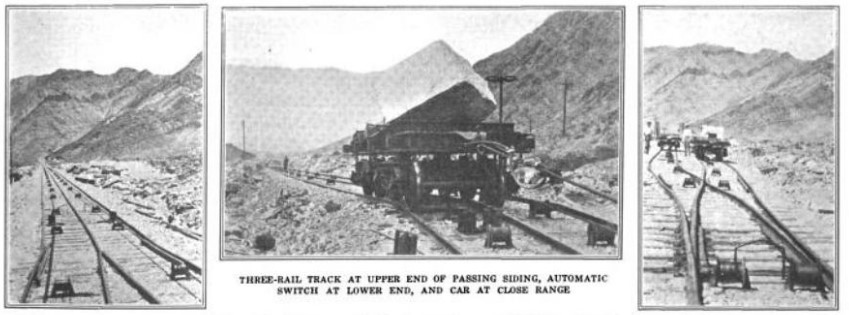
Photographs of the Carrara Gravity Railroad, Engineering Record, September 16, 1916.
Gold Ace Mining Company

Certificate No. 764, Five Hundred Shares to H. Z. Peters & Co., April 25, 1929. J. Collar, Asst. Secretary; G. Ray Boggs, President.
The Gold Ace Mining Company was incorporated on May 25, 1928, by G. Ray Boggs, a mining engineer and manager of clay quarries in Amargosa Valley. Boggs optioned an old, low grade mine, the Bull Moose, two miles north of the abandoned Carrara camp.
According to Aviation Magazine of October 19, 1929, Gold Ace Mining purchased a six-person, single engine, “Sunbeam” biplane from Commercial Aircraft Corp., Ltd., of Van Nuys, Calif. Boggs graded a landing strip, and transported the first gold bar produced from the mine to Los Angeles via the Sunbeam.
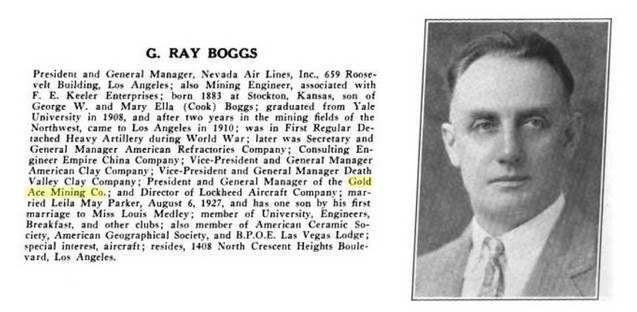
G. Ray Boggs Biography, Who’s Who in Los Angeles County, 1929.
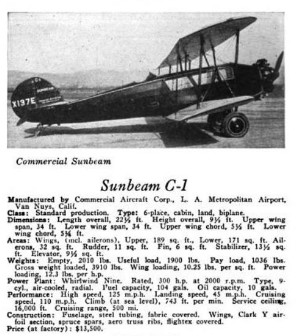
Sunbeam C-1 Airplane Specifications, Western Flying, September 1929.
Amargosa Mining and Leasing Company
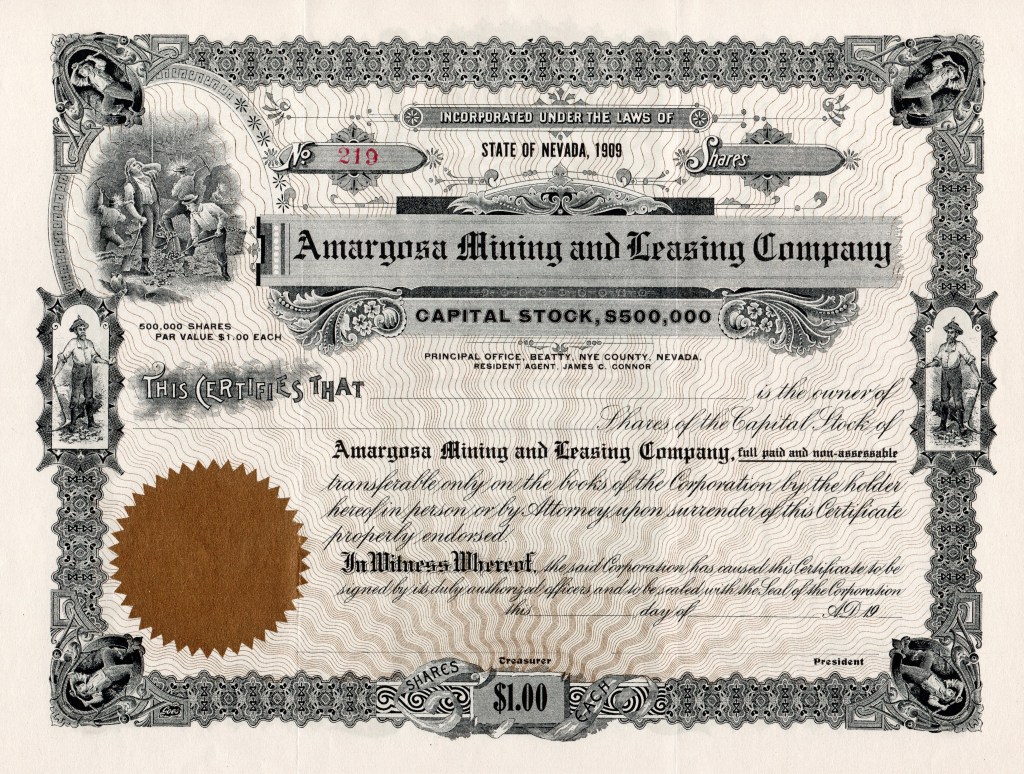
Certificate No. 219, Unissued.
All we know about this company is that it was incorporated on September 30, 1909, with an office in Beatty, Nevada. The company appeared on the Nevada Secretary of State’s biennial listing of corporations up to 1913, but no further information was located.
 Death Valley Mining History - Thru Scripophily