Ballarat and Panamint City
Inyo Consolidated Mining & Milling Co. of California
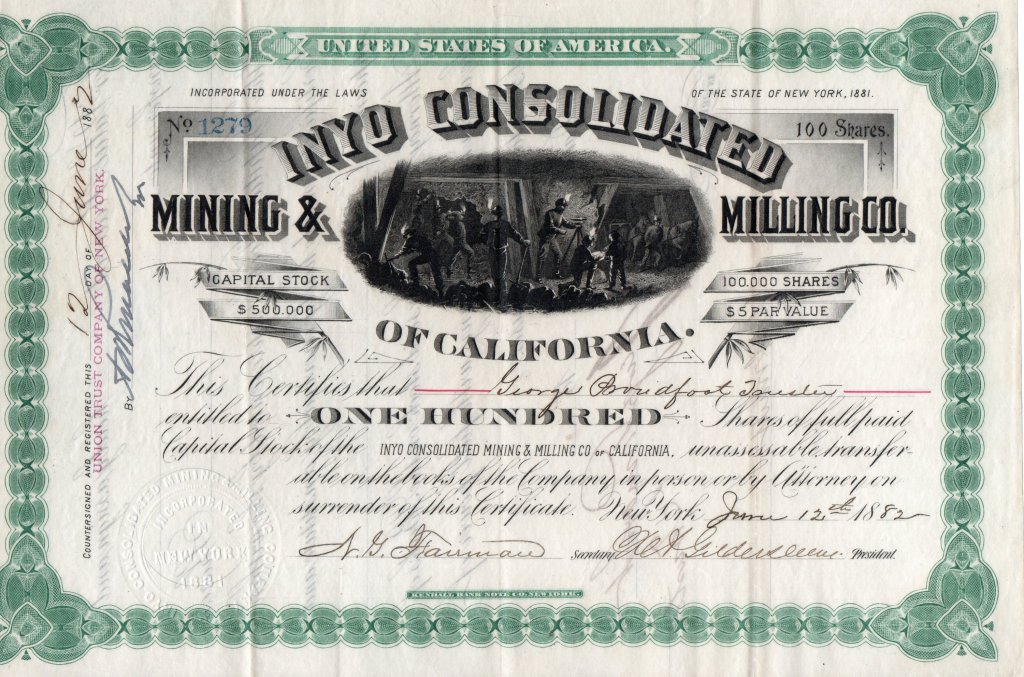
Certificate No. 1279. One Hundred Shares to George Proudfoot, Trustee, June 12, 1882. Nelson G. Fairman, Secretary; H. A. Gildersleeve, President.
Ballarat Gold Mining Company
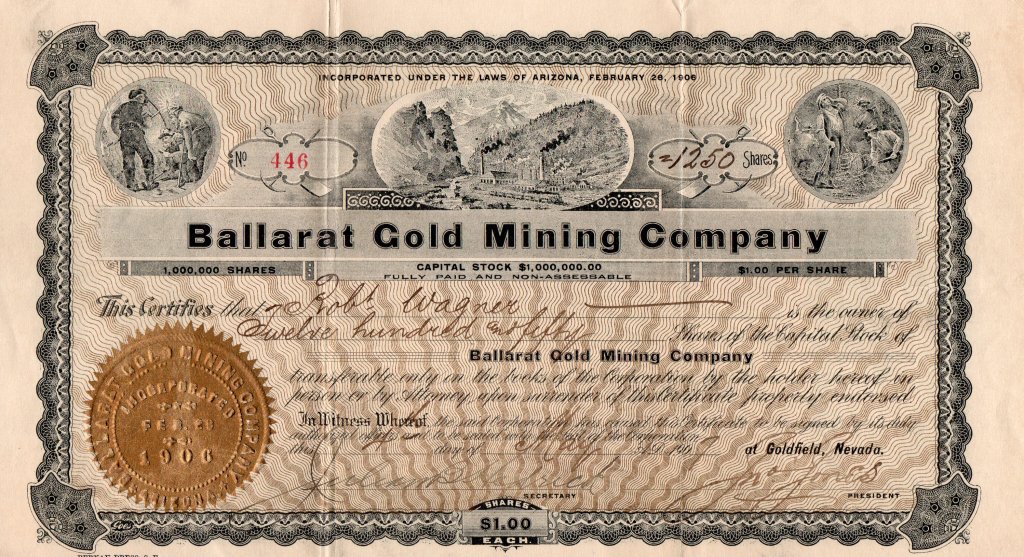
Certificate No. 446. 1,250 Shares to Robert Wagner, May 4, 1907. John (“January”) Jones, President; Julian B. Hedrick, Secretary.
In the closing days of the 19th century, a miner named Phil Ginser discovered a nice pocket of high-grade gold ore in the Ballarat district, not far from Mineral Hill. Ginser worked the lode for a year or so, sending small batches of select ore to the custom mills at Ballarat. But by the summer of 1900, Ginser grew tired of manual labor and headed for Salt Lake City to play the “dying miner” con. There, within three weeks, claiming he was “wasting away under the dreadful effects of consumption,” Ginser unloaded his little prospect on prosperous furniture store owner, Charles Freed, and retired with $10,000 in cash – some said $50,000. Freed incorporated the Ballarat Gold Mining Company in Utah with a capitalization of $500,000 on July 30, 1900. Freed then sent mining engineer, Fred H. Vahrenkamp, to the mine to put up a thirty-, or even forty-stamp mill. But after taking out what little high-grade Ginser had left, Vahrenkamp advised Freed not to waste another cent.
Vahrenkamp, however, realized that there was easier money in promoting gold mining stock than in mining gold. He saw potential in the original Ginser mine, which the Ballarat Gold Mining Company had abandoned by 1903. He formed the Gold Crown Mining Company in the summer of 1903 to reopen the mine and put up a mill and tramway the following spring. He apparently got rid of his stock before the other stockholders discovered that there was nothing left in the mine that was worth going after.
Apparently, while Ginser’s mine was now worthless, the mine’s name still held value. On February 28, 1906, notorious Nevada mining promoter John “January” Jones incorporated a new Ballarat Gold Mining Company in Arizona with a $1 million capitalization. Soon the promotions began. “I Am on the Ground at Goldfield ··· Follow Me and Win ··· Follow Me Into Ballarat ··· Buy Shares In Gold Mining Company at 15 Cents ··· I respectfully urge you to act at once in this extraordinary investment offering.”
Disregarding Ginser’s and Freed’s location, the new company operated the Scotchman, Shooting Star and Comet lodes, and the Scotchman mill, about five miles south of Ballarat in the Panamints. By October 1908, the company applied for patents on their mines and mill – and that’s the last report we hear about the company. Perhaps Jones and his co-promoters had mined the pockets of their investors until those lodes went bust.
On October 10, 1915, The Financial World reported: “January Jones Bobs Up Again. In 1907 January Jones was a conspicuous figure in the sordid mining promotion circles of New York City. That was before the post office authorities began to use a stiff broom to clean all the fakers out… This record alone would rob a person of the confidence of investors, but not with ‘January’ Jones. Evidently, he has figured that the memory of people is short, and they will not recall at this late day, his early and vicious mining schemes, so he has started up in a modest way again in Goldfield, Nev. … If investors will give Jones the cold reception his prefix suggests they will be money in and not money out.”
Pleasant Canyon Development Company
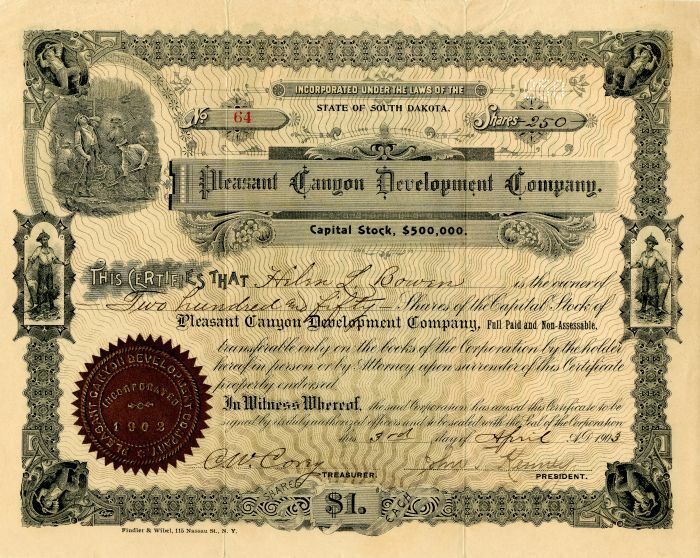
Certificate No. 64, Two Hundred Fifty Shares to Helen L. Bowen, April 3, 1903. C. W. Corey, Treasurer; John T. Kenney, President.
The Inyo Independent of August 22, 1902 reported that John T. Kenney transferred his real property holdings to the Pleasant Canyon Development Company at Ballarat, California, earlier that month. However, the next we hear of the company is the newspaper reporting in June 1903, that the company was delinquent on its property taxes for its Cooper No. 1 & 2 mines and its a four stamp quartz mill. That’s the last we know of the company.
Snow Canyon Mining & Milling Co.*
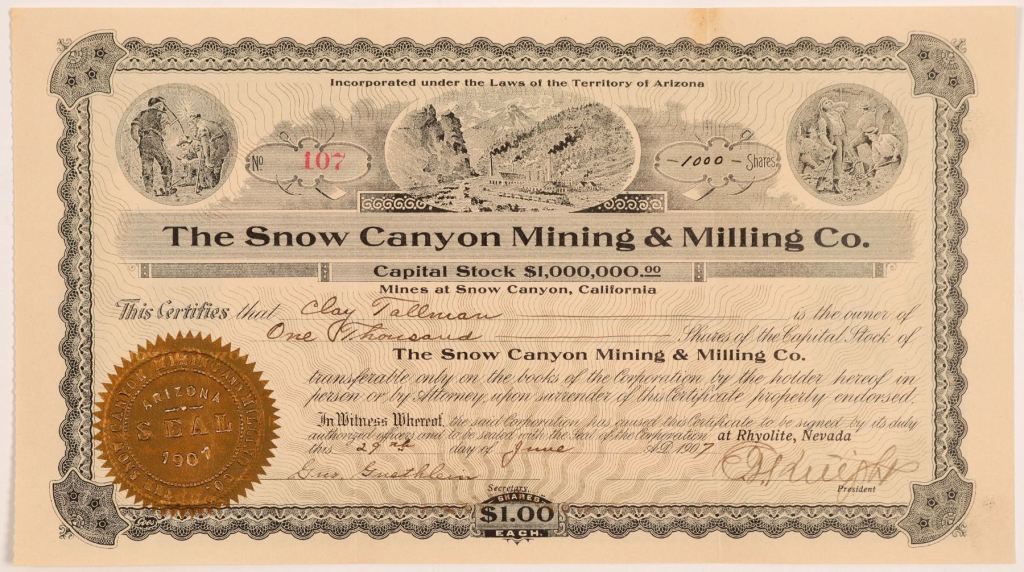
Certificate No. 107, One Thousand Shares to Clay Tallman, June 29, 1907; Gus. Guethlein, Secretary, E G. Knight, President.*
Snow Canyon is located in the Argus Range, west of Panamint Valley and Ballarat, California.
The Mining Investor of June 8, 1908, conveyed a report from the manager of Snow Canyon Mining. The company had completed a half-mile road to the access the New Year, Oro Fino, and Owl Claims. A cookhouse, dining room, bunk house, blacksmith shop, hay shed, office and mill had been constructed. Promising assays were reported, and the company had a little over $1,000 cash on hand.
There were no subsequent reports regarding Snow Canyon, and the company was likely a victim of the financial panic of 1907.
American Silver Corporation
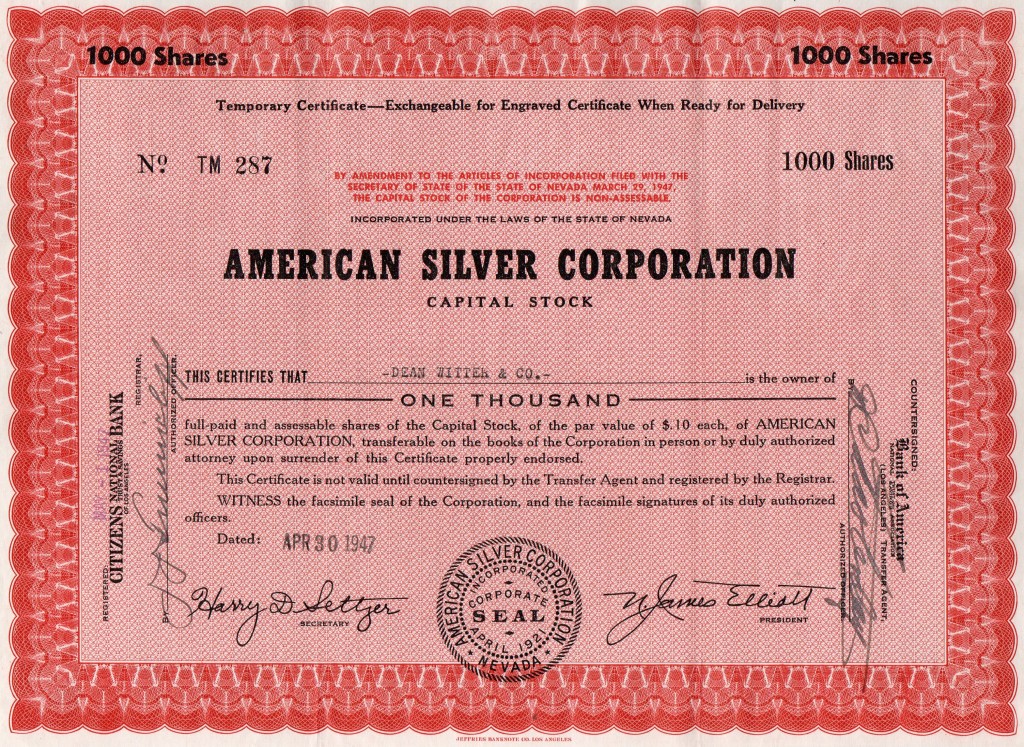
Temporary Certificate No. TM270. One Thousand Shares to Dean Witter & Co., April 30, 1947. Harry D. Settzer (?), Secretary; N. [Nathan] James Elliott, President.
The American Silver Corporation leased 12 patented claims, 4 patented millsites, and 42 unpatented claims in the Panamint City area in 1947-1948. Nathan James Elliott, a movie press agent, established the company to commence a “get-rich-quick” scheme involving the long dormant mines. Elliott spun a sumptuous verbal web that entrapped many of the film capital’s finest, aided by the company’s vice president and comedian Ben Blue, a silver-tongued promoter. The company built a camp at Panamint, improved the Surprise Canyon road, and initiated efforts to promote the “Consolidated Panamint Silver Mining Company” on the New York Stock Market, reportedly raising $1,000,000 before the District Attorney of New York County took action to quash the fraudulent scheme. As a result, the company reported no shipments before filing bankruptcy on March 22, 1948. During the mid-1950s, the American Silver Company reopened the road up Surprise Canyon to Panamint City preparatory to some mining activity, and in the 1970s mining activity was renewed for a time at Panamint, but faulting in the elusive veins would make them difficult to follow.
Don-Clare Mining Company

Certificate No. 11. Five Hundred Shares to William E. & Anna Thorne, and Harvey W. & Marion Conn, as Joint Tenants, January 28, 1956. James L. Gaylord, President; Mary Karp, Secretary.
This certificate was obtained from the Holabird Americana auction house of Reno, Nevada. Owner Fred Holabird, former mining geologist, related information about the Don-Clare Mining Company. Fred’s story, and information gleaned from additional research, illustrates how over time, memories may not always jibe with written, reported information:
Mr. Holabird recalled that he met Don Clare and his wife sometime around 1978 at Clare’s very-remote prospector cabin in southern Clark County, Nevada. The Clare’s were anti-government folks and wanted to maintain a low profile. Don Clare owned mining claims at Ballarat and elsewhere in Inyo County. However, Holabird, as a mining geologist, was made to feel very welcome.
Holabird was told by Don that he owned property at Ballarat, the green bunkhouse that used to be a cookhouse. But the people living there were followers of Charles Manson. Don told Holabird to be very careful, and to mention Don’s name first thing if Holabird were to visit the bunkhouse while in the Ballarat area. While investigating the World Beater mine and ore complex in the Panamint mountains, Holabird had the opportunity to visit the bunkhouse. He was greeted with a rifle pointed at his face by a guy named “Spider.” We assume that upon mentioning Don Clare’s name, the rifle was lowered and Holabird survived the encounter.
Our subsequent research into the history of the Don-Clare Mining Company led to information held by the Nevada Historical Society. Their records indicate that a Donald Finlayson (“Don?”) was a principal Don-Clare shareholder and that Clarence (“Clare?) A. Thorne was Don-Clare’s general manager. Mary Karp, the Don-Clare secretary on the stock certificate, was also described as a principal shareholder. Don-Clare owned and operated a tungsten mine in the Nevada’s Rawhide mining district in the mid-1950s.
Information gleaned from the westernmininghistory.com website reports that the “Thorn Property,” previously known as the Don-Clare mine, was last active in 1976 as an open pit operation.
So, it’s likely that Fred Holabird met Donald and Mrs. Finlayson at their cabin, and Donald Finlayson may have had claims in the Panamints near Ballarat. We have no doubt that the memory of “Spider” pointing rifle at Mr. Holabird at the green bunkhouse at Ballarat was 100% accurate. That’s something that no one forgets.
Central Panamints Area
Skidoo Townsite and Mining Company
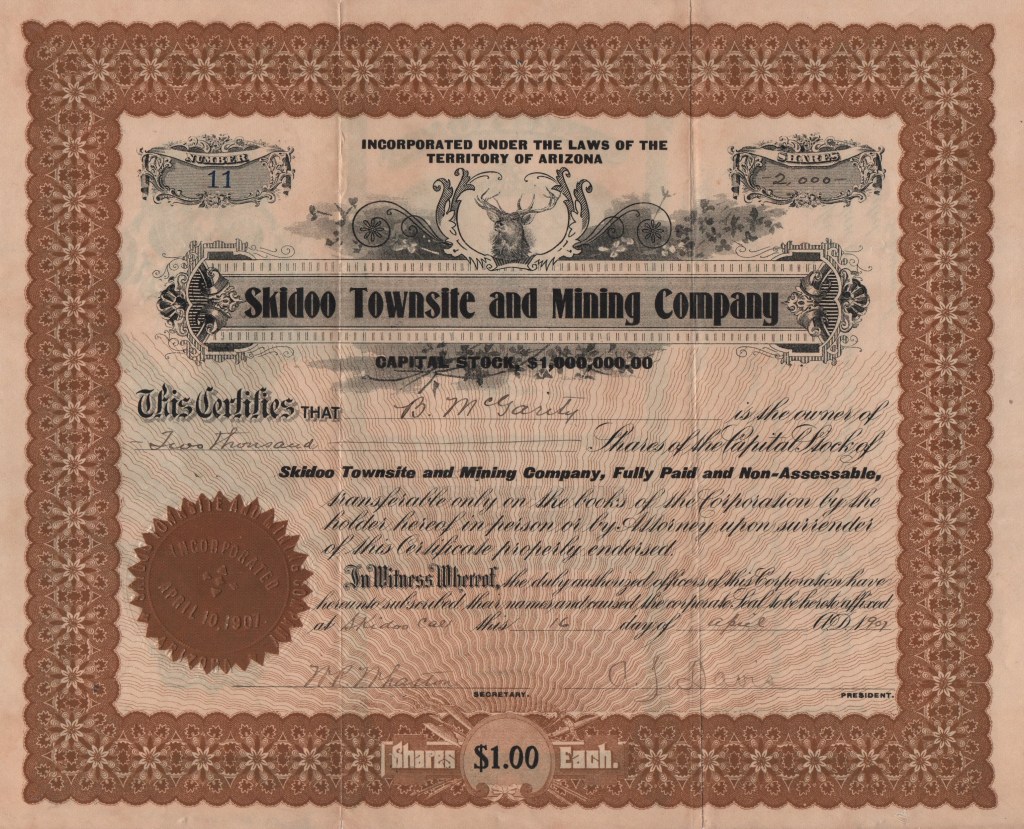
Certificate No. 11. 20 Shares to B. McGarity, April 16, 1907. N. R. Wharton, Secretary; A. J. Davis, President.
In January 1906, two wandering desert prospectors, John Ramsey and John “One Eye” Thompson, made their slow way up Emigrant Canyon toward the newly discovered gold strike at Harrisburg. The long trek of Ramsey and Thompson toward Harrisburg was suddenly interrupted by a rare freak of nature in the Death Valley region–a blinding fog. Quickly becoming disoriented in the murky light, and afraid of getting lost in one of the many surrounding canyons, the two decided to encamp near Emigrant Spring and proceed on their way in the morning. By the next day the fog had lifted, enabling a view of some nearby ledges whose color appeared promising. A true desert prospector always had time for even a brief survey of such formations.
What Ramsey and Thompson found completely dismissed all thought of a further journey and precipitated their prompt location of several claims in the vicinity. Comprising the Gold Eagle Group, this series of rich ledges appeared to stretch north-south for about 1½ miles, varying from two to twelve feet wide, and showing $82 in gold per ton.
The Nevada mogul most responsible for Skidoo’s success was E. A. (Bob) Montgomery, who immediately purchased the original Gold Eagle Group of claims from Ramsey and Thompson.
From its very beginning, Skidoo displayed a definite tendency toward an organized and systematic development pattern that no doubt played a great part in helping sustain it through the rough years ahead. The rapid influx of mining men to the vicinity, some with families, made the establishment of a townsite and the disbursement of residential and business lots the next natural step in the area’s growth. By the end of August 1906, a townsite, variously designated as Montgomery and later Hoveck, was platted just east of the Skidoo Mine, which was functioning as the center of milling operations. Neither “Montgomery” nor “Hoveck” captured the imagination of the townspeople, however, nor did either of those two solid citizens particularly desire to be so memorialized.
The details of the debate resulting in the colorful designation of “Skidoo” have been lost to history and open to conjecture for years, the linking of the then popular slang term “23 Skidoo” with the townsite having been variously attributed to: 1) the length of the Skidoo pipeline in miles; 2) a total of twenty-three claims in the original discovery group, coincident with twenty-three surveyed blocks in the new townsite (this seems the most likely suggestion, though newspaper reports mention twenty-four claims), prompting Bob Montgomery’s wife Winnie to suggest the appellation; 3) the location of the original mineral discoveries on the twenty-third of the month; 4) the twenty-three men who supposedly founded the town; etc. Whichever fact prompted the suggestion, the new name was wholeheartedly approved by all.
Bell Mountain Silver Mines, Inc.
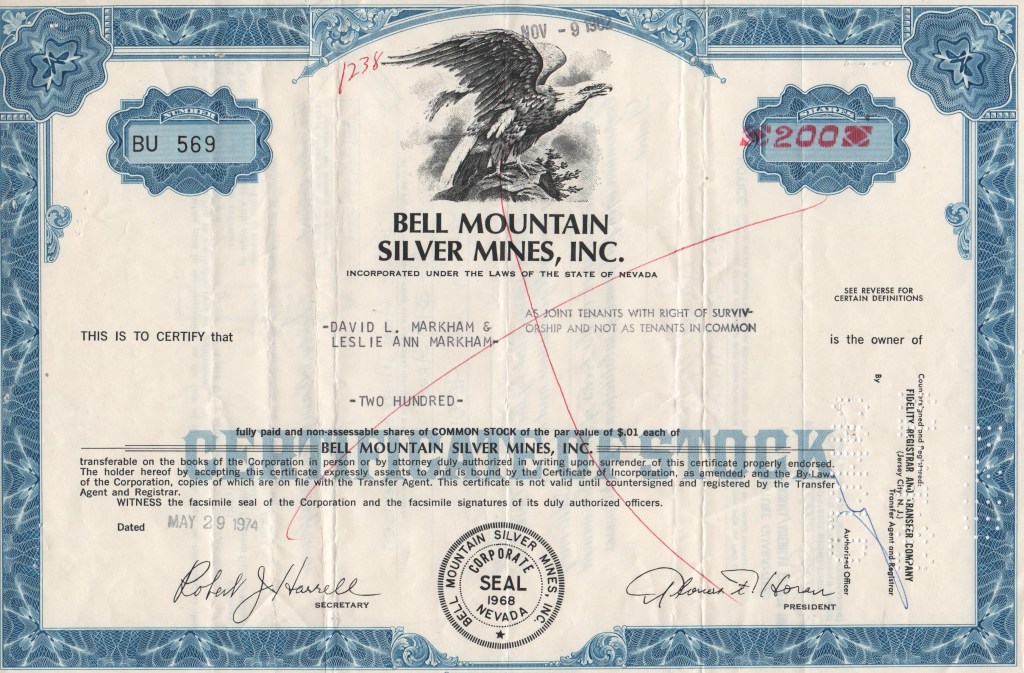
Certificate No. BU 569. 200 Shares to David L. & Leslie Ann Markham, May 29, 1974; Thomas Horan, President; Robert Harrell, Secretary.
At the northern margin of the Panamints, prospectors Harry Ramsey and “One Eye” Thompson located twenty-six mining claims as Gold Eagle group, in March 1906. Shortly thereafter, the claims were purchased by E.A. “Bob” Montgomery, who organized the Skidoo Mines Company.
The Del Norte mine was just north of the Skidoo mine. Skidoo district mines were developed and worked continuously from 1908 to January 1913, when a snow slide and freezing temperatures damaged the famous Skidoo water pipeline. Before water service was restored, the Skidoo mill was destroyed by fire. That can happen when the water to put out a fire is not available.
In October 1913, the pipeline was returned to service and the rebuilt mill operated continuously until 1917. The mines were worked intermittently during the 1920s, and from 1930 until 1942, when gold mining was declared to be a non-essential World War II industry. After the war, the Skidoo mines were worked intermittently on a small scale until Congress passed a Death Valley mining moratorium in 1976.
In 1969, the Del Norte mine was leased from its owners to Bell Mountain Silver Mines, Inc. The company began exploration work, including 52 drill holes and sampling of 1,200 linear feet of surface outcrops using near-surface blasting. Exploration involved a four-acre area. The results were promising, and Bell Mountain was developing a heap-leaching pilot test of Del Norte ore when the 1976 moratorium was adopted. Subsequently, no further work occurred at the Del Norte mine.
Interestingly, until the end of Skidoo area operations, small tonnages with high grade gold ore were sold and shipped to Knott’s Berry Farm in Buena Park, California and used at the park’s gold panning attraction.
Trail Canyon Mining Company
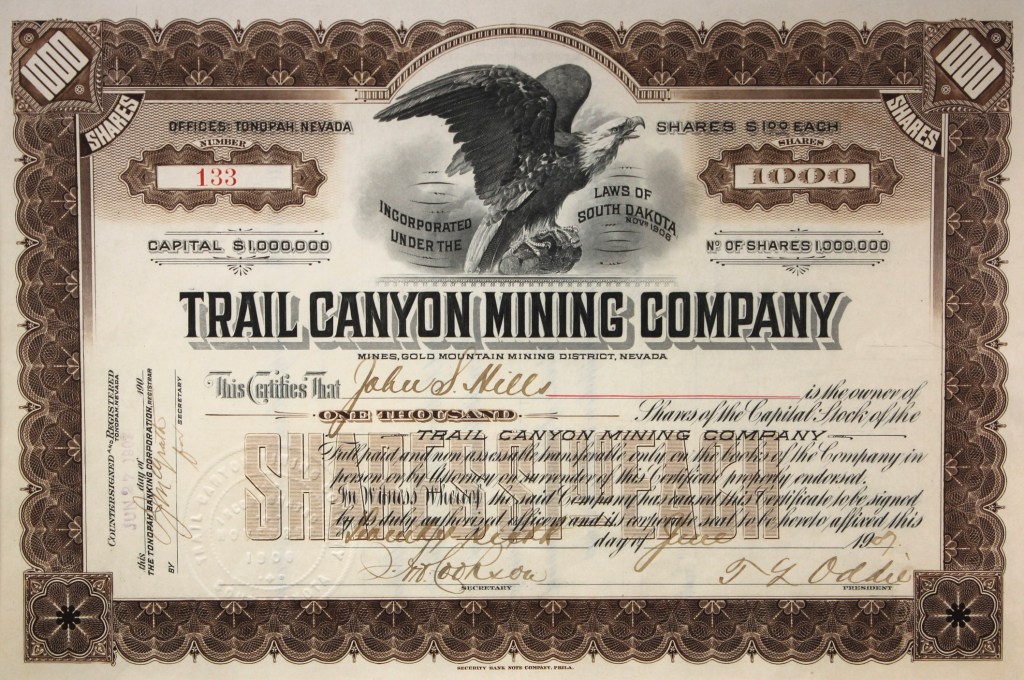
Certificate No. 133. One Thousand Shares to John S. Hills, June 26, 1907. Jno. Cookson (?), Secretary; T. (Tasker) L. Oddie, President.
In the spring of 1907, Charles M. Schwab, Tasker Oddie and F. J. Leutjens purchased five promising claims in Trail Canyon whose assays were running from $50 to $3,000 per ton.
What seemed to be a promising future for the company did not materialize, due to the collapse of the New York stock market in March 1907, followed by similar international financial crises. The panic spread to the west, causing two Goldfield banks to close. Tasker Oddie, who had invested and speculated heavily and rather recklessly in various mining claims and property and mining related enterprises in Tonopah and the Bullfrog Mining District, was ruined by the economic collapse. Five flimsily subsidized mining company of which he was president, including the Trail Canyon, failed when Oddie was unable to make good his obligations to the stockholders of to the Tonopah Banking Corporation, which had invested in his development work.
Death Valley Talc Refining and Manufacturing Co.
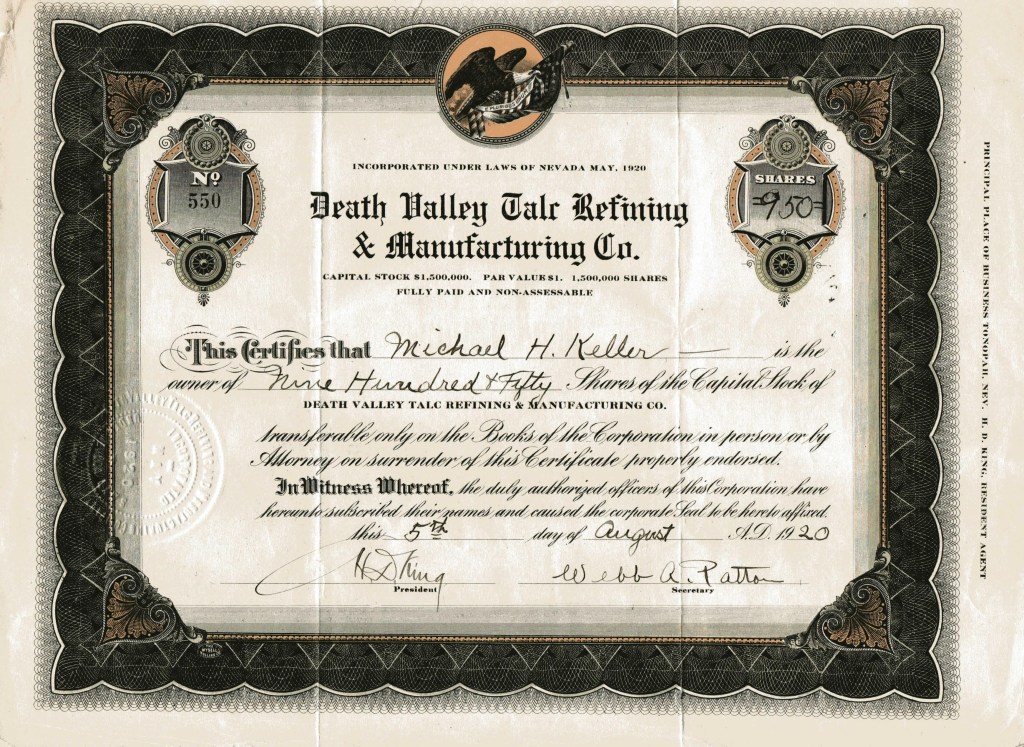
Certificate No. 550, Nine Hundred Fifty Shares to Michael H. Keller, August 5, 1920. H. D. King, President; Webb A. Patton, Secretary.
Chas. Pfizer & Co., Inc.

Certificate No. N0147873. Two Shares to Freehling Meyerhoff & Co., October 26, 1960. John F. Duffy, Treasurer; John E. McKeen, President.
Haskell Mining Company
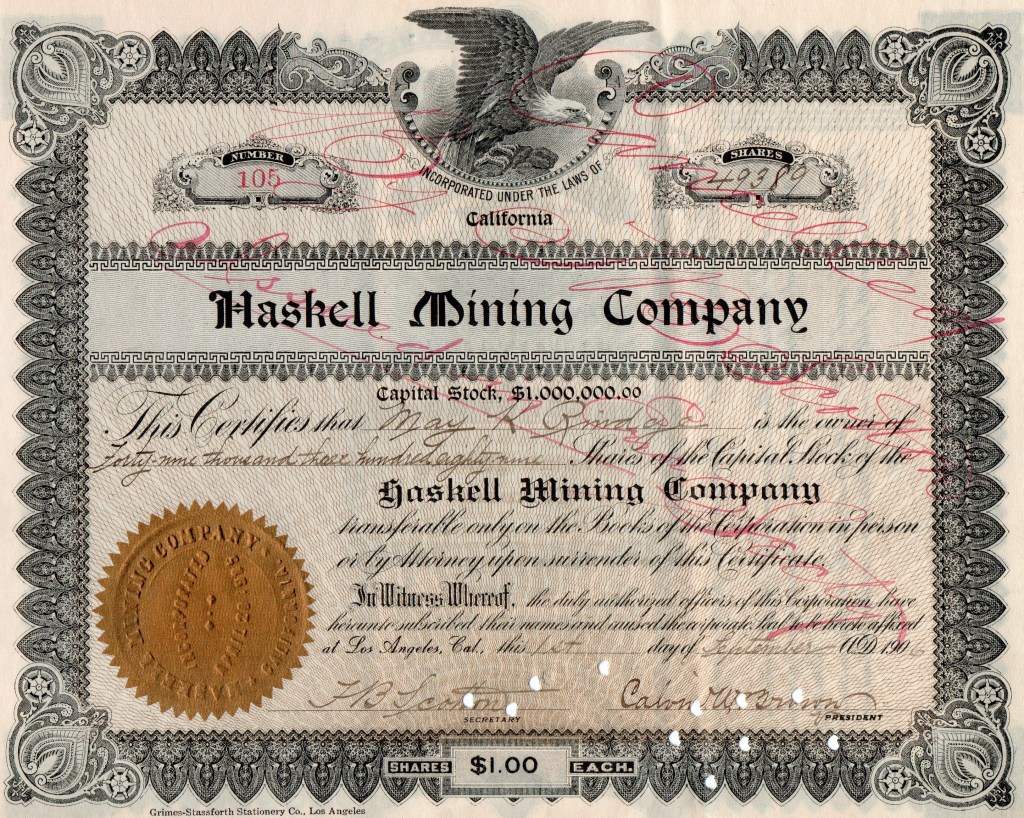
Certificate No. 105. Forty-Nine Thousand Three Hundred Eighty Nine Shares to May K. Rindge, September 1, 1906. Calvin W. Brown, President; F. B. Scotton, Secretary.
The Haskell Mining Company owned claims on the west side of the Panamints, on the flank of Porter peak. The claims were patented in 1919, meaning the U.S. General Land Office transferred ownership of the ground, not just the mineral rights of the claims, to the company. If Haskell Mining paid the real property taxes to Inyo County, the company retained ownership of the land.
Unlike every other certificate in this collection, one thing you don’t see on the certificate is the statement, “Fully Paid and Non-Assessable.” This means that when the company directors determined that the company needed additional funds, they could hit stockholders for more money on a per-share basis. If an owner didn’t pay an assessment, the company could, and in several instances did, auction the delinquent owners’ shares at a public auction. Assessments were levied for several years from 1907 to 1915.
Also of note is the stockholder May K. Rindge. Rhoda May Knight Rindge, (b. 1864, d. 1941), also known as May K. Rindge, was an American businesswoman. She was known as the Queen of Malibu as well as the ‘Founding Mother of Malibu’ and Los Angeles’s first high-profile female environmentalist. She held the distinction of being the first female to serve as president of a railroad company. Additionally, she founded Marblehead Land Company in 1921 and most notably, Malibu Potteries in 1926, the first business in Malibu. The company originated Malibu tile, and the venture became one of Southern California’s most successful of its kind.
Rindge also founded the Malibu Movie Colony, building and renting cottages—and later selling them—to early Hollywood stars such as Bing Crosby, Gloria Swanson, and Mary Pickford. She fought bitterly to preserve her family’s rancho, the Rancho Topanga Malibu, which extended from Los Flores Canyon in Malibu into Ventura County.
In 2019, the National Park Service purchased the 55-acre Haskell Mining Company patented lands, an in-holding within Death Valley National Park. The acquisition protected historic artifacts such as glass and pottery shards, a concrete and steel monument, and mine shafts that provide a glimpse into mining activities in the early 20th century.
The Pannamint Mountain Mines Syndicate
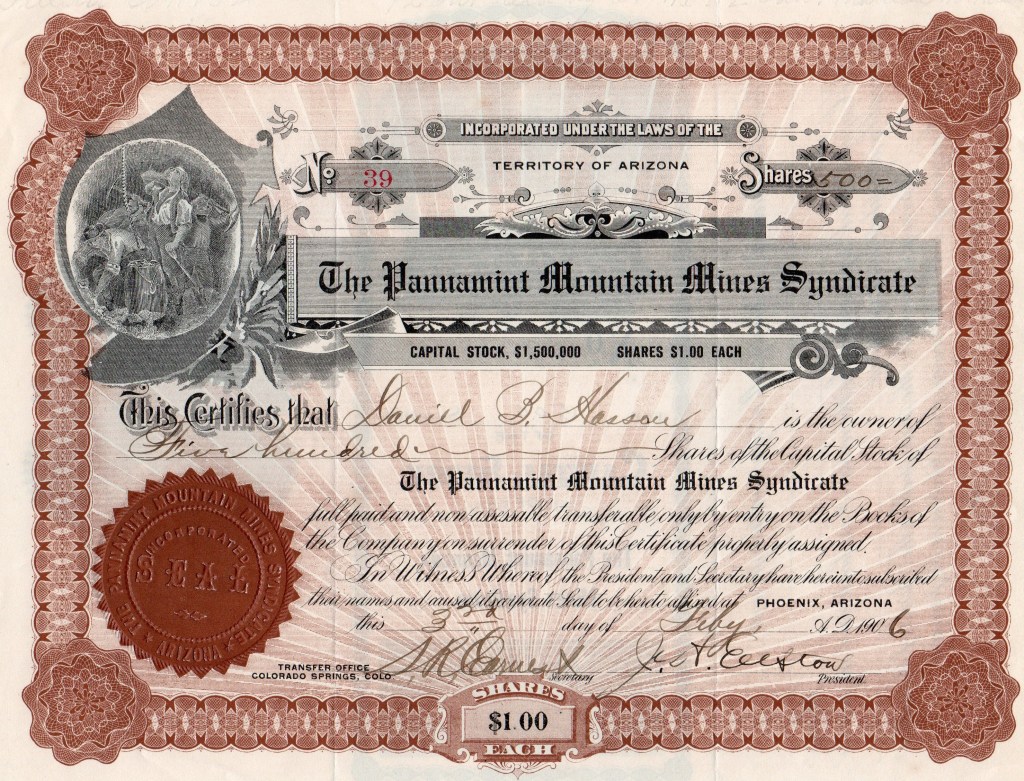
Certificate No. 39. 500 Shares to Daniel B. Hasson, February 3, 1906. S. R. Earnest, Secretary; J. T. Easton, President.
In the 1870’s to the 1890’s, the spelling of the mountain range and mining camp west of Death Valley as “Pannamint” was not uncommon. By the first decade of the twentieth century, however, it should have given pause to use the name in a mining company.
The Pannamint Mountain Mines Syndicate was incorporated in Arizona in 1905, capitalized at a lofty $1.5 million. According to the 1910 Mines Directory, the outfit owned about 320 acres of patented mining land in the Wild Rose District, with “some development work” having been done.
The company was mentioned in the July 1912 journal, The Medical World, in the section “Business Talk to Doctors – A Lesson in Mining Stock Investments.” A civil engineer from Atlanta, supposedly a knowledgeable mining expert had spent over $75,000 in western mining stocks, including the Pannamint Mountain Mines Syndicate. Upon his demise, his heirs realized only $5.65 at auction for the entire investment.
According to the 1926 edition of the Marvyn Scudder Manual of Extinct or Obsolete Companies, the company no longer existed and its stock was worthless. The Pannamint Mountain Mines Syndicate, with no reported production, was just another example of stock jobbery of the 1905 – 1907 period of the Death Valley region.
Wild Rose Mining Company
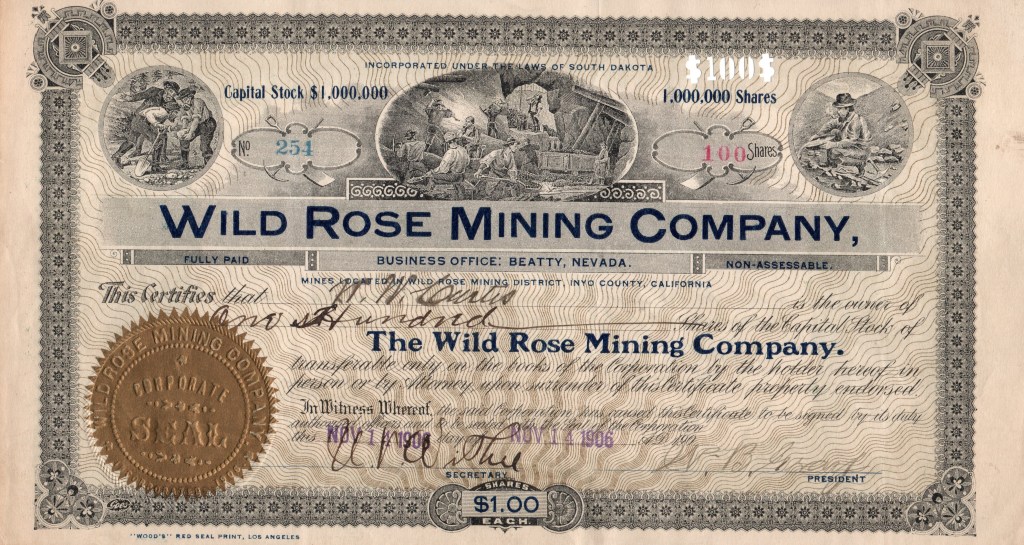
Certificate No. 254. 100 Shares to W. W. Curtis, November 14, 1906. W. B. Gray, President; U. V. Withee, Secretary.
The properties of the Wild Rose Mining Company were not located near Wild Rose Station on the west slope of the Panamints, but rather in Trail Canyon on the eastern side of the range, southeast of Skidoo, yet within the Wild Rose Mining District.
E. H. Goodpaster discovered the Wild Rose Mine, in association with J. W. Seller and A. V. Seller in September 1905. In April 1906 the company had been incorporated by W. B. Gray, Dr. U. V. Withee, and W. H. Sanders. The various properties owned and mined by the company produced gold, silver, copper, and lead. Surface outcrops boasted values ranging from $9 to $716 per ton. Records thus suggest that the Wild Rose Mining Company was a true producer and not merely a stock promoter’s scheme.
In early 1907, after a thorough examination of the property by competent engineers, Boston, Mass. and Providence, R. I. capitalists purchased control of the company for $300,000. The sale was made by Dr. Withee, who had just returned from a two-month trip east. The Wild Rose Mine was described at the time as having a ledge in place from five to six feet wide, with assays from $26 to $31 a ton.
By 1913, it was all over for the Wild Rose Mining Company, with California revoking its business license for failure to pay taxes and fees due to the state.
Allied Chemical Corporation
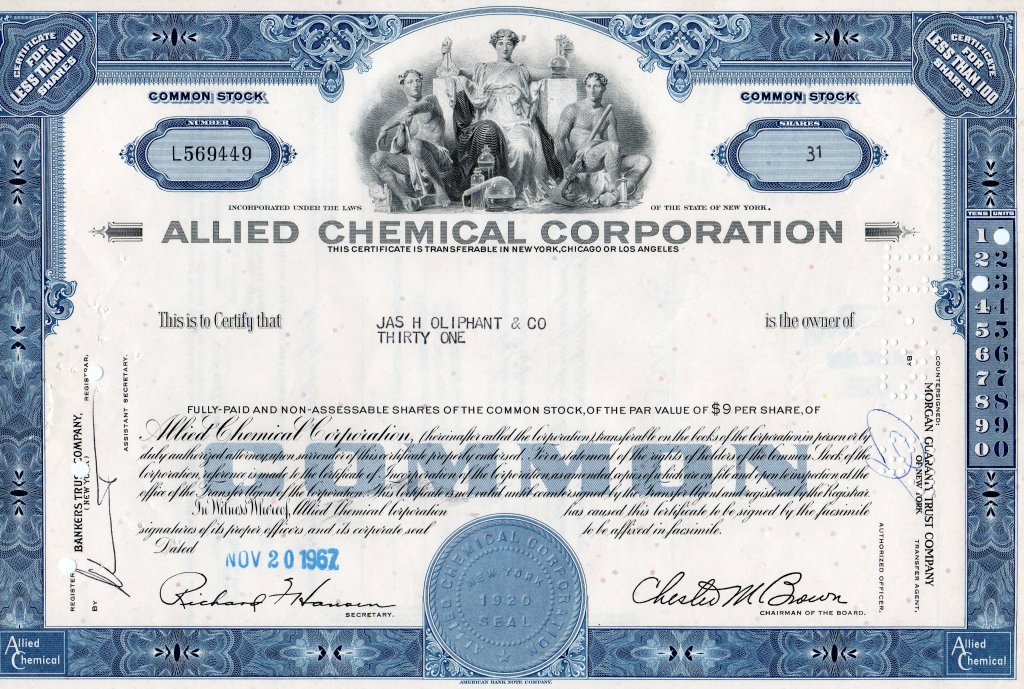
Certificate No. L569449, Thirty-One Shares to Jas. H Oliphant & Co., November 20, 1967. Richard F. Hansen, Secretary; Chester M. Brown, Chairman of the Board.
See also Allied Chemical in Mines of the Last Chance Range.
Lead Mines of Galena Canyon
New Sutherland Divide Mining Company
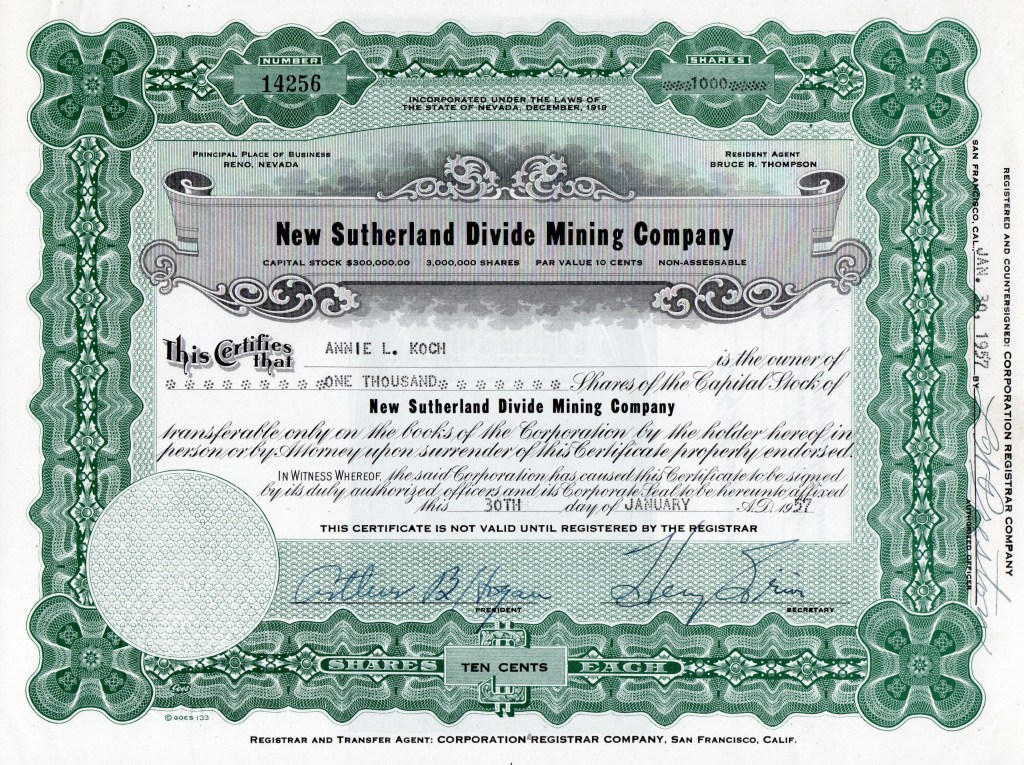
Certificate No. 14256, One Thousand Shares to Annie L. Koch, January 30. 1957. Arthur B. Hogan, President; Henry Grim (?), Secretary.
Victory Divide Mining Company
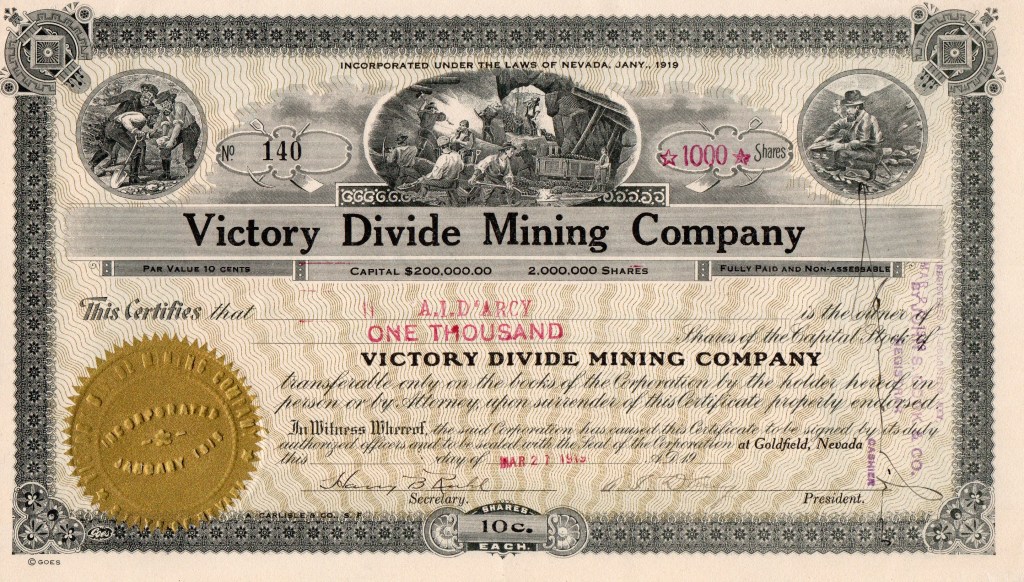
Certificate No. 140, One Thousand Shares to A. I. D’Arcy, March 27, 1919; Harry B. Ruhl, Secretary, A. I. D’Arcy, President.
In 1929, Jack Salsberry leased the Carbonate mine to the New Sutherland Divide Mining Company, in which he had an interest. He then succeeded in getting a contract with the giant U. S. Smelting, Refining and Mining Company to sublease the mine. Salsberry and his partners worked up the stock from 5 cents to 50 cents while they tried to unload before the smelting company backed out.
A few years later, they subleased the mine to another corporate shell, the Reorganized Victory Divide Mining Company, run by A. I. D’Arcy, who made a show of reopening the Carbonate and Queen of Sheba mines. D’Arcy worked the Victory stock up from 3 cents to 13 cents while he unloaded his own holding, then let it crash in the summer of 1926.
Salsberry’s New Sutherland Company reopened the mine in 1930 and over the next several years, they shipped more than 4,000 tons of ore before they finally quit. By then the Carbonate Mine had become the second most productive lead mine in the Death Valley country.
 Death Valley Mining History - Thru Scripophily