Death Valley Railroad Company
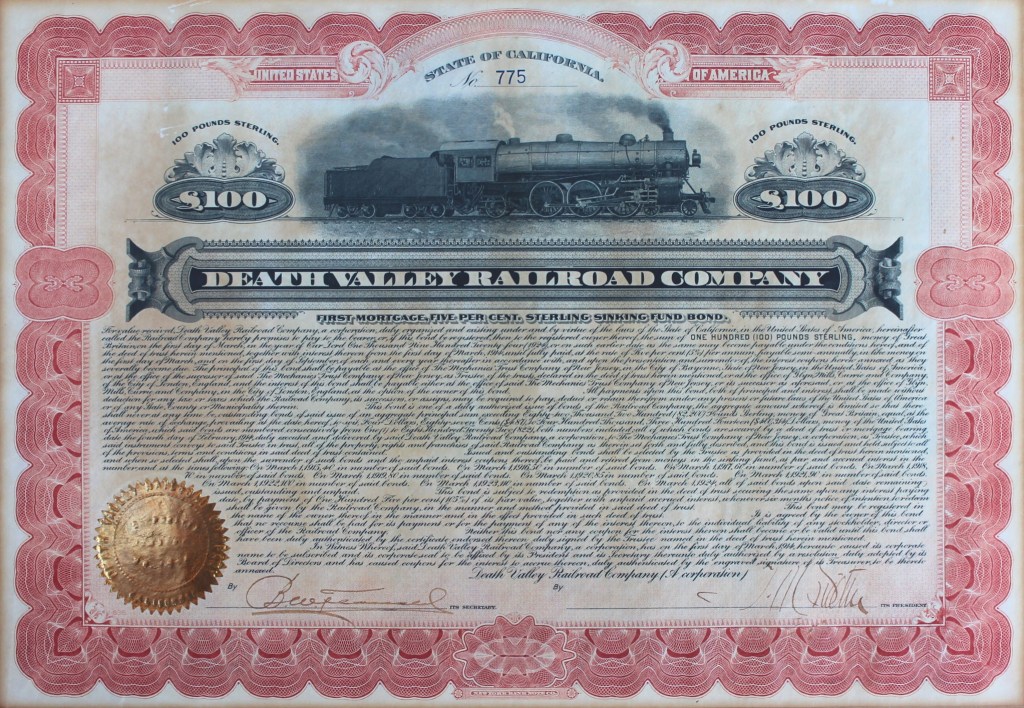
Death Valley Railroad Company, First Mortgage, Five Per Cent, 100 Pounds Sterling, Sinking Fund Bond, No. 775. B. (Benjamin) W. Edwards, Secretary; F. M. (Francis Marion) Smith, President.
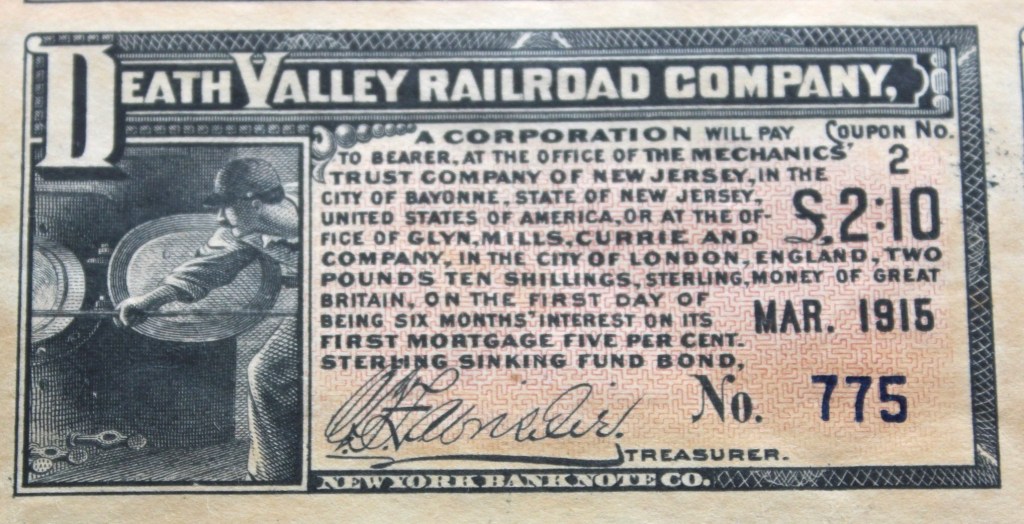
Death Valley Railroad Company Bond No. 775, C. B. (Christian Brevort) Zabriskie, Treasurer. Two Pounds Ten Shillings Stirling Dividend Coupon, Payable March 1915.
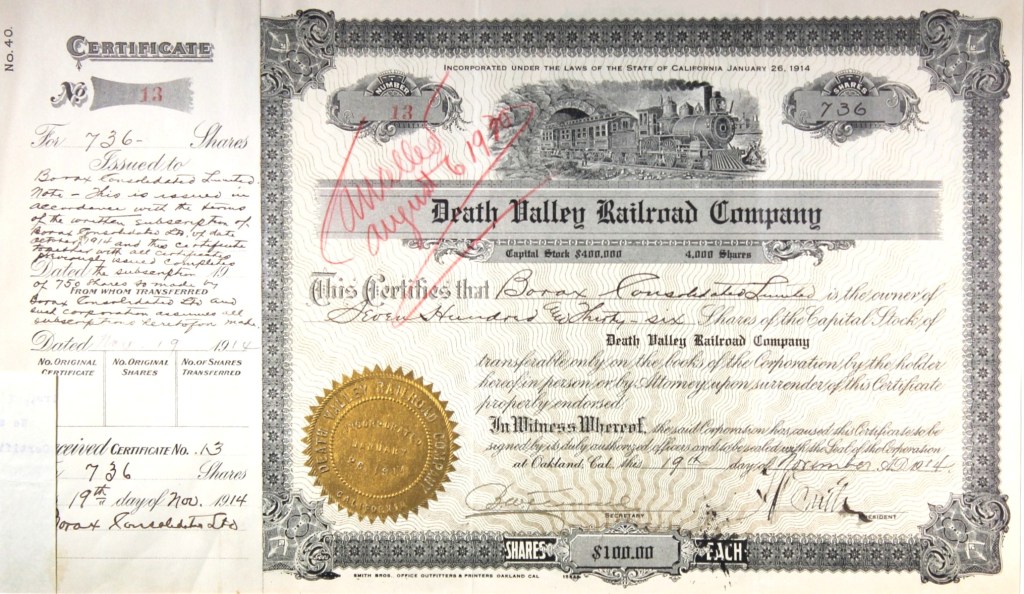
Death Valley Railroad Company, Certificate No. 13 (with stock certificate ledger book stub), Seven Hundred Thirty-Six Shares to Borax Consolidated, Ltd., November 19, 1914. B. (Benjamin) W. Edwards, Secretary; F. M. (Francis Marion) Smith, President.
The entry on the stub reads, “Issued to Borax Consolidated Limited. Note – This is issued in accordance with the terms of the written subscription of Borax Consolidated, Ltd., of date October 19, 1914 and this certificate together with all certificates previously issued completes the subscriptions heretofore made, November 19, 1914.”
The notation in red pencil on the certificate reads, “Cancelled August 6, 1930.”
Death Valley Railroad Company, Ltd.

Death Valley Railroad Company, Ltd., Certificate No. 92, Unissued.
There is no information that a Death Valley Railroad Company, Ltd., was actually incorporated as indicated on the stock certificate. It may have been considered as a backup plan in case the California Corporation Commission declined to approve the Death Valley Railroad Company incorporation application.
Tonopah and Tidewater Railroad Company
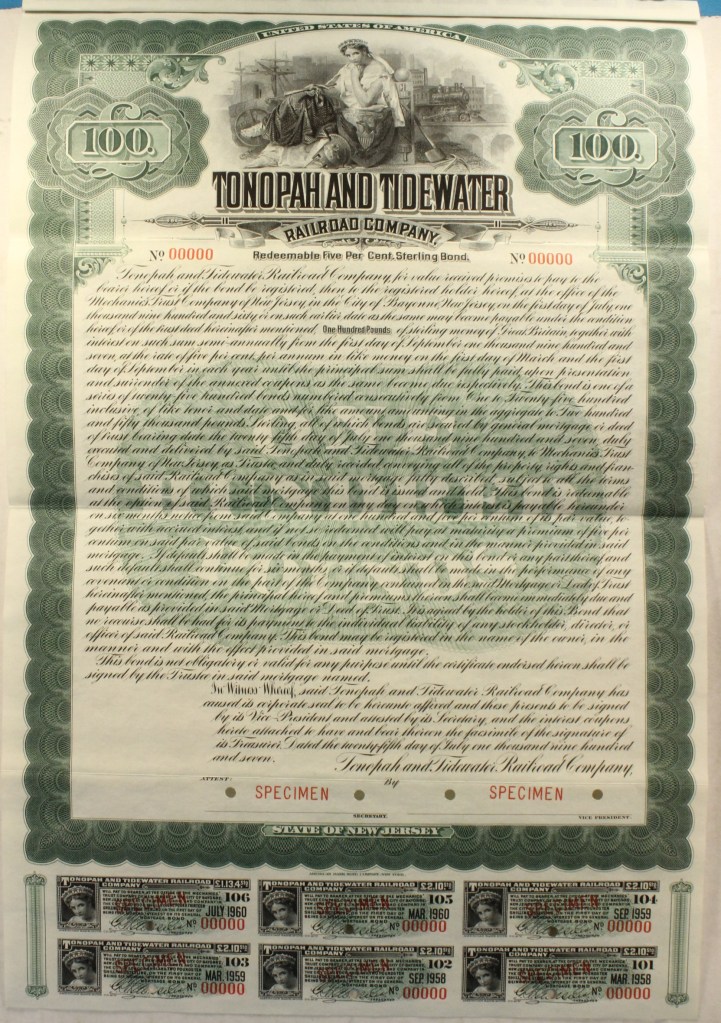
Tonopah and Tidewater Railroad Company, Specimen Bond, Five Percent, Pound Sterling.
Tonopah and Tidewater Company*

Certificate No. A5, Three Shares to George Carragan, July 21, 1908. C. B. (Christian Brevoort) Zabriskie, Treasurer; Davis Van Buskirk, 2nd Vice President.*
In 1908, the Bullfrog Goldfield Railroad, facing declining mining traffic, entered into a joint operating arrangement with the Tonopah and Tidewater Railroad. A holding company, the Tonopah and Tidewater Company, was incorporated to facilitate this. The T&T Co. exchanged its own stock for nearly all the stock of both merging railroads, effectively consolidating control.
The joint operation failed to yield financial success. On June 26, 1914, a reorganization agreement was reached and the BGRR ended its arrangement with the T&T and came under control of the Las Vegas and Tonopah Railroad, which acquired 51% of its stock.
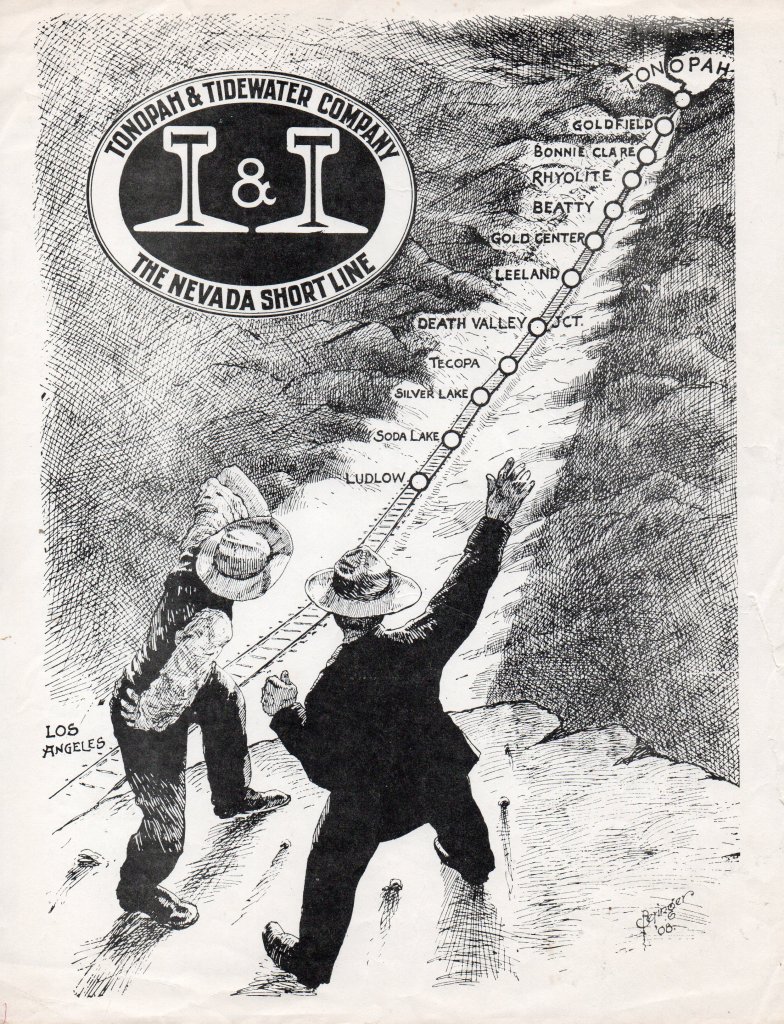
Tonopah & Tidewater Company, fanciful overview of the Joint T&T and BGRR route. Beringer, 1908.
Las Vegas and Tonopah Railroad
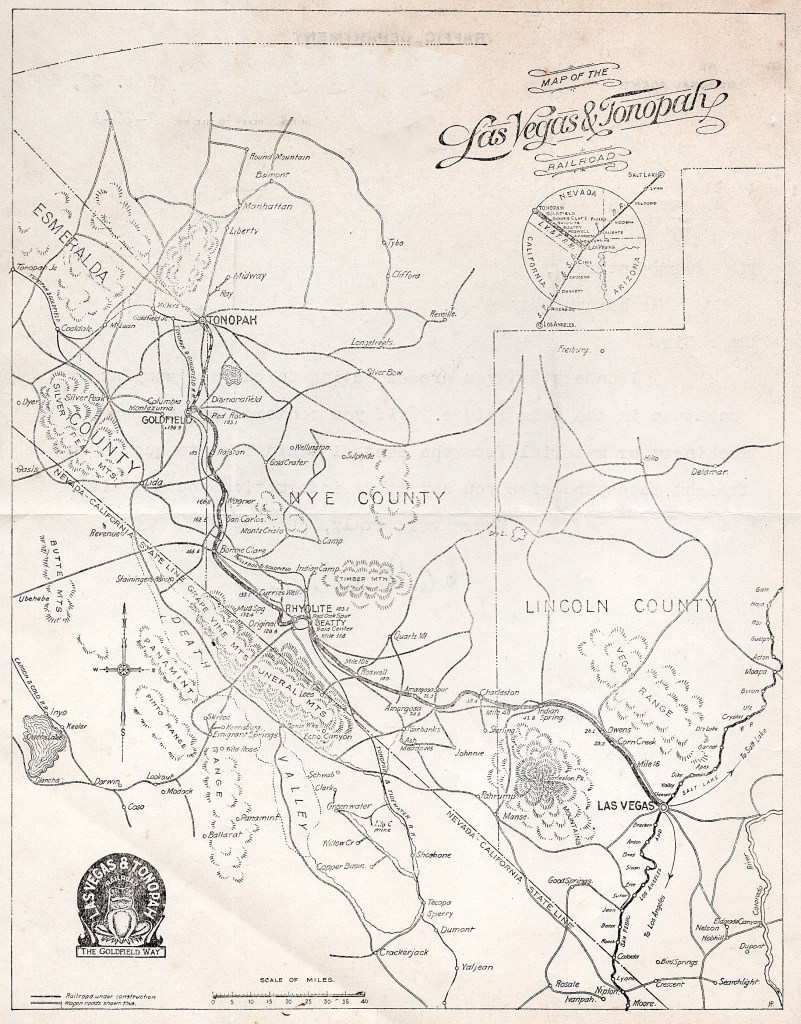
Map of the L. V. & T., October 1908.
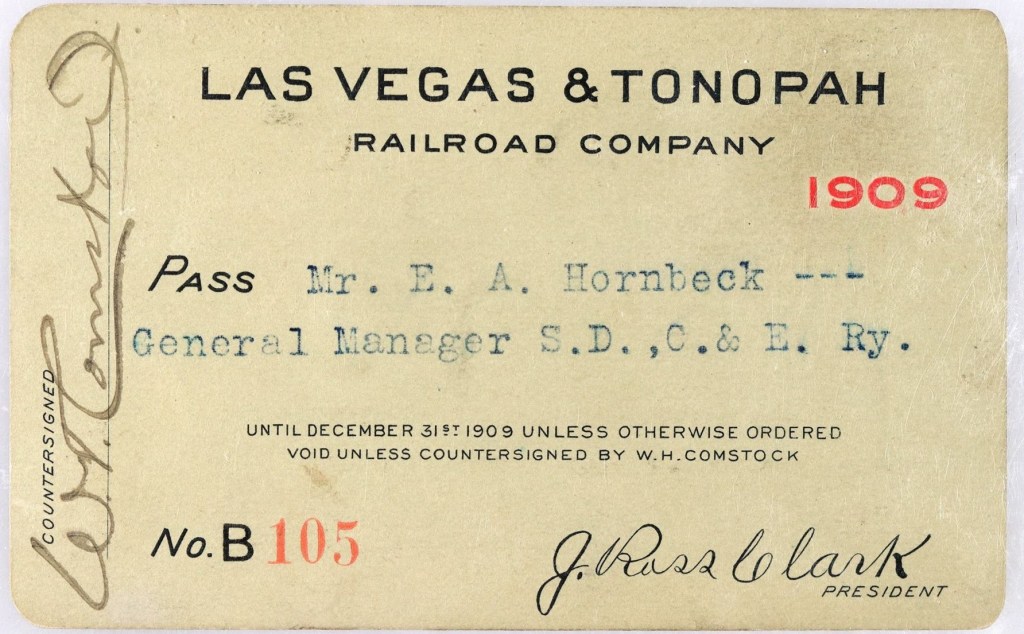
1909 Annual Pass No B105, Issued to E. A. Hornbeck, General Manager, San Diego, Cuyamaca & Eastern Railway. J. Ross Clark, President.*
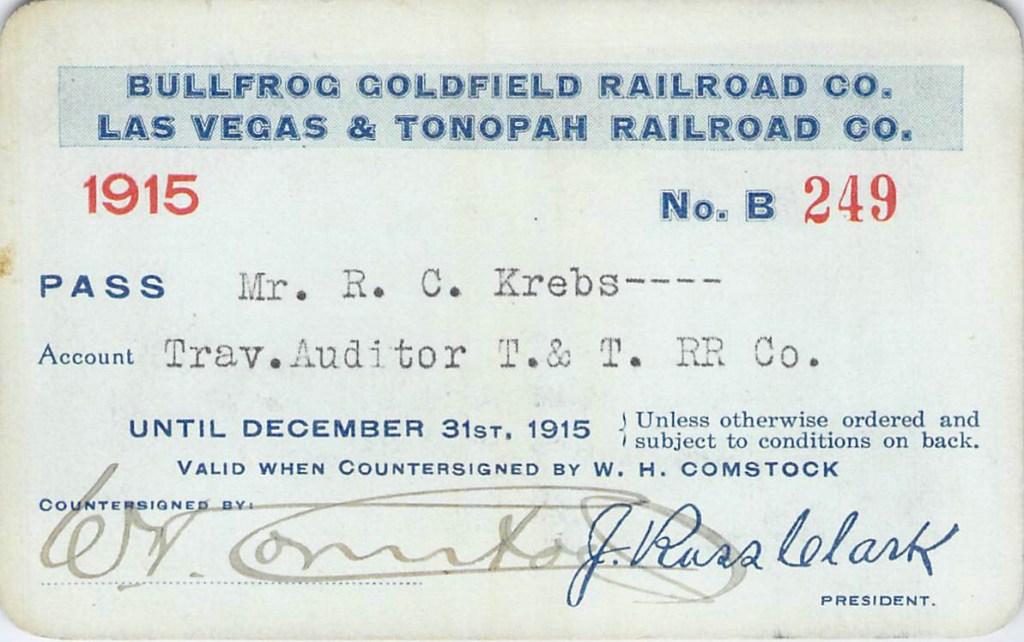
1915 Annual Pass No. B249. Issued to Mr. R. C. Krebs, Traveling Auditor, Tonopah & Tidewater Railroad. After affiliation with the Bullfrog Goldfield Railroad. J. Ross Clark, President.*
Tonopah and Goldfield Railroad Company
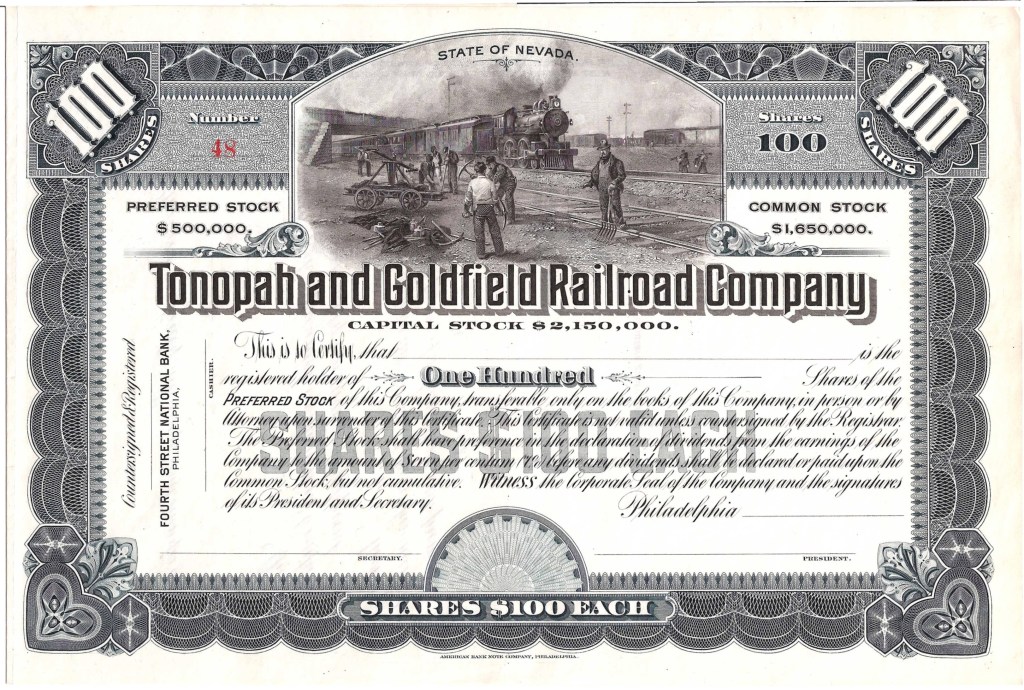
Certificate No. 48, Unissued.
The Baby Gauge Railroad at Ryan
The Baby Gauge Railroad was a 24-inch mining railroad built by the Pacific Coast Borax Company around 1915. It was built to haul borax ore from several local mines to Ryan, where the ore was transferred to the 36-inch Death Valley Railroad.
By 1927, the mines at Ryan played-out. Rather than abandon Ryan, PCB transformed it into the Death Valley View Hotel. The Baby Gauge became a tourist attraction, offering scenic rides to and through the borax mines on converted flatcars. The Baby Gauge operated until the 1950s, when an injury accident led to its demise.
Short segment of a color home movie of the Baby Gauge in operation, circa April 1938.
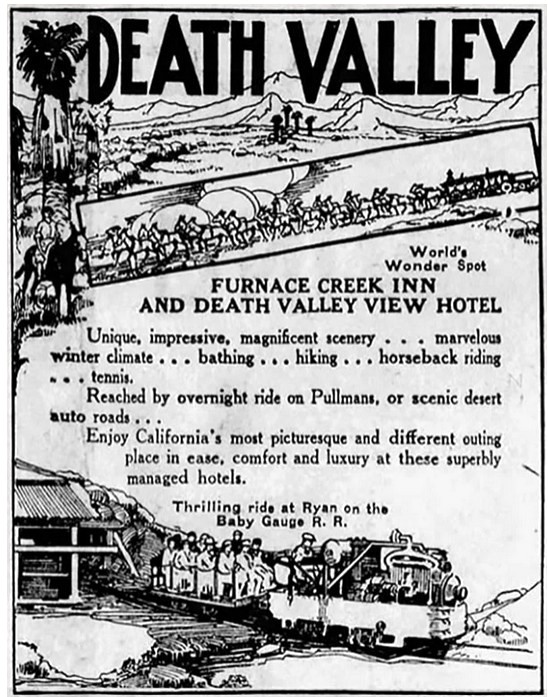
Advertisement, featuring the Baby Gauge trip, Los Angeles Evening Express, December 20, 1929.
Union Pacific Railroad
In 1927, Pacific Coast Borax partnered with Union Pacific Railroad, which promoted package tours to Death Valley. Tourists could travel in comfort by rail from Los Angeles via the Union Pacific, Tonopah and Tidewater, and the Death Valley Railroad as far as Ryan. From Ryan, the “Baby Gauge” mining railroad tour took visitors through the played-out borax mines of Monte Blanco. Motor coaches provided transportation to Death Valley sites in the vicinity of Ryan and Furnace Creek.
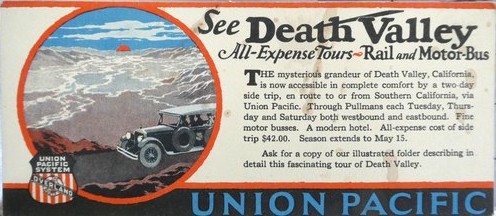
Promotional Ink Blotter, Union Pacific System.*
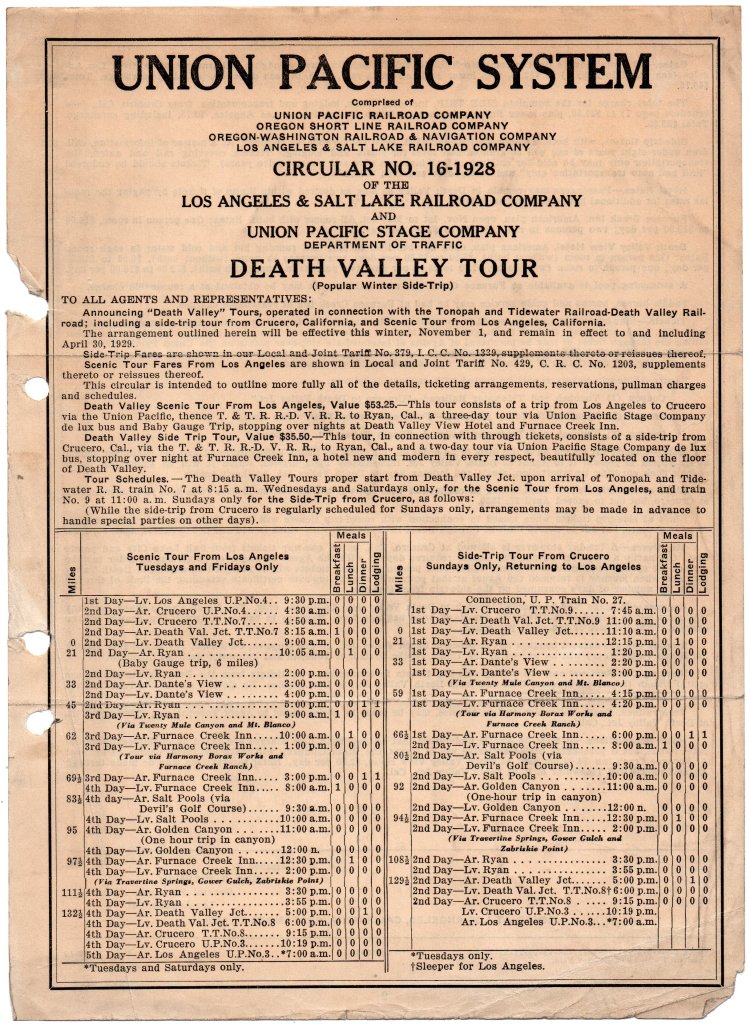
Circular No. 16-1928, Union Pacific System, Describing the Death Valley Tour, Departing and Returning, Los Angeles and Crucero, California.
Amfac, Inc.
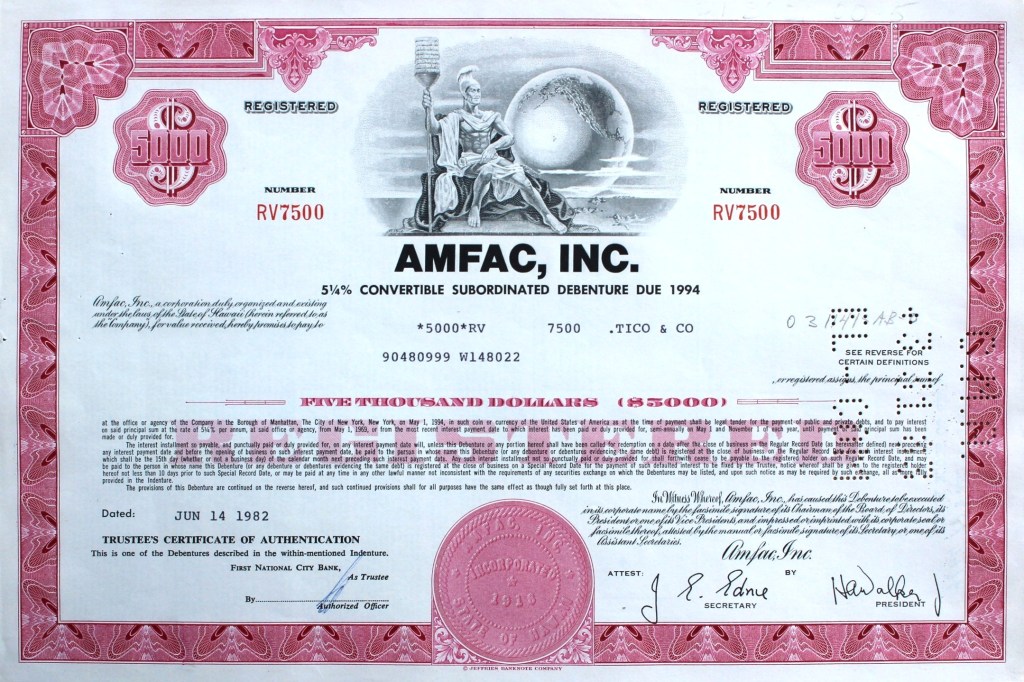
Certificate No. RV7500, 5-1/4 Percent Convertible Subordinated Debenture Due 1994, $5,000 to Tico & Co., June 14, 1982. J. E. Ednie, Secretary; H. (Henry) A. Walker, Jr., President.
The Fred Harvey Company began operating Furnace Creek Inn & Ranch lodging in Death Valley in 1956, when the company entered into a lease agreement with U.S. Borax to manage the properties. These sites had originally been developed by the Pacific Coast Borax Company starting in the 1920s, with the Furnace Creek Inn officially opening on February 1927.
In 1966, Fred Harvey purchased the Death Valley properties outright from U.S. Borax, and two years later, in November 1968, the Fred Harvey Company was acquired by Amfac Inc., which continued operating the resort. Amfac, previously American Factors, was headquartered in Hawaii.
In 1988, Amfac was acquired by JMB Realty, and by 2002, the hospitality division was rebranded as Xanterra Parks & Resorts.
Trona Railway
The Trona Railway’s 30.5-mile line began operating in March 1914. The line transported the evaporite minerals produced by American Trona Corp. to the Southern Pacific Railroad at Searles, California. Until 1937, the railroad carried passengers on mixed consists. As an essential transportation link, the Trona Railway ownership passed through the several successive corporate owners of Trona’s mineral operations.
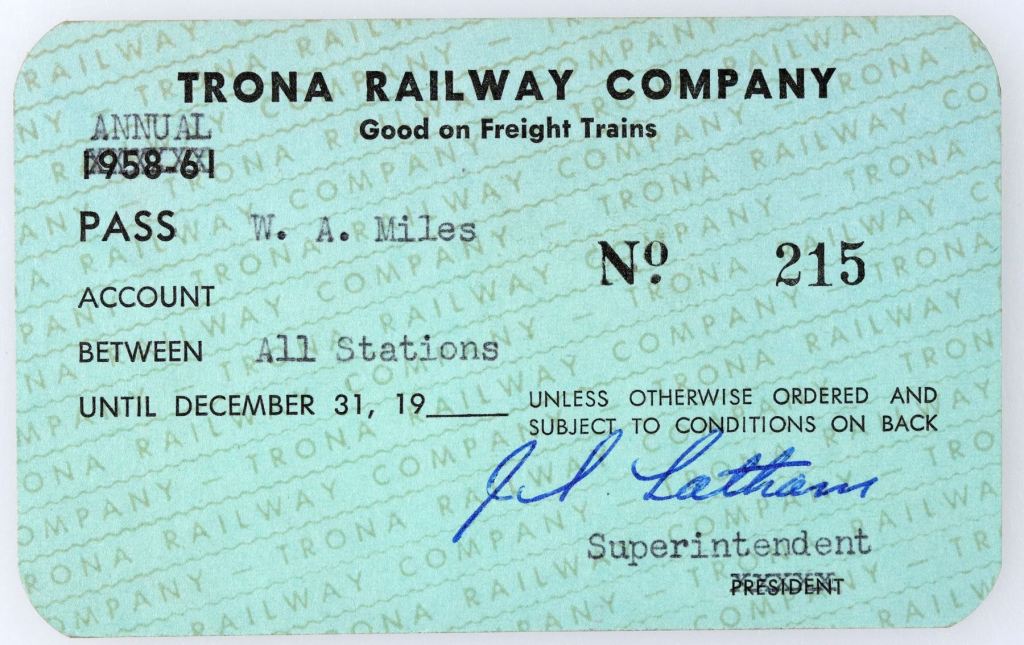
Trona Railway Pass No. 215, Issued to W. A. Miles.*
Bonanza Air Lines, Inc.
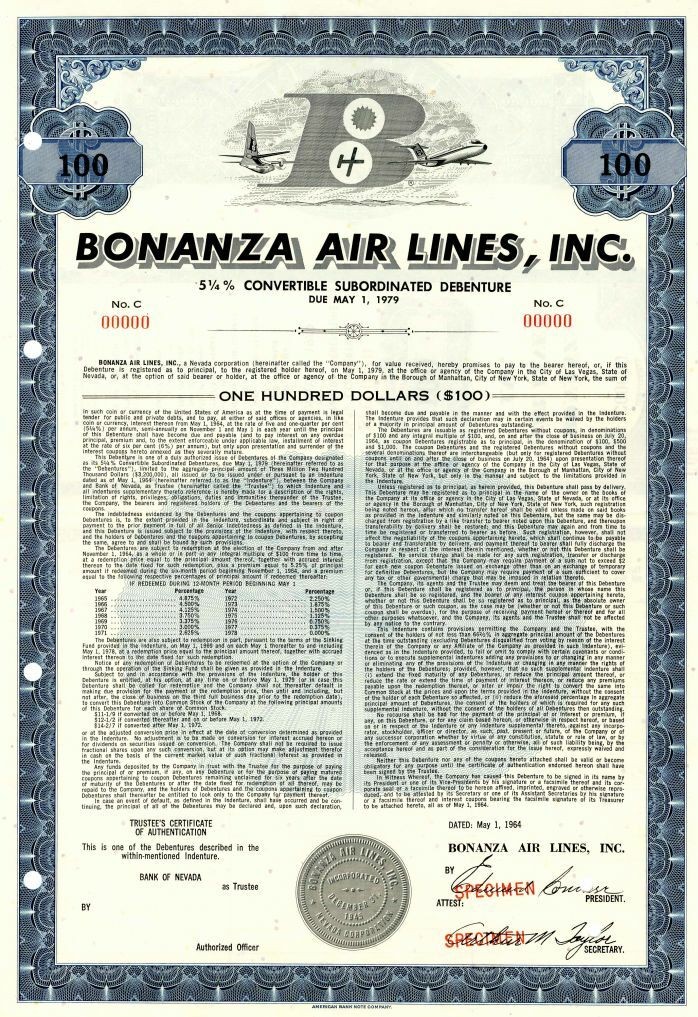
5-1/4 Percent Convertible Subordinated Debenture Bond, Due May 1, 1979, Specimen, May 1, 1964.
The first to Death Valley via airplane was made possible in April 1927 – at the Stove Pipe Wells Hotel, the valley’s first tourist lodging lodging. The unpaved airstrip was on the north side of the toll road, opposite the bungalows. The strip was completed in time for airmen to attend the Easter sunrise services held on the nearby sand dunes.
The original airstrip at Furnace Creek was established by Pacific Coast Borax in the late 1920s, below Furnace Creek Inn, at the site now occupied by Sunset Campground. By 1930, Curtiss-Wright Flying Service operated weekly, seasonal Ford tri-motor service from Grand Central Air Terminal in Glendale, Calif.
Post-WW2 air service to Death Valley reached Death Valley after the U.S. Civil Aeronautics Board granted Bonanza Air Lines’ application to include Furnace Creek as a seasonal stop on the company’s Reno, Nev. to Phoenix, Ariz. route. Bonanza was able to use the paved, replacement (and current) airstrip, northwest of Furnace Creek Ranch.
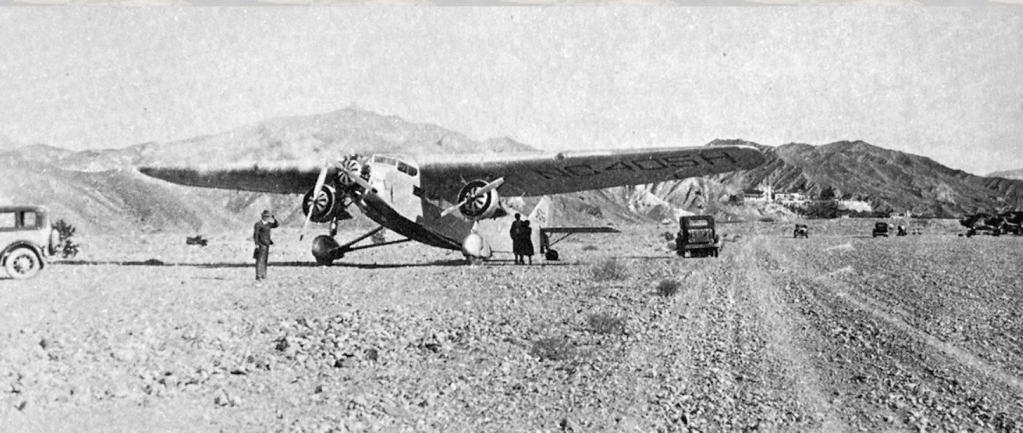
Curtiss-Wright Flying Service’s Ford tri-motor airplane at Furnace Creek during the 1930-1931 season.
In November 1953, Bonanza expanded seasonal service with daily flights from Las Vegas, Nev. Bonanza was also granted Airmail Route A.M. 105 on their seasonal Furnace Creek stop of the Reno – Phoenix route. However, all of Bonanza’s scheduled passenger and mail service to Death Valley ended in April 1955 by order of the CAB.
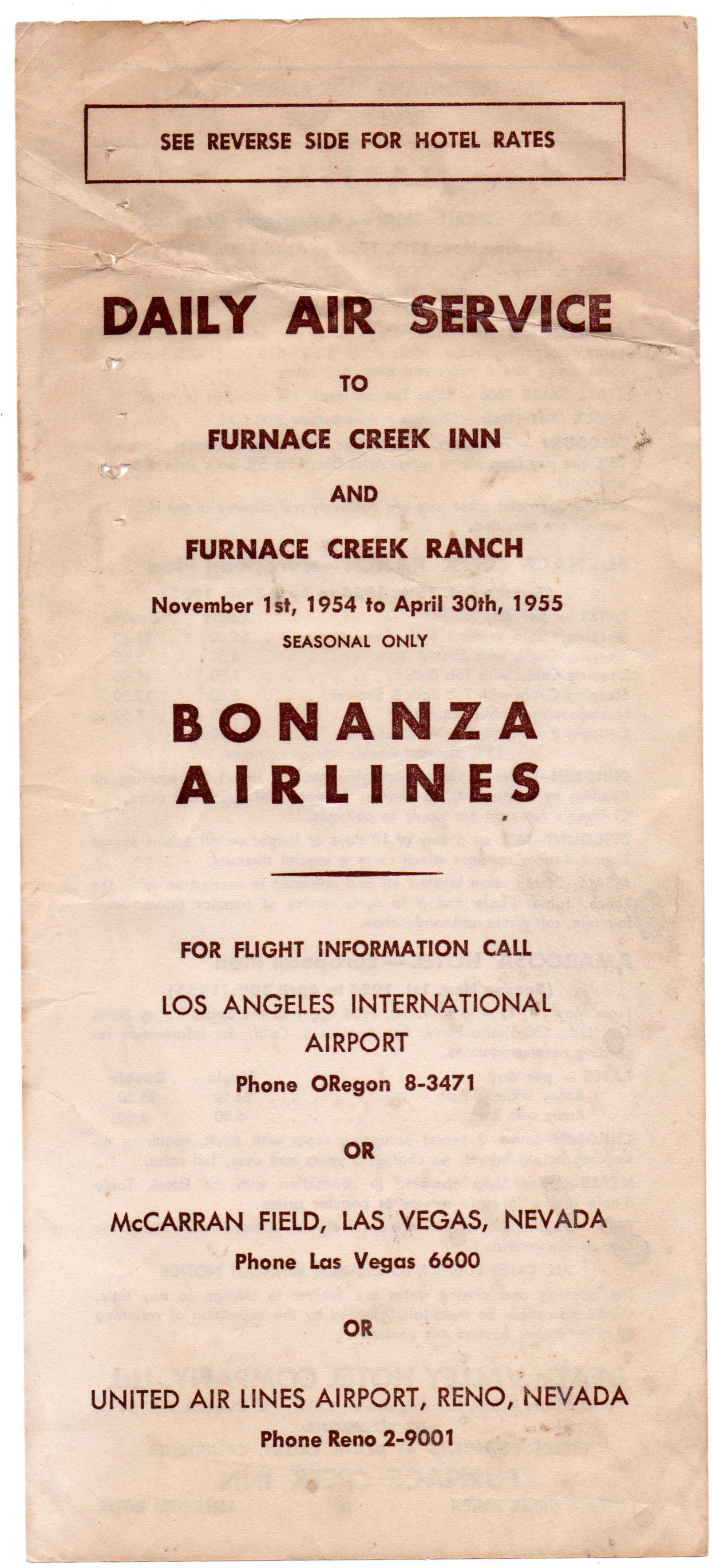
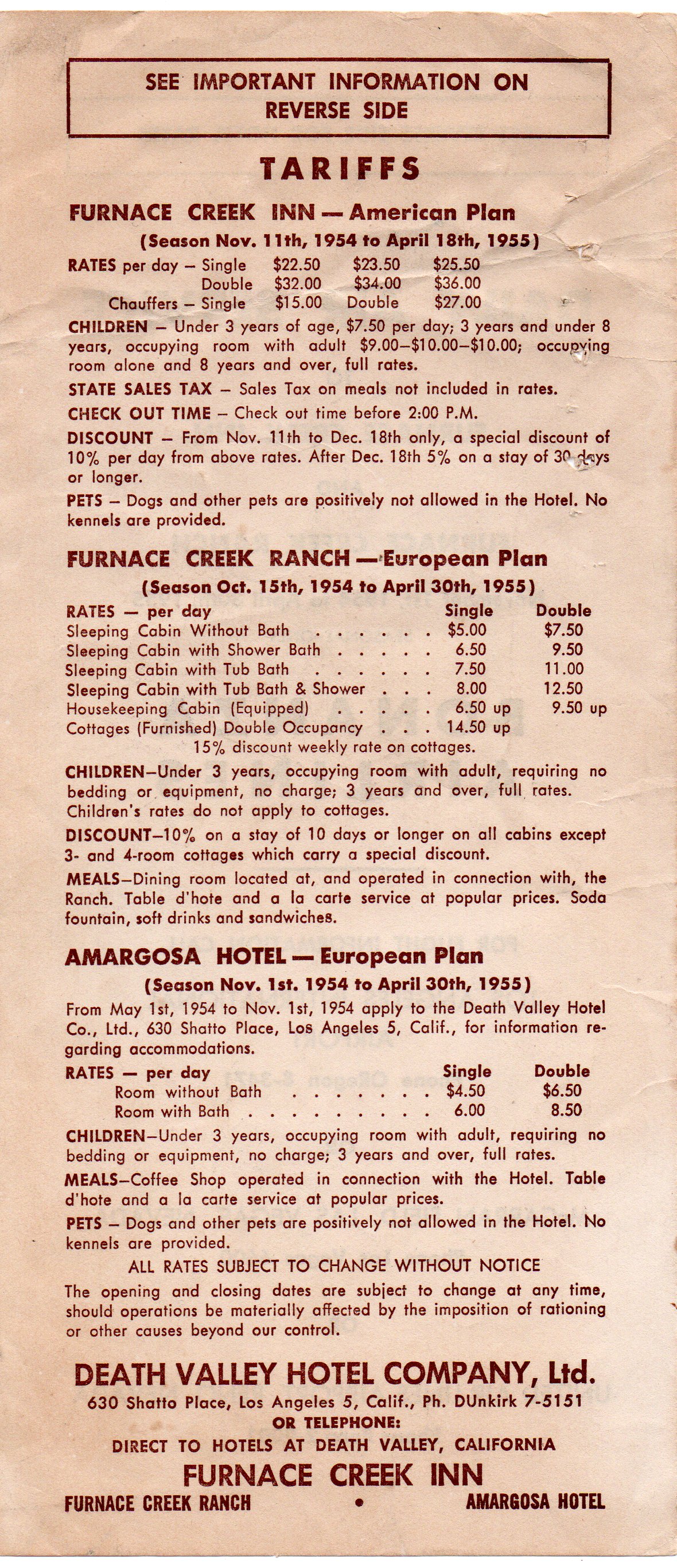
Bonanza Air Lines circular for Death Valley air service and lodging, 1954 to 1955 season.
 Death Valley Mining History - Thru Scripophily