Saline Valley is a closed hydrologic basin, located northwest of Death Valley, south of Eureka Valley, and east of Owens Valley. The valley is immediately east of the Inyo Mountains. The valley is within Death Valley National Park.
In 1864, an Owens Valley farmer surnamed Smith discovered a salt deposit covering 12-square miles at the southwestern edge of Saline Valley. Using horse-drawn teams, Smith scraped salt from the surface of the salt marsh and transported wagon loads of the product to Owens Valley. Smith’s route crossed the Inyo mountains via Waucoba Canyon on trips that took two days. He sold the excellent quality salt to Owens Valley settlers for household use. Although Smith never lacked customers, he eventually abandoned the project because of the difficulty and cost of hauling.
The Saline Valley Salt Company

Certificate No. 1566, One Hundred Shares to John Hartman, September 2, 1912. Fred R. Smith, Secretary; White Smith, President.
The Saline Valley salt deposit was “rediscovered” in 1902 by L. Bourland, who incorporated The Saline Valley Salt Company the following year. After operating the salt works on a small scale for a couple of years, mining ceased upon the death of Bourland in 1905. Two years later, Bishop, California attorney White Smith, along with brothers Fred and Eugene, took over the company and determined to revive operations. For several years, they resumed gathering and transporting salt via “horsepower.”
The Southern Pacific Railroad completed the rail line into Owens Valley around 1910 to support the construction of the Los Angeles aqueduct. The Smiths considered constructing a railroad spur or a pipeline for brine between the Southern Pacific to Saline Valley. Both options were determined to be too costly. Ultimately, they decided to construct a 13.4-mile aerial tramway from Saline Valley, up and over the Inyo Mountains to the railroad that skirted the east shore of Owens Lake.
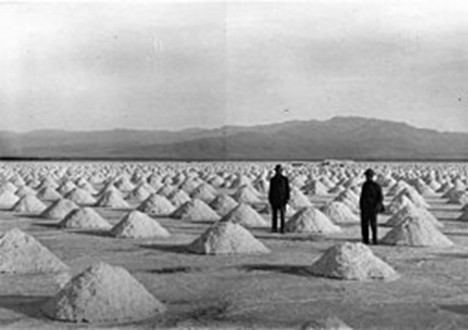
Piles of Harvested Salt, circa 1912, Saline Valley.
The Tramway
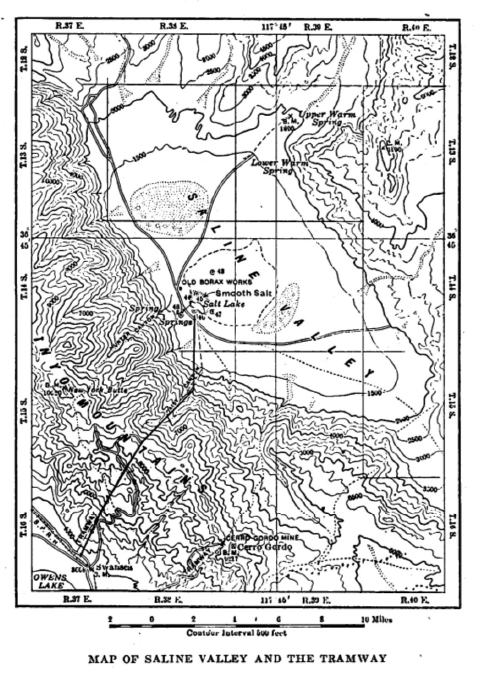
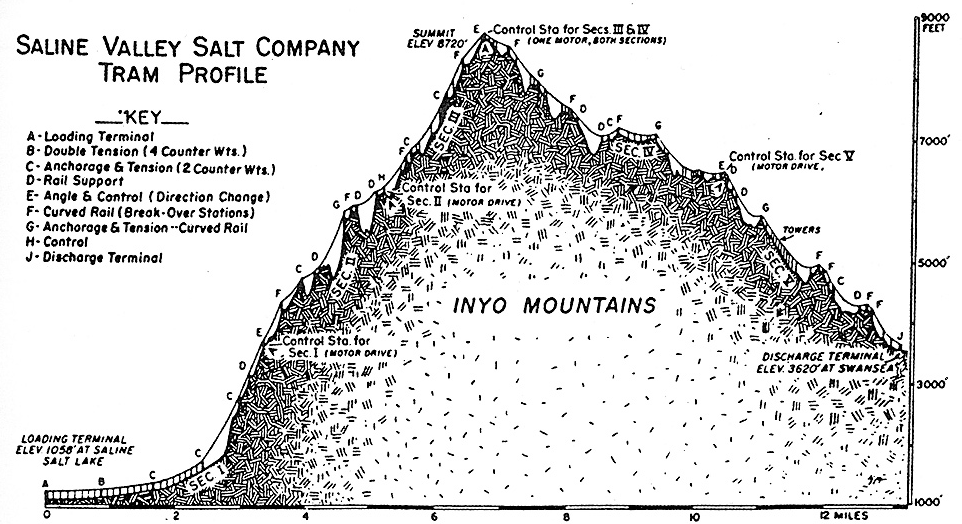
Map and Profile of the Saline Valley Tramway. Western Engineering, July 1917.
The tramway spanned approximately 13.4 miles and ascended nearly 7,500 feet in elevation from Saline Valley to Keeler, on the eastern shore of Owens Lake. At the time, it was one of the steepest and longest tramways in the world. It included over 300 towers to carry the cable and cars.
Keynote Mine and Milling Company

Certificate No. 92. One Thousand Shares to Mrs. S. M. D. Fry, May 31, 1905. O. S. William, President; C. F. Lechleiter, Secretary.
William Hunter came to the Cerro Gordo mines in the mid-1860’s and established a pack animal ranch in the Hunter Mountain area. He is credited with the discovery of the Beveridge Mining District in the rugged terrain of Hunter and Keynote canyons on the eastern slopes of the Inyo Mountains.
The Keynote (sometimes, “Keynot”) Mine was located immediately west of the park’s Saline Valley Salt Lake in today’s Inyo Mountains Wilderness, and about 10 miles east of Lone Pine. The Keynote consisted of seven claims on the ridge north of Keynote Canyon. Mining began in 1878. Ore was at first milled in arrastras driven by horsepower. By 1885, the ore was carried by pack mules to a mill in nearby Beveridge Canyon.
The mine was worked intermittently until the early 1900s. The Keynote Mine and Milling Company was organized in August 1904 by company president O. S. William, likely to mine gold from the pockets of unsophisticated investors. The extraordinary riches were advertised in a full-page advertisement in the San Francisco Call in January 1907. Why, if you didn’t believe all the glowing reporting, you were free to hire your own mining engineer to travel to the most remote district in Inyo County (short of Death Valley) to perform an independent inspection. On second thought, the 30 cents per share price was a bargain.
In September 1908, The Inyo Independent reported that Attorney Charles E. Collins of Chicago was in Lone Pine, “…trying to bring about an adjustment of the affairs…” of the mining company. “If his efforts are successful operations will be resumed under new management.” The “adjustment” didn’t go well, for that’s the last news we hear about the Keynote Mine and Milling Company.

Advertisement for the Keynote Mine and Milling Co. San Francisco Call, January 20, 1907.
 Death Valley Mining History - Thru Scripophily