Mining at Searles Lake began in 1873, when John Searles established the San Bernardino Borax Mining Company. He was the first to transport borax using 20-mule team wagons, hauling borax 175-miles to San Pedro before the railroads were built. The lake became a hub for mineral extraction, producing borax, soda ash, potash, lithium and other evaporite minerals.
The company town of Trona was officially established in 1913, operated by the resident mining company to house and serve employees. The Trona Railway was build in 1913 to 1914 to provide a rail connection to the Southern Pacific at Searles Junction.
Today, Searles Valley Minerals continues to use solution mining to dissolve minerals from beneath the lake bed. The mineral crystals are then recovered by drying in rotary kilns and solar evaporation ponds.
San Bernardino Borax Mining Company
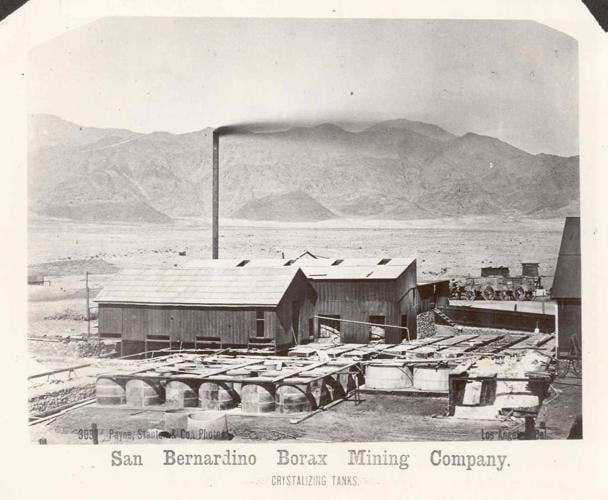
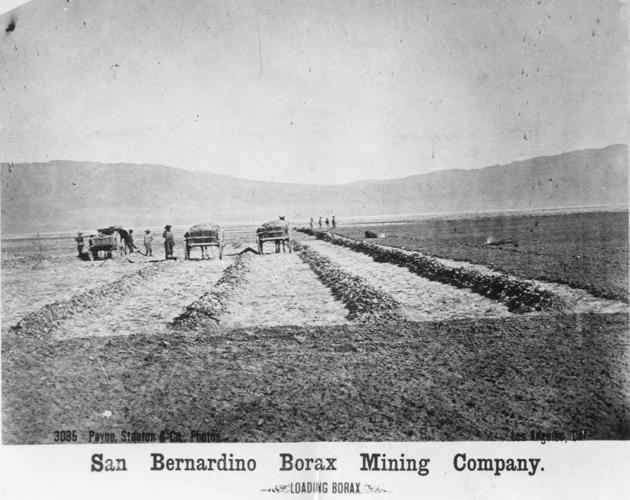
San Bernardino Borax was founded by John W. Searles in 1873. F. M. (Francis Marion) “Borax” Smith purchased Searles’ Ban Bernardino Borax in 1895. The Searles Lake borax operation was closed by Smith, in favor of his Death Valley borax deposits. By 1906, the lake was be investigated as a source of soda ash.
California Trona Company
The California Trona Company was organized in 1908 to manufacture soda ash from Searles Lake brines. To that end, California Trona purchased the assets of the San Bernardino Borax from Pacific Coast Borax. However, before California Trona could begin production, the company failed financially and went into receivership. The receiver kept the company’s mineral claims intact, even fighting off claim jumpers with an armed force. A court judgement in 1916 found in favor of California Trona’s title to 26,000 acres of mineral claims.
American Trona Company
The American Trona Company was established in 1913 and ultimately acquired the assets of the California Trona Company from receivership. The company completed the Trona Railway and founded the company town of Trona, California in 1914. Initial mineral recovery processes from brines failed to scale up from laboratory to commercial operations. It wasn’t until around 1916 that potash production was achieved on a commercial scale.
Nevada Chemical Company
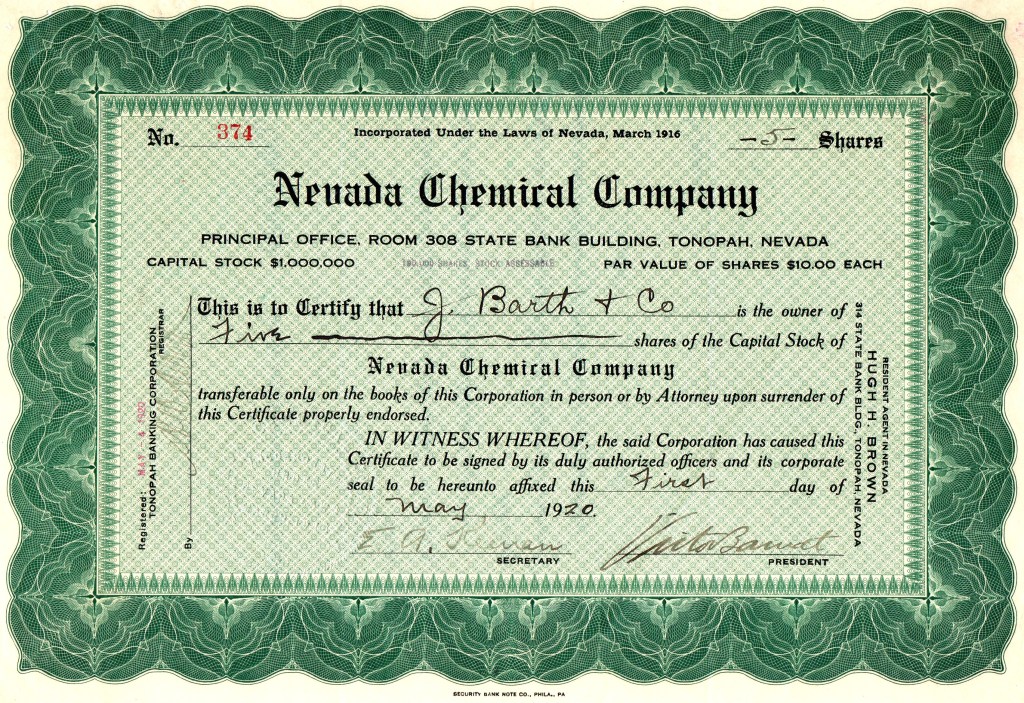
Certificate No. 374, Five Shares to J. Barth & Co., May 1, 1920. E. A. Keenan, Secretary; Victor Barrett, President.
In 1913, Searles Lake was placed in a Federal potash reserve by Executive proclamation, because potash was considered a relatively scare resource. In 1918, the U. S. Department of the Interior divided the Searles Lake potash deposit into 12 parts in order that the lake would not be monopolized by any one company. The Interior Department granted a land patent to American Potash and Chemical Corp. Leases were provided to eleven different parties, including Nevada Chemical. By 1949, Nevada Chemical, and all other lease-holders were out of the picture, with the entire lake’s mineral resources under the control of either American Potash or West End Chemical.
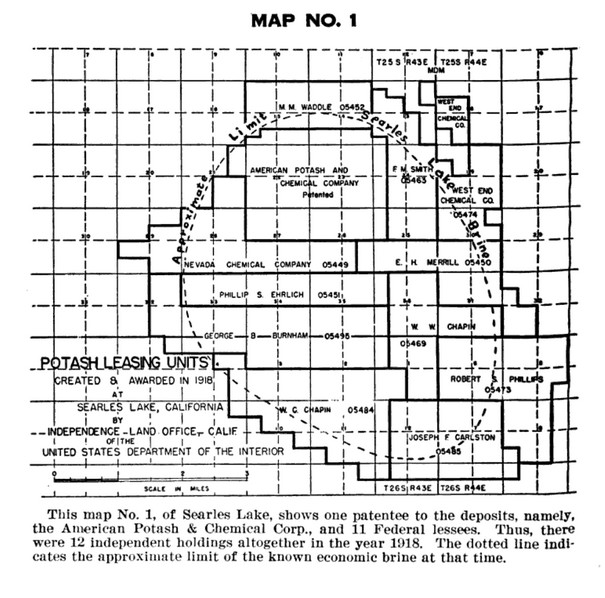
Map showing the location of the lease holding of Nevada Chemical Company on Searles Lake, 1913. Source: Study of Monopoly Power, Monday, May 8, 1950, U. S. House of Representatives, Special Subcommittee on the Study of Monopoly, Power of the Committee on the Judiciary, May 8, 1950.
American Potash and Chemical Corporation
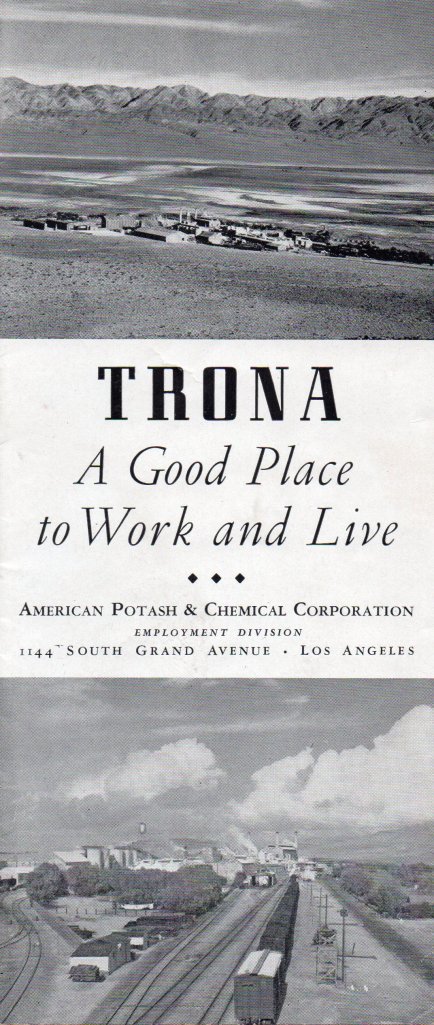
Employment Brochure, Front Panel, American Potash and Chemical Corp., Employment Division, May 1943.
Stauffer Chemical Company
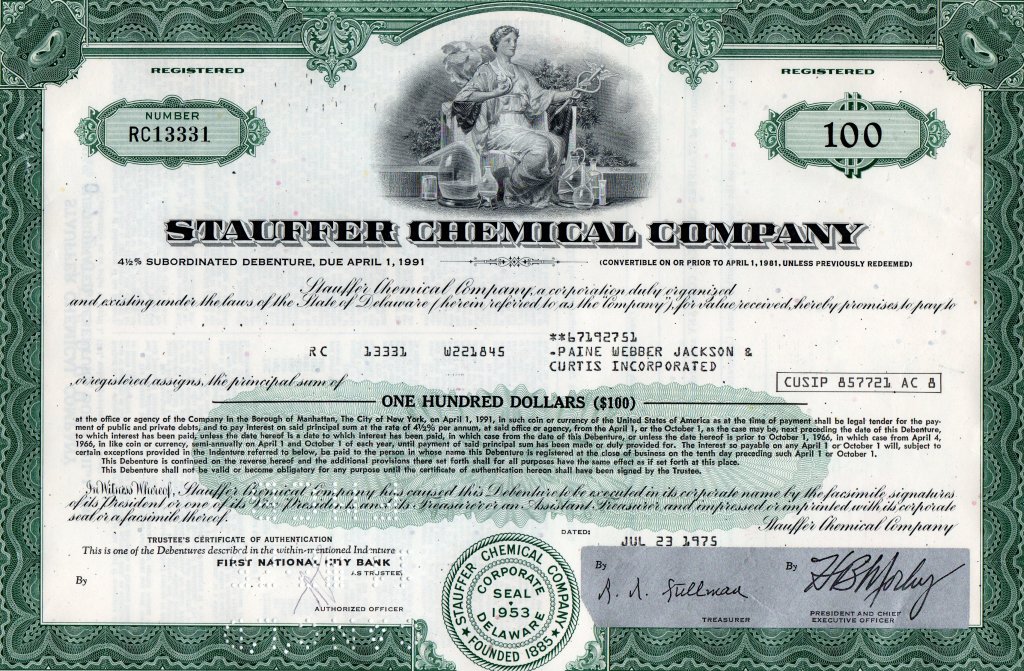
$100 Bond Certificate RC13331, to Paine Webber Jackson & Curtis Inc., July 23, 1975. R. A. Fullman, Treasurer; H. B. Morley, President and CEO.
According to the U.S. Bureau of Mines, American Potash and Chemical Corporation and West End Chemical Company (organized by the “Borax King” Francis Marion Smith) of Trona, California, were divisions of Stauffer Chemical Company in the 1960s. The plants still produce evaporite minerals from the brines of Searles Lake.
Kerr-McGee Corporation
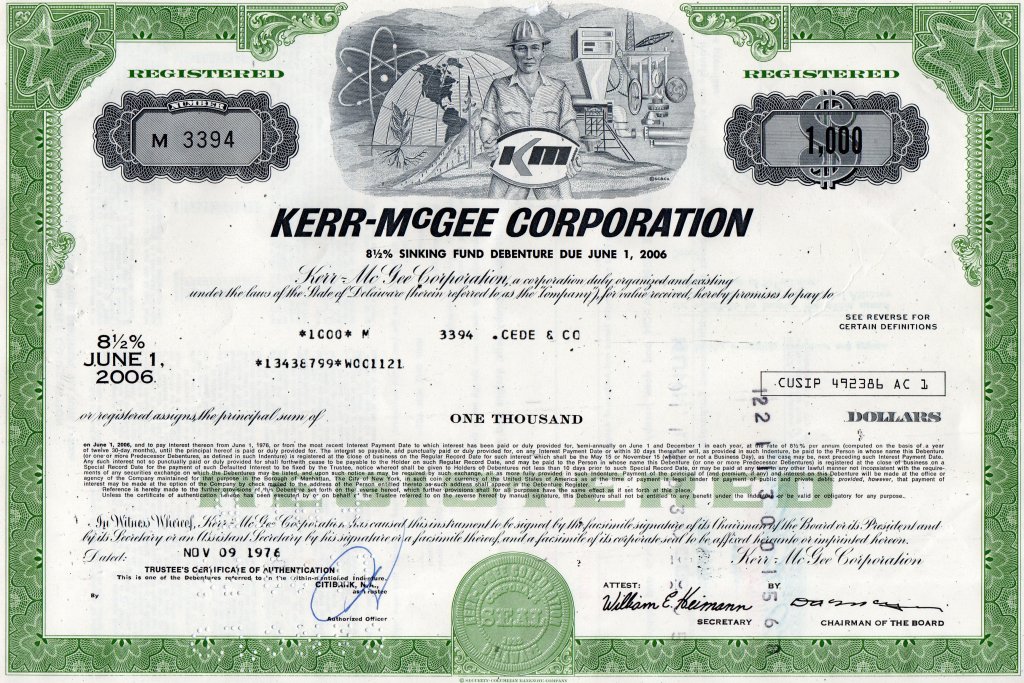
8-1/2% Sinking Fund Debenture Due June 1, 2006, One Thousand Dollars to Cede & Co., November 9, 1976. William E. Heimann, Secretary, D. (Dean) A. McGee, Chairman of the Board.
Kerr-McGee Chemical Corp., which took over Stauffer Chemical Co.’s West End plant in late 1974, extracted borax, soda ash, and sodium sulfate from Searles Lake brines. In addition, Kerr McGee was producing co-products such as lithium carbonate, potassium sulfate, potassium chloride and even bromine. Kerr–McGee was also building a new soda plant at Trona (the existing plant site).
Borates were marketed by Kerr–McGee under the brand name “Three Elephant” and the trade names “Dehydrated Borax,” “Pyrobor,” “Refined Pentahydrate,” and “V-Bor.” In addition, Kerr–McGee produced boron trichloride, boron tribromide and elemental boron. Boron trichloride is the raw material required to manufacture boron filaments that strengthen aerospace products and sporting goods.
International Minerals and Chemical Corporation
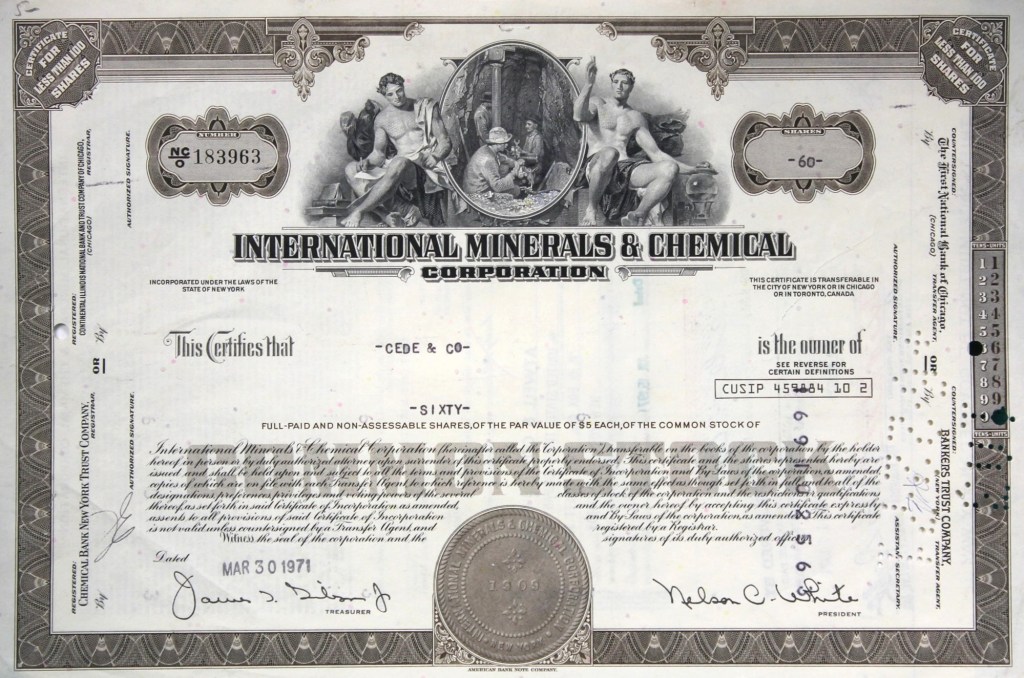
Certificate No. NC/O 183963, Sixty Shares to Cede & Co., March 30, 1971. James D. Gibson, Treasurer; Nelson C. White, President.
The International Minerals and Chemical Corp. (IMC) acquired the Trona chemical plant in December 1997, from North American Chemical Corp. IMC continued to operate the facility until its merger with Cargill’s crop nutrition division in 2004, forming the Mosaic Company. That year, Sun Capital Partners acquired the Trona plant.
West End Companies
For F. M. “Borax” Smith’s West End companies, including those operating at Searles Lake, click here.
 Death Valley Mining History - Thru Scripophily