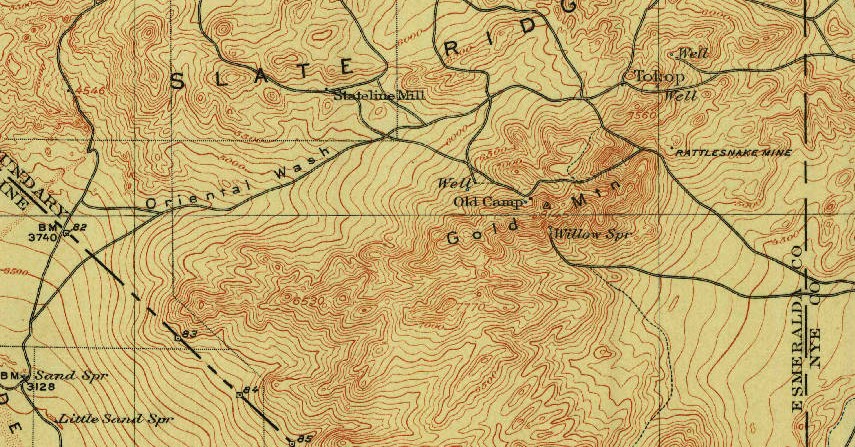
Map of the Lida Quadrangle, Nevada – California, USGS, October 1913.
The Tokop District is located in southern Esmeralda County, extending from the Nye County boundary on the east to the California state line at the head of Death Valley on the west. It embraces Gold Mountain on the East and Oriental Wash (sometimes considered as a separate district) on the west.
The State Line, Miller, and Oriental Mines
In July 1866, prospectors Tom Shaw, George Ayer and Grand Rhodes discovered rich gold croppings at what would become the Gold Mountain District. Fearing attack from Shoshone Indians, they left the region but vowed to return.
Shaw and partners returned in January 1868. On the north side of Oriental Wash, they located the 12-foot thick gold-bearing quartz lode and named it the State Line. However, the State Line mine’s 100-mile distance from the closes mill (in Belmont) and the lack of water, made turning a profit on mining almost impossible. Ayer and Rhodes gave upon the State Line, but Shaw labored on with small scale “pocket” mining for several years.
In 1871, with new partner Jim Ruth, Shaw built a mule-powered arrastra at Shaw’s Spring, about 5 miles east of the mine. This first step of concentrating the gold ore and reducing haulage of waste rock to the mill, made the State Line mine the first profitable mine in Death Valley.
George Ayer didn’t entirely give up in the Gold Mountain District. In August 1872, with partners Sam Halsey, Jim Ruth, and Tom Coates, he found a magnificent ledge with free gold on the east side of Gold Mountain. They named the bonanza the Oriental.
State Line Gold Mining Company No. 1
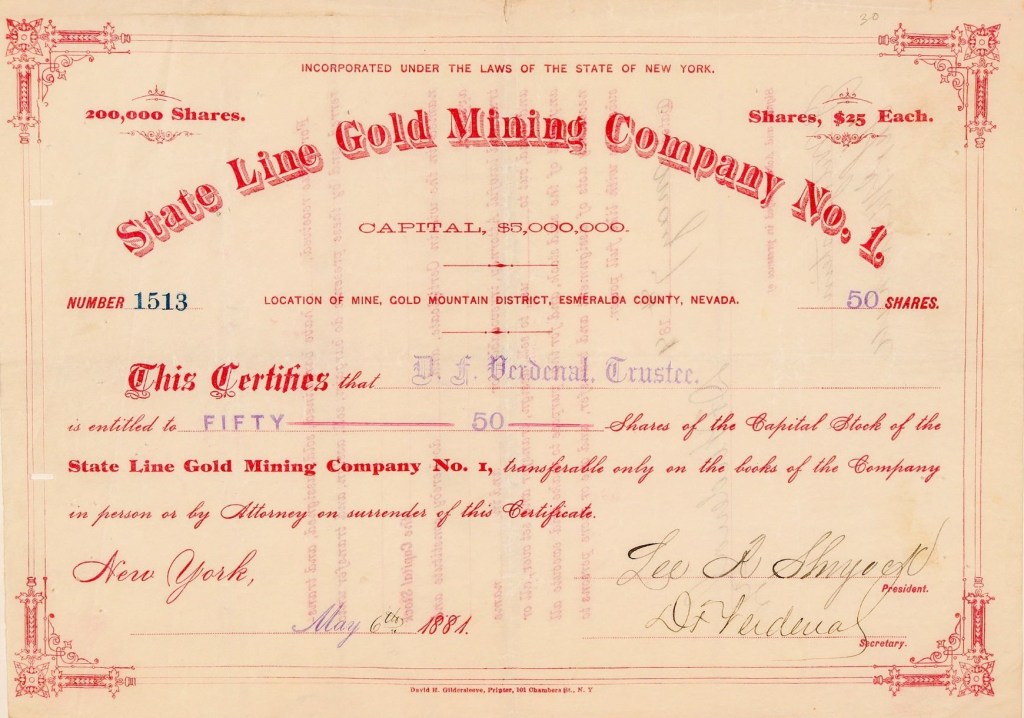
Stock Certificate No. 1513, Fifty Shares to D. (Dominique) F. Verdenal, Trustee, May 6, 1881. Lee R. Shryock, President; D. F. Verdenal, Secretary.

Certificate No. A3471, 50 Shares to L. H. Taylor, October 4, 1881, Lee R. Shryock, President; D. (Dominique) F. Verdenal, Secretary.
State Line Gold Mining Company No. 2
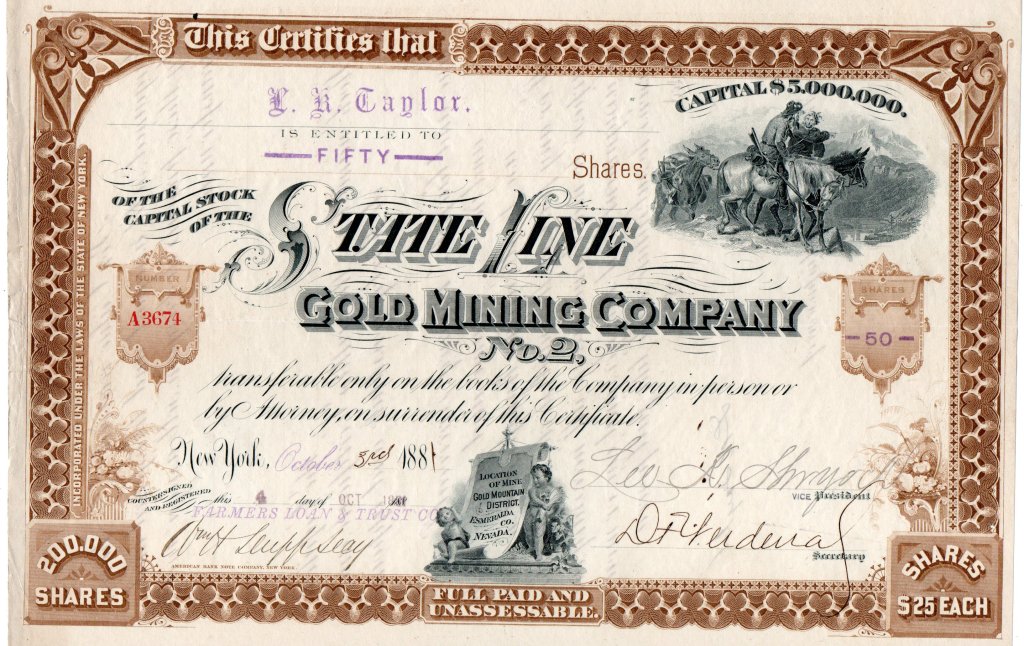
Certificate No. A3674, Fifty Shares to L. K. Taylor, October 3, 1881. Lee R. Shryock, Vice President; Secretary, D. (Dominique) F. Verdenal, Secretary.
State Line Gold Mining Company No. 3

Certificate No. A3516, Fifty Shares to L. R. Taylor, September 23, 1881. D. F. Verdenal, Secretary, Lee R. Shryock, Vice President.
State Line Gold Mining Company No. 4
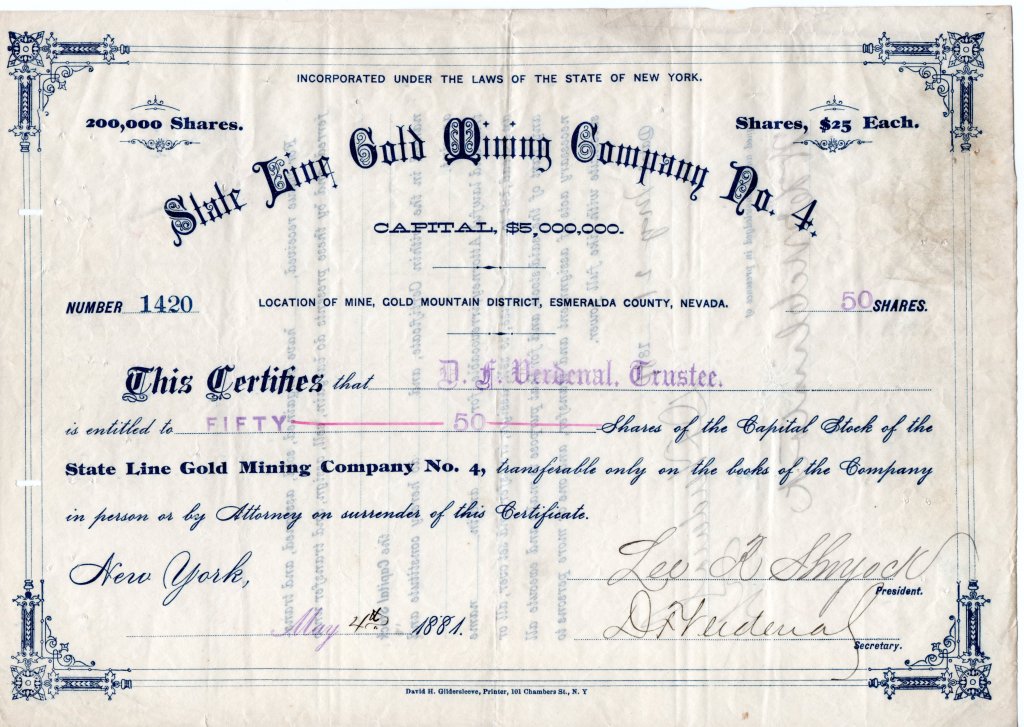
Stock Certificate No. 1420, Fifty Shares to D. V. Verdenal, Trustee, May 4, 1881. Lee R. Shryrock, President; D. (Dominique) F. Verdenal, Secretary.

Certificate No. A2393, Fifty Shares to J. Brownell, July 6, 1881. Lee R. Shryock, President; D. (Dominique) F. Verdenal, Secretary.
Oriental Gold Mining Company
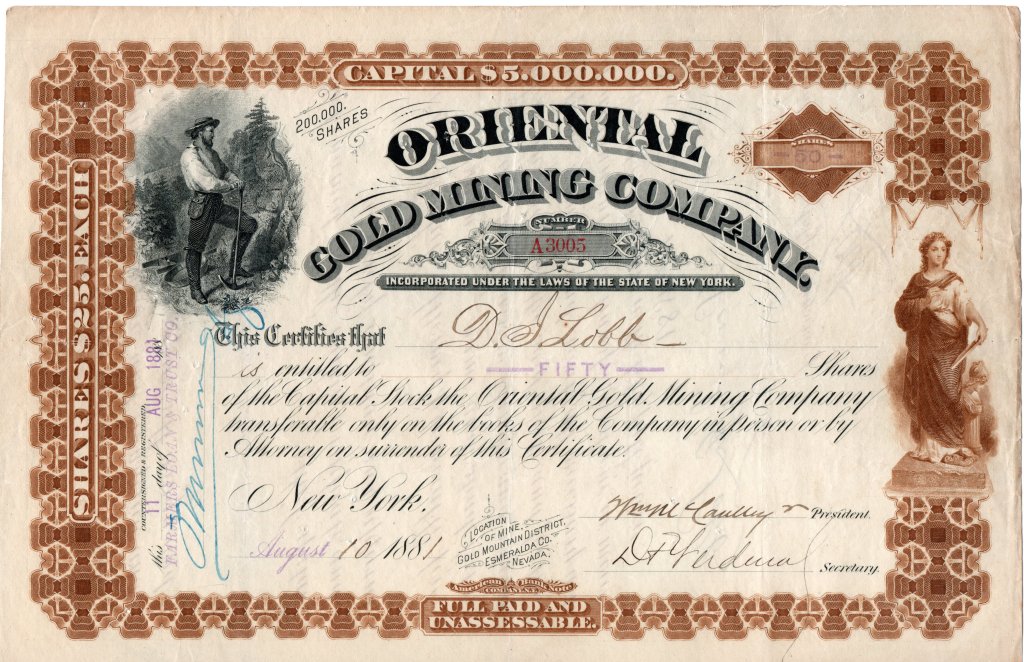
Certificate No. A3005, Fifty Shares to D. J. Lobb, August 10, 1881. Wm. M. Culligan, President; D. (Dominique) F. Verdenal, Secretary.
Miller Gold Mining Company
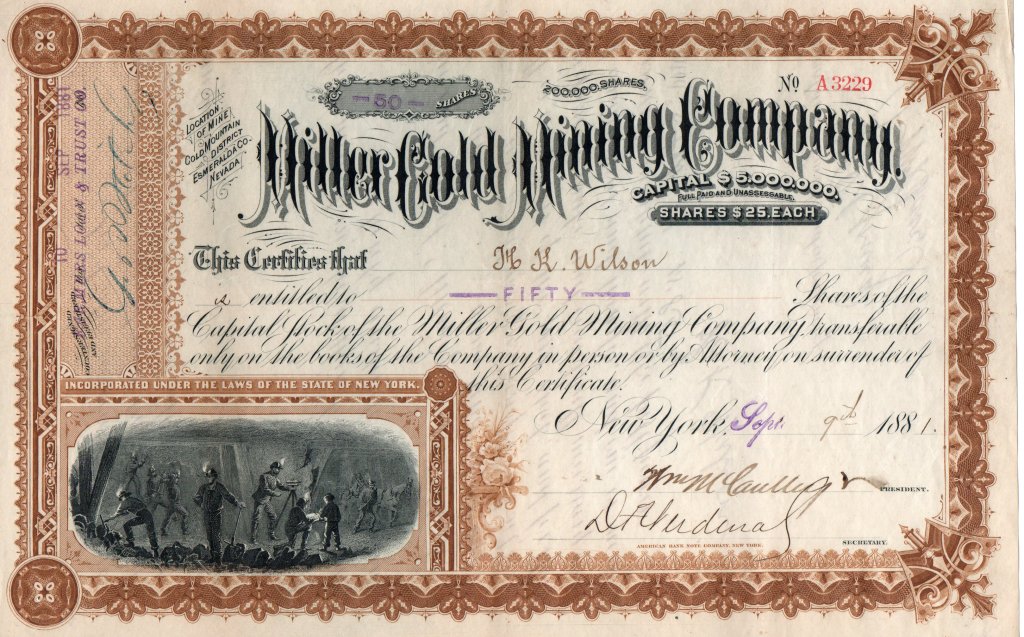
Certificate No. A3229, Fifty Shares to H. H. Wilson, September 9, 1881. Wm. M. Culligan, President; D. (Dominique) F. Verdenal Secretary.
Tokop Consolidated Gold Mining Company

Certificate No. 67, Five hundred Shares to Joe E. Stevens, March 8, 1905. W. H. Lang, Secretary;W. J. Douglas, Vice President.
Tokop is somewhat remote to Death Valley, but not to one of the valley’s famous pioneers: Christian B. Zabriskie.
In 1885, F. M. “Borax” Smith hired Zabriskie to supervise the borax mining operation at the Columbus Marsh playa near Candelaria, Nevada. Over the years, Zabriskie rose to prominence with Pacific Coast Borax and later, with Borax Consolidated, Ltd. However, that didn’t mean Zabriskie didn’t have other interests in the region’s minerals.
The namesake metal of Gold Mountain was found in 1902 at the head of Oriental Wash by prospectors Robert H. Steward and William Douglas. They named the quartz ledge “Tokop”, the Shoshone word for “snow.” At $14 a ton, it wasn’t much of a find at the remote site. Nevertheless, Steward and Douglas bonded the claim to Tonopah promoter Lucien L. Patrick for $6,000, who formed the Tokop Mining Company. The camp of Tokop was born and grew to eight tents before the Goldfield bonanza lured everyone away in January 1904, including Patrick.
Everything changed in March 1905, when Steward and Douglas, back in control of their mine, struck ore valued at $2,600 at ton. Enter Zabriskie, who bought the mine and formed the Tokop Consolidated Gold Mining Company. The company stock was listed on the San Francisco Stock Exchange. On March 30, 1905, the stock was offered at 45 cents a share.
The good times didn’t last long. By the end of April 1905, the stock dropped to 15 cents. In May, the touts appeared in the San Francisco newspapers, claiming that Tokop Con had ore assaying $20,000 at ton. Apparently, the claim didn’t “pan out” and the stock dropped to 10 cents at the end of the month. There were no reports of the mine milling or shipping ore of any value.
In 1906, Zabriskie is reported to have lost faith in Tokop and moved on (or back) to focusing on borax. The obituary of Tokop Consolidated was written in the San Francisco Call, on July 27, 1907, when the newspaper reported that the company listing was removed from the San Francisco Stock Exchange.
Gold Mountain Consolidated Mines Company
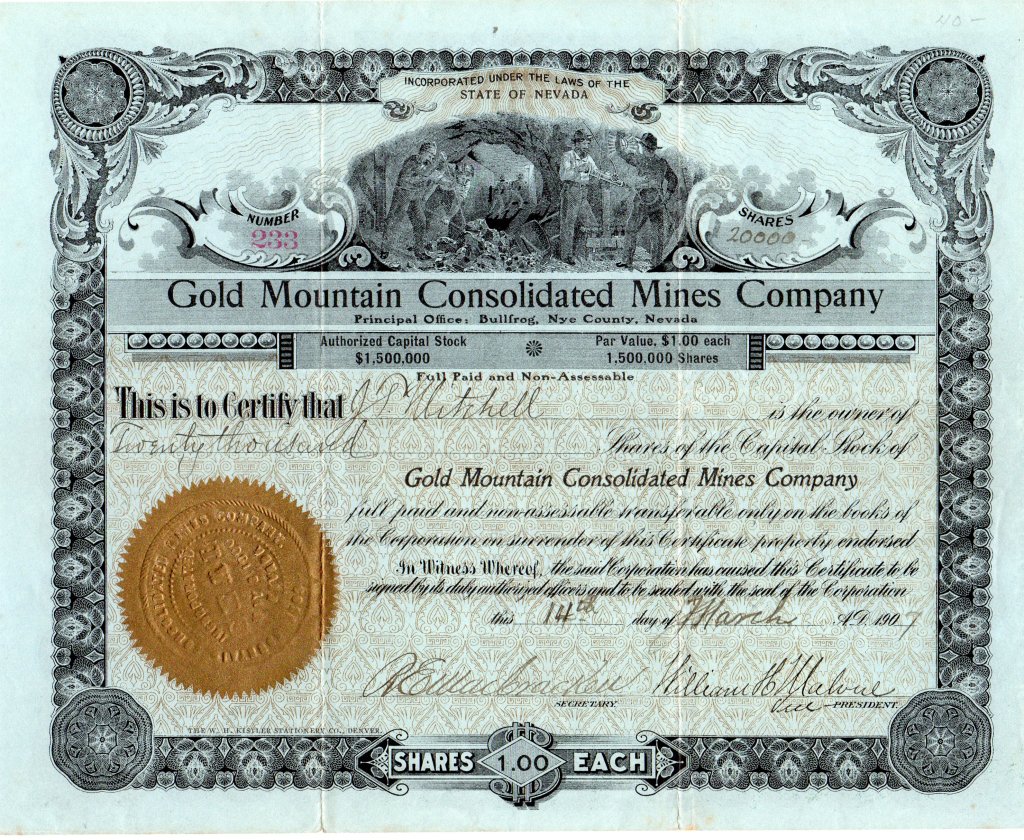
Certificate No. 233, Twenty Thousand Shares to J. T. Mitchell, March 14. 1907. R. E; MacCracken, Secretary; William H. Malone, Vice President.
Gold Mountain Consolidated filed for incorporation in Nevada on May 3, 1906, by investors from Denver, Colorado. Other than “some development work” cited in The Mines Directory of 1910, there is no indication that the company ever produced ore.
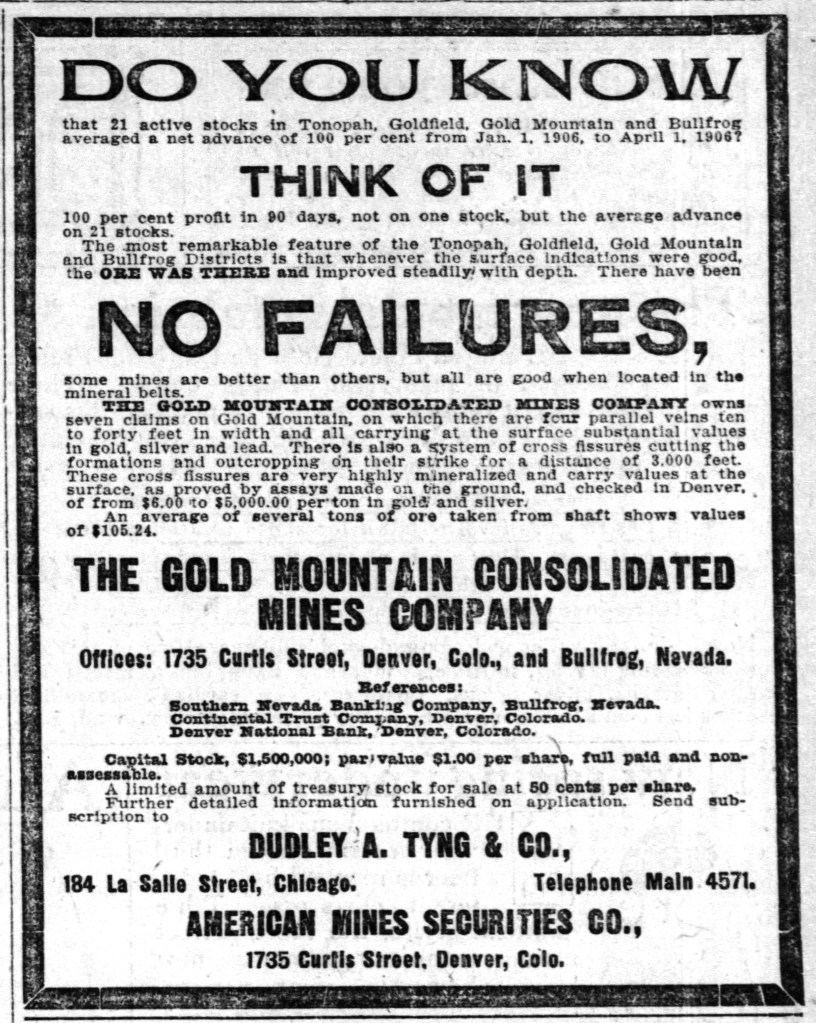
Advertisement for Gold Mountain Consolidated Mines Company, Chicago Tribune, April 22, 1906.
The Nevada Prospecting and Mining Company
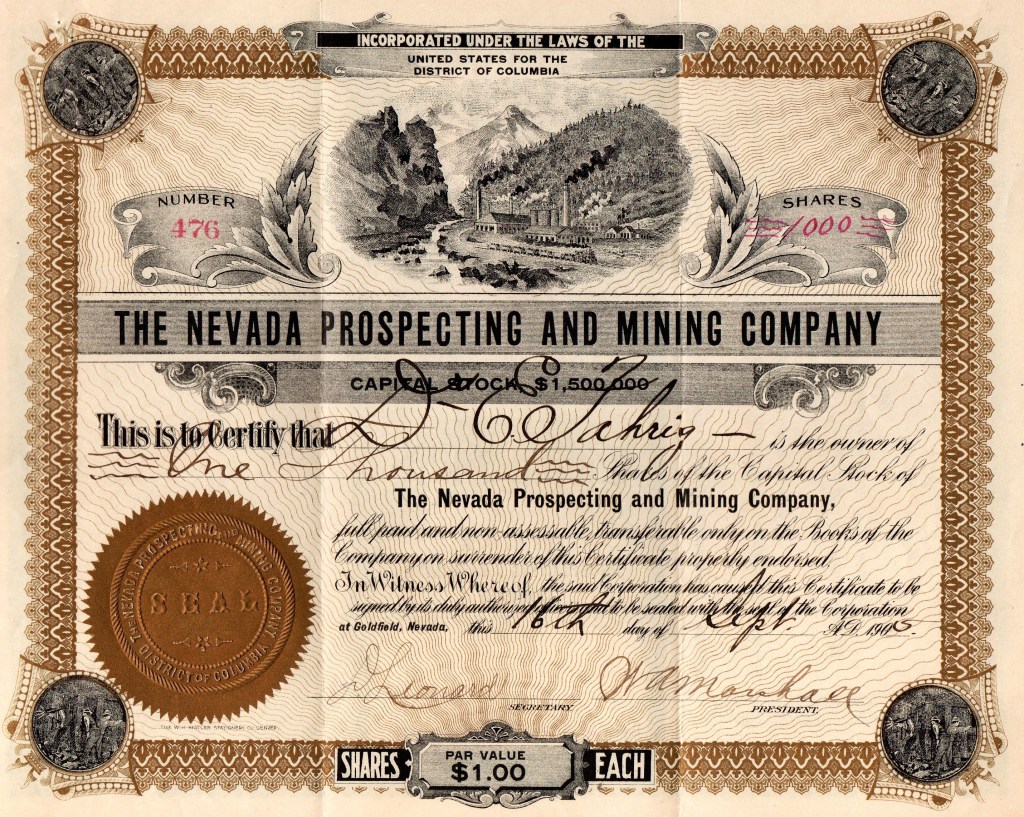
Certificate No. 476, One Thousand Shares to D. E Fahrig, September 16, 1905. D. Leonard, Secretary; W. (William) A. Marshall, President.
According to the Goldfield News of December 15, 1905, “[Nevada Prospecting and Mining Company] owns 160-acres of ground, viz., Nanoma and Homeward claims, 40-acres, Goldfield District; Cardinal, Wart and Cynosure claims, 60-acres, Bullfrog District; and 3 claims, aggregating 60-acres, in the Gold Mountain District, Nevada. Development work is progressing favorably. Treasury stock selling at 10 cents per share.” After that report, no additional information is found.
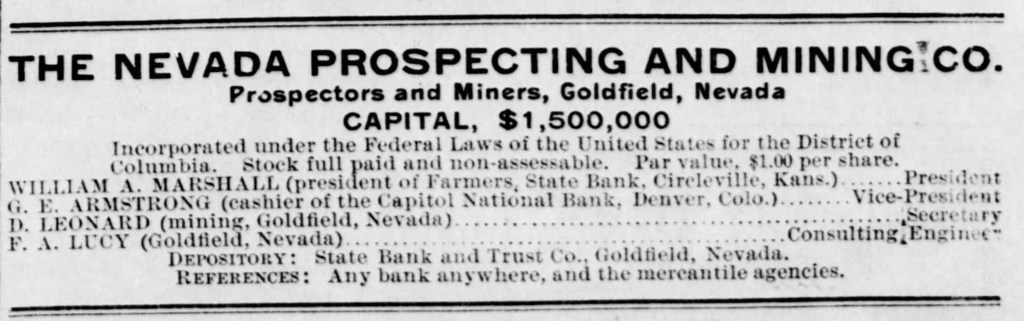
Advertisement, Goldfield News & Weekly Tribune, April 4, 1905.
 Death Valley Mining History - Thru Scripophily